Showing posts with label student agency. Show all posts

Friday, 29 October 2021

Creativity abounds.. more than just a cliche

Presumably in the beginning a cliche wasn't a cliche, but an observation of something that appeared to be true. It became a cliche because it seemed to be so true that people used it often, often as in a lot, and so it became over used, it became a cliche. Social media, and its tendency to cut every thought down to as few words as possible, has meant that a lot of our lives seems to be described in a series of cliches.

So something like 'If you do what you've always done, you'll get what you've always got', was once someone's observation of what they thought they were seeing often  in the world around them., and so thought this was a wisdom about their world. I have come to the point where there is also another way of saying this: "If you think what you've always thought, you'll do what you've always done, and you'll get what you've always got". And in our mahi to improve learning and educational outcomes for learners, this has never been truer.

In this case however there is good research data to back this up. In a Manaiakalani wānanga yesterday I was reminded (as I often am) of Hattie's meta analyses that show (amongst a huge number of profound things) that teacher expectations have a very large effect size in terms of their impact on learners.

"With an average effect size of 0.4, Hattie finds the effect size of teacher estimates of achievement is 1.62 and the effect size of collective teacher efficacy is 1.57."

Reference: https://www.k12dive.com/news/teacher-expectations-top-list-of-effects-on-student-achievement/422029/

So its effect size is even greater than that of collective teacher efficacy, which I've written about before. So it should be no surprise that when you expect creativity, that's what you get. That ought to be exactly what you expect. That ought to be exactly what you get when a kura increasingly immerses itself in the Manaiakalani pedagogy 'Learn Create Share'.

And.. lo and behold (cue dramatic music, here!!), that seems to be what I am seeing at Hornby High School.  Over this term, our Year 10 and 11 students, as a part of their wānanga time, have been engaged in personalised passion projects (PPPs). Our aim here has been to improve student engagement with their learning, to harness their inner creativity, whatever that looks like. It's time for that reminder that we don't mean creativity in only the creative arts sense (although we definitely mean that too), but creativity across all learning areas for all learners. The PPP approach in wānanga has been an illustration of us not just expecting creativity, but also putting in place those systems, structures, and routines, that are necessary to support it. It offers student agency, it offers the possibility of doing just what Yong Zhao says we should.

He suggests that at the moment we do this:


Whereas we should be doing this:

This is a notion that sits at the centre of our Kāhui Ako plan and achievement challenges.

The net result? My feeling is that creativity is flourishing. I have dipped in to Year 10 and 11 blogs and gained an interesting insight into that flourishing creativity.

Here for example is the work of Lauren and Louise who set out to create a graphic book based around a story that Lauren had written.

Or here, the work of Johanna and Genica, who crated bubble tea, and designed a cafe in Minecraft.

There's Mya who designed and created a quilted blanket in the textiles room.

Or Tamsyn who looked at drawing as a means to improving wellbeing.

There are so many more, and my sample is purely random. I just jumped around on our list and 'browsed'.

And then outside of the PPPs, Nadia of Year 12 was chosen to be a "Member of the Shakespeare Globe Centre New Zealand Young Shakespeare Company 2022 (SGCNZ YSC 2022)", for which she will travel to London.


Creativity everywhere. Is this happening by pure chance? I suspect not. It happens because we have clarity around our pedagogy, a pedagogy that places creativity at its centre. It happens when we place creativity at the centre of much of teachers' thinking, and I hope at the centre of their expectations.

You get what you expect, you see what you are looking for.. the cliches go on, but you get the meaning.


Friday, 7 May 2021

Te Rito Toi 5 .... cultural diversity, the sense of self, and creativity

We were in  Blenheim supporting our daughter running the St Clair half marathon (she managed a PB.. ka mau te wehi, Natasha!!). 


As we wandered in the vineyard area after the event I came across an artist in the process of creating art (painting) as people went about their business of celebrating, eating, and drinking. I plucked up the courage (I don't normally approach complete strangers quite like this) and asked her 'what do you feel as you paint? She looked at me, and I clarified 'not what do you think, what do you feel?' She replied "actually that's a really good question, I haven't thought about it quite like that before". As the conversation progressed it became clearer to me that she had thought about it before, but perhaps not in those terms. I also realised that I had perhaps asked a stupid question; this quote from 'Te Rito Toi Replanting creativity in post normal times' sprang to mind:

Gordon was trying to say the unsayable, struggling with thoughts that lay beyond the capacity of mere words to express. Pavlova, when asked what she meant by her interpretation of Swan Lake replied, ‘if I had been able to say it in words, do you think I should have gone to all the trouble of dancing it?’

(Clarence Beeby, Director General of Education, at the funeral of Gordon Tovey in May 1974).

I told her that, as best I could recall the quote (as a story rather than a quote, my memory isn't that good.)

Anyway, our conversation progressed, and she spoke in terms of her own inner self and her sense of self, how she 'felt' about herself, and life, about the world in which she lived, and her desire to say things that she couldn't say in words (in precisely the way that Pavlova is reputed to have done).

Professor O'Connor and his team have identified 11 dimensions that potentially activate creativity, and I have listed those before.

I have another 'wondering'. Whatever drivers we might be able to describe in our schooling systems, our innate creativity perhaps cannot be activated unless we have a level of self awareness, a level of confidence, in who we are. Specifically I wonder if we need to have a sense that we are culturally located, that we have at least some connection with our whakapapa, before our creative potential can be unleashed. I'm not suggesting that being 'culturally located, culturally safe', generates creativity per se. My wondering is if being in such a state and place is one of those 'necessary but not sufficient' conditions, and therefore if we could avoid some of the tendency to 'kill creativity' if we were better at this?

If so, this adds another dimension to the already overriding moral obligation on schools to ensure that they build and maintain culturally responsive and sustainable environments. Every child ought to be able to bring their cultural back pack inside the school gates. I'm sure all kura try. How well do we do? How well is Te Huruhuru Ao o Horomaka Hornby High School doing?

Is it also possible, in my own wondering, that creativity comes from an inner conflict as we struggle to see, to know, to come to terms with our own inner self, our place in the world, and our whakapapa? It was interesting to read in a recent edition of 'The Listener' (May 8-14 2021) about the role of conflict in creativity, particularly in group settings.


I'm not proposing that we set students up in conflict in order to generate creativity. It's just interesting.

I have also thought about the role of stress. I wonder if creativity is perhaps more likely to occur in some settings when we are close to the edge of our comfort zone. Is that the 'place' we have to be to find the motivation to seek new solutions, to find new ideas? Is creativity enhanced when we experience eustress (as opposed to distress .. "Eustress is a word used to describe stress that is positive, motivating, and enhances functioning while distress refers to bad and overwhelming stress that impairs functioning." https://www.choosingtherapy.com/eustress-vs-distress/#:~:text=Eustress%20is%20a%20word%20used,overwhelming%20stress%20that%20impairs%20functioning. )

I wonder if schools that support diverse cultural identity more effectively end up seeing higher levels of creativity from students (regardless of curriculum area or kura activity)? Is it possible that schools with more culturally diverse student and staff populations are more predisposed to greater creativity, assuming the other drivers of creativity are activated? How would/could we find out? Difficult, I suspect, if it is (as I suggest) one of those 'necessary but not sufficient; conditions. Mind you, could this be an interesting application of the CAST Creative Schools Index?

None of this is any sort of 'claim', there is no suggestion that any of this is some sort of truth. It is simply what I have 'wondered'. It also strengthens the case for the Manaiakalani pedagogy 'Learn Create Share', doesn't it? Our typically lower decile schools tend to reflect wide cultural diversity. Here's a thought: if any of my other wonderings are true (IF), then are our more culturally diverse schools the potential powerhouses for creativity and innovation across Aotearoa? 

Food for thought, eh!!


Thursday, 7 May 2020

Peering into a Post Covid world

Many kura, teachers, and leaders, are turning their attention to what our Post Covid school world might look like. That act of looking ahead is in itself a supremely human act because it is an act of hope, and faith, hope and faith that the future will be better, that we will come out the other side of this (and any) crisis, that we in fact have a future at all.

In thinking about that future I have on several occasions evolved and voiced some thinking around the structure and focus of 'education' (as opposed to learning), and it goes something like this.

In a child's early years much learning takes place via that child's interests, or passions. Children explore, they play, they experiment, and then as they progress through their Primary years they have increasing levels of skill attached to that, often using with Direct Instruction (which is not always from teachers, but often from whānau). Throughout this we are of course meant to be developing a series of important dispositions that we call the key competencies, things like thinking and self management.

When those students hit secondary school, it's as if we think that it's now time to get our 'big girls'/boys' pants on' and start some proper education. Students are expected to sit down, shut up, and listen to the teacher because the teacher knows everything. We think we are filling their heads with knowledge and skills, based very much on the 'just in case' view of learning. I may be doing us all a disservice, but it seems as if we think that this is the way universities work, after all students sit in lectures of 100-250 students, and a learned professor lectures at them for an hour, so that must be real learning. It's the way universities operate. It ignores the fact that while that may have been true decades ago, increasingly universities are shifting undergraduate practice towards more collaborative work and/or more project work. That is, the days of the lecture being the sole source of real learning are in fact coming to a close. What's more, increasingly universities (even pre Covid) have been operating online with recorded lectures that are rewindable.

And then those who a deemed able are allowed to enter what we call Postgraduate education where they do a combination of 'papers' (classes that very often involve collaborative work at the least) followed by a research project, a dissertation, a thesis. These projects are guided by a supervisor, and are often based on areas of interest to the student.

It's as if we have gone full circle, from passions at the beginning, back to passions at the end. Spot the odd one out .. secondary education. WHY do we think that suddenly learners have different motivations for their learning? Why do we think that adolescents are happier than any other group to sit down, shut up, do as you are told, and we will fill your head?

Now we should not underestimate the impact of adolescence and hormones, but the more I think about it the more I think that in itself it is a very compelling reason for doing things differently. Adolescent learners are more likely to be oppositional, more likely to question, simply because of the rewiring of their whole brain 'architecture' as mother nature does her neural pruning. Giving adolescents choice (called agency), giving them permission to chase their passions, would surely be a better way of doing this. Is it any wonder that we struggle with engagement?

If students are engaged with their passions, wouldn't this be a much better way in which to scaffold those dispositions that we want our young people to gain.  We want them to be self managing, we want them to learn the benefits of persistence, of being able to relate to others, to be able to think and communicate. Wouldn't that be much more likely to happen if students are following their passions? Wouldn't that be a more likely outcome if they have to wrk collaboratively? I know that it is when I am doing something I love that I am most likely to learn new skills.

I don't ever discount the value of direct teaching. I am a bit of a Hattie fan, and his work shows repeatedly that direct teaching has a very high effect size, it impacts very significantly on learning (any effect size above 0.4 means that the strategy is doing more than would be achieved if you did nothing)

Great Teachers = Great Schools. That's It. | Educational ...

That said, notice that even here is it not at the top of the list of most powerful teaching strategies.

Almost the only time I learn new stuff is when I need to do so. Aren't we guilty of a degree of conceit if we think that adolescents want to sit down in front of us and learn everything we want them to learn,  when WE decide they are to learn it? After all, as adults we typically don't.

So what am I suggesting? I am suggesting that we treat learning in the middle secondary years more like an undergraduate course, with a combination of direct teaching and collaborative project/passion based work. Learning would be partly face to face (after all, I think we have had our belief in the importance of relationships strongly reinforced), and partly distance.

In the senior secondary school, courses could look more like a post-graduate course: key subjects that are delivered often collaboratively, and a passion requiring a real output. Each student walks the journey with a dedicated supervisor walking alongside. Amongst other things, the supervisor might bring specialist subject knowledge to support the student's learning, and project. The supervisor would be there to work out what NCEA standards should be attached to the work of that student. The learning leads the assessment, rather than the assessment leading the learning. That sounds a lot more motivating to me. I think it also tells us that we have an even greater need for talented subject specialists staffing our schools, that's for sure.

As a Manaiakalani school, this all sounds like a wonderful next step or evolution in our 'Learn Create Share' pedagogy. It's not something you can do tomorrow, but it might be a vision of a future for learning for our teenagers.

At Hornby High School we have already shifted our junior curriculum to learning in cross curriculum groupings like English and science, or maths and physed.  We don't have it right yet, but we are certainly heading in what I think is the right direction.

It also sounds a lot more like a great pathway to creative excellence.

How would that go?
Love to hear your thoughts
Robin Sutton
Tumuaki

Friday, 1 May 2020

Is this distance learning stuff working?

We have now been in distance learning mode for between 4 and 6 weeks (depending on whether or not things stopped for the 'term break'. For Hornby High School students we offered up work for the break, but still treated that 2 weeks as a break before proactively seeking to re-engage. I first priority was hauora and relationships, and only after we'd focussed on that did we shift to more traditional 'back end of the curriculum' learning. We continue to maintain a focus on hauroa, with Deans monitoring student wellness though regular contact via Wānanga and Form Teachers.

I have taken some time to think about what I may be seeing, and have developed a hunch, a working hypothesis if you like. The hunch is based on a small amount of observational data only. Our staff are collecting engagement data each day, each week, and at some stage soon I hope I may get the chance to take a more detailed look at it to see whether or not it bears out my hunch.

Here's my hunch.

We can divide our learners into four groups.


  1. Those high flyers who will be just that, regardless of how we 'deliver' or 'cause' their learning. Here is an example of that from Jessica. We have many others.
  2. Those students who sit in the middle, whose engagement in school is variable, from whom we get the usual range of work from poor to great results, dependent on how successful we are in grabbing their attention and engaging them (in my opinion their range of engagement is more a result of what we do .. as a system .. than what they do)
  3. Those students who attend school some or most of the time but with whom we struggle to get much meaningful engagement
  4. Those students who do not engage, and with whom we work hard as we support them through a range of social and psychosocial issues created by anything from poverty, to mental or physical health challenges, to those who have beens seriously damaged by societal problems that are beyond their control

Groups 1 and 2 seem to be engaging as they usually do.

Group 3, so often disengaged 'at school', is now engaging in greater numbers and with greater enthusiasm, because the distance learning paradigm gives them more of the agency that they want. Without someone standing over them saying 'do your maths now', they are more likely to engage in their maths when it suits them, and just as successfully if not more so than they do in the conventional 'school' setting.

Group 4 continues mostly to be disengaged, and I stress through no fault of their own.

I also want to stress that this is my 'hunch', this is what I think I may be seeing emerge as a first set of outcomes from our distance learning.

Now teachers across the country are quite possibly saying that they worry because of the lack of engagement evidenced by attendance (or not) at GoogleMeets (especially with my Group 3). I have anecdotal reports of attendances on class GoogleMeets ranging from 2 out of 25, to 25 out of 25, in various class and year groups. However I would like to suggest that we are fundamentally wrong in our assumption that when students are present in front of us they are fully engaged .

There is a research backing for this. In a longitudinal study (one that takes place over a long period of time) the late Professor Graham Nuthall (University of Canterbury) conducted some powerful research in which he and his team 'wired up' students and recorded what they were saying during their classes. The results were published posthumously as The Hidden Lives of Learners .


One of the profound findings was that even when present in class, levels of student engagement are far lower than teachers think. So we shouldn't assume that things are worse in this virtual environment than they were in the physical environment.

In fact my hunch is that many students in Group 3 are better engaged and are in fact thriving in this environment because of the agency that they now have. They were not thriving before.

This is a 'win'. Instead of having only groups 1 and 2 engaged in their learning, we now have groups 1, 2, and 3, more engaged in their learning. I am not prepared to speculate on relative %'s of our student body. I am doing enough speculating with my hunch as it is, without trying to sound in some way numerically authoritative.

That still leaves us with Group 4, and their loss to the system, while not new, still drives ongoing inequity in society as those children fail to access the education that could liberate them from their status. The very cool thing is that (again anecdotally) we have students from that group too who are producing some amazing work in the distance learning state when they were NOT doing so even when they are physically present at school. It seems that it is whānau support that is the critical success factor for this group. Mind you that it is probably the case with most learners.

Much of this has been made possible because of our 5 year engagement with The Manaiakalani Programme. The underlying 'Learn Create Share' pedagogy, the benefits amplified with the use of digital technology, has been a true tāonga for our learners AND our teachers. The transition to the distance learning paradigm has, I suspect, been much easier for our amazing team because of the preparation that they have participated in over those past 5 years. Their familiarity with digital tools has been a wonderful enabler.

So, is distance learning working? My hunch is that it is definitely not delivering anything worse than we had before, and it might just be delivering more engagement and therefore, over time, better learning for our rangatahi. We'll look at the data over the next little while, but I think we need to get used to this 'distance learning'.. not only might the pandemic mean that it is with us for a while longer, but I suspect it offers opportunities that benefit a greater proportion of our society than we ever did before.

Education is not for the privileged few, those who have traditionally been the 'winners'. It is for everyone. And as a society we cannot afford to write off a significant proportion of our talent. We need EVERYONE enabled to be human and to contribute to our collective wellbeing.

Never waste a good crisis. BRING IT ON!!!

Robin Sutton
Tumuaki


Wednesday, 15 April 2020

Did our plans survive first contact?

Apparently it was the nineteenth-century Prussian military commander Helmuth van Moltke who said “No plan survives first contact with the enemy".

No battle plan ever survives contact with the enemy." Helmuth von ...


That is, whatever we plan, what happens once we confront the things we have planned for? Do our plans actually work?

I would be lying if I said that I had no doubts at all that our preparations for distance learning would 'do the job' with our learners at Te Huruhuru Ao o Horomaka Hornby High School. Doubts are normal, even when you have done everything you think you can in preparation for any new circumstance.  At the bottom of this post is a footnote in which I have offered a summary of our preparations, of the framework that we have built to support learning.

Going The Distance: Part-Time Online Learning Lacking | Wyoming ...

Source: Creative Commons (Wyoming Public Radio)


We entered this new remote learning space well prepared, we thought. After our first day in this distance learning paradigm, I asked our wonderful staff team for feedback on our 'learning from home' experiences. I hasten to add that our focus in this first week has been on re-establishing relationships rather than knowledge transmission, and feedback suggests that we did absolutely the right thing.  I wanted to share some of these authentic stories as I think it is important that we document our journey. There will be much to think about, and our first task is to 'make sense' of what we are seeing, feeling, hearing, and doing.

I have anonymised these comments, but if these are your stories, you'll recognise them. However no-one else will.

Response 1:
I have had the best day chatting with my form class and some parents. The students were chatty, engaged, honest and highly respectful. ........ the students were on time for their calls and they were prepared to chat (seated and in an appropriate spot.)
...... it has made for a productive and enjoyable day. I am 100% exhausted though.
 Response 2:
Kids seem keen to join the chats and I would say most have been following our updates on Fb and email, so they know what’s what and what’s expected of them in terms of online learning. 

I’m surprised how tired I am from sitting and chatting for 6 hours but all great fun catching up with students and whanau. It was great to see how this digital stuff connects us - had quite a few kids at dads house for example call in, but we were also able to get mum on the line too from her home just by sending an invite! Or collaborating with other staff e.g. XXX has one sibling, I have the other so we did a 4-way video chat to lessen the stress on mum needing to book in 2 time slots. 

Lots of support from parents too. Seem keen to get their kids back on a schedule and keep them busy... One young man jumped off his video call and powered through 130 min of online Lexia reading (for context, we ask for 100 minutes total for the week - 20 min each day!) sent a big congratulations email for his effort! 
 Response 3:
All really positive! Everyone seems happy at home and are getting on with work! Conversations varied from me driving the conversation to meeting the family and the pets ha ha that one was cute! All in all positive and seemed happy to chat. General consensus was they want to come back to school ASAP so that is great too! 
Response 4:
I connected with 8 families today and all (students and whānau) were pleased to catch up and asked me what my lockdown "stories" were. The reminder to get on with (or start) the work set was timely for some students (even though I stressed that this is a health crisis not an education crisis).

Generally I got the feeling that whānau welcomed the call from the "normal" after a stressful time of lockdown. They seemed to appreciate the "Nigel Latta" approach of not pushing these kids too hard, but also welcomed us taking charge of some of their kids' "discretionary time".
Response 5:
Great buy-in, parents and students appeared to be quite comfortable and confident using google meet. All learners were engaging with the online material to some degree and all parents were very happy with our plan moving forward. I had some parents asking if we could schedule more google meetings and they were keen on the idea of watching recordings of lessons. Was great to have a chance to connect with some parents I had not met yet.
Response 6:
Approx 40% strike rate for the online component.  For those online a good vibe.  ....... 
The classes have three groups ........  The (first) will cut through the work independently; the (second) will need all the time over the next two weeks, the (thrid) will hope to complete the work when we are back at school - ........  The stratification reflects that which happens normally but with a different set of students.  Student XXXXX has approx 38% attendance rate (normally) but he is chomping through the theory work.  Student YYYYYY  is working at warp speed as is Student ZZZZZ.  

What I think I am trying to say is that the greatest influence on engagement is the parents.  Also, different methods / mediums / and environments of information transmission suits individuals differently in different situations.  For some the medium, method and environment does not impact greatly they just get on with the job at their own pace.  Others possibly see pedagogical learning as an impediment to their lives and subsequently duck, dive and dodge the learning opportunity - until necessity forces "their feet to be held against the educational fire" 
Response 7:
Everyone I have spoken to is doing well, some families have their own challenges with isolation, less connection with friends or juggling working at home with parenting. 

Students all seem positive and ready to engage back into their learning again. It was really lovely to see them and their parents who were very grateful that we were making the effort to host video conference calls. Some are less familiar with using Google Meet but a quick phone call to talk through connecting has been working well.

But it was great!! Excited faces, happy parents and a lot of compliments on how connected they have been to the school and teachers
Response 8:
I have already setup my YXXX and YYYYYY classes online and we/they are have made excellent progress during the “holidays”.
Response 9:

Overall my form class is very positive, no one scored below a 7.5 on asking how they were doing.

All parents .......  were actively involved and asked questions " How long " etc..

General feeling is that students are missing the contact. Most are on insta, snap chat, messenger. etc. 
None reported not having any work, no contact, some had been speaking to subject staff.

All have indicated good connectivity, no problem with devices. One family has 7 at home

And for a little colour, I love this one:

Some hilarious moments.  This one in particular.  I was privy to 2 dog 'accidents' in the house complete with parental expletives, kids squealing and a younger sibling moving the screen so I could witness the before and after 'clean-up'  lol, lol, lol 😂
Some sense making;

1. We gathered a lot of data as Form and Wānanga teachers entered brief notes on their 1:1 meetings with students and whānau. The over-riding theme of this is that our students miss the daily contact with peers, and with teachers. We should not be surprised by this, given that one of our foundational beliefs is that we are a relational school, and that we believe that relationships are an essential foundation to learning.

2. Gathered across the data collection, and referred to explicitly here by one teacher, is the observation that students who in our physical classroom settings don't always appear to be well engaged are in fact 'going for it' in the distance learning setting. I wonder if the issue here is that these students have been given 'agency', they have been given much more control over their learning. If so, what then is the next step in building this agency for the benefit of more of our learners? And what of those learners for whom we have built a 'dependence'? Those learners who have been taught by practitioners who teach from the perspective of the 'cult of personality'? These are the learners who will continue to rely on their teachers. What of them?

3. Online contact/meetings/teaching is exhausting. I know that from experience, with my day made up of anywhere between 2 and 6 hours of online in meetings. I end the day exhausted, myself. I do not think that is sustainable for either teachers or students. My conclusion therefore is that simply replicating our physical classroom practice online is NOT the answer. I am aware of schools attempting to do this. I hope for the sake of their learners AND their teachersI am wrong, but I am not convinced that that approach is sustainable over the long term.

4. This more general observation is based on more than just this very small sampling, and something perhaps a little more evaluative from me: I suggest that we are seeing a change to education that is unlikely to be 'undone'. It is much like a 'pandora's box'. Once we have let this distance learning thing out, once we have supported (actually once we have 'allowed') student agency, there will be no going back.

My opinion, - I hope there is NO going back. If we can see students more fully engaged, if we can see students managing and controlling their learning more, then the outcome must surely be better learning?

So, our plan, based on 5 years of preparation as a part of The Manaiakalani Programme, does appear to have survived first contact as of the end of day 1.

Footnote:

Hornby High School joined The Manaiakalani Programme in 2015. The programme is a taonga gifted to schools from the Manaiakalani cluster and the Manaiakalani cluster in south Auckland. This approach to learning uses a clear pedagogy (Learn Create Share), with the benefits amplified with the use of digital technologies (Chromebooks) in order to make learning authentic and visible. Content is made visible via teacher Google sites. This means that all learners can access material relevant to their learning. at any time, from anywhere. We call this ubiquitous learning. Learners make their learning visible by publishing it to authentic audiences via the blogs.

Schools are support by an education programme leader whose main task is to assist teachers to upskill in the specific skills required to use the pedagogy and the technologies.

We have been privileged to be support initially by Education Programme Leader Mark, and now by Kelsey, and this work is funded by the Uru Mānuka Education Trust which has done some extraordinary work to ensure that we can sustain these initiatives.

Sunday, 2 February 2020

Do you mean 'creativity', or do you mean 'creativity'?

He puna auaha

A centre of creative excellence

This is our vision for Te Huruhuru Ao o Horomaka Hornby High School, a bold vision for a secondary school, at a time when we need to be bold in education. I'm not afraid to be bold, I'm not prepared to step back from the challenge, because now more than ever before we need to be bold, to develop new ways of thinking in education. Our historical system has failed too many children, too many rangatahi have left the portals of secondary schools undervalued and underprepared for the world that they face. And I am privileged to be able to walk our journey with a group of colleagues who share the vision, who share the appetite for change, an appetite to shake up the system to better serve our amazing tamariki, despite the anxiety that the change creates for them.

For those who weren't involved in the development of our vision, and the development of our roadmap, a reasonable question might be 'do you mean creativity or do you mean creativity'?

The simplest interpretation would be to assume that our vision is to be a centre of the creative arts. That in itself is laudable and desirable, and it is a part of our plan. However our intention is to be much bolder than this. We are seeking creativity in everything that we do. A question I often ask of colleagues is 'what does creativity look like in your daily work? In the classroom? On the sports field? Around the Board table?'

Our staff team has been re-imagining what we want learning to look like, and I want to share their work. I stress it is THEIR work, not mine, and is testimony to their commitment to the vision, and to our rangatahi. I'd also stress that many parts of this work are not unique. In the finest spirit of the development of creativity, we have taken our own educational 'artist role models' and we have evolved their ideas and adapted them to suit our Hornby High School community of learners. Before I outline our progress so far I would like to pay tribute to those inspirations, those other kura that have informed our own thinking. They are Campion College in Gisborne, Rototuna High School in Hamilton, and Rolleston College in Rolleston (outside Christchurch). There are other inspirations that have come from a range of thinkers, but these have been our greatest sources of inspiration, because they have shown as a 'how', a way of 'doing' and 'being'.

Our changes to date can be classified into two areas:
  • The strengthening of relationships for learning, something that might previously have been termed our pastoral system, although what we are devising goes far beyond the pastoral systems of old
  • Connected curriculum, operating under our title Hurumanu
The pastoral changes include:
  • Shifting progressively to a vertical pastoral system akin to a true whānau system, where students will be grouped together across Years 7 to 13. This will be phased in over the next few years. We were strongly advised NOT to drop all students into the system straight away. Other schools reported difficulty as senior students unintentionally sabotaged the change because it is completely different to the horizontal groupings that had experienced throughout their secondary schooling.
  • Using 7 hours per week from 'old school curriculum time' for what we have termed 'Wānanga' (and yes, that macron is important!!). Students will spend the bulk of this time in Wānanga groups of 23-25 maximum with their 'learning advisor', an adult who will come to know them better than any other adult on the team. They will explore cybersmarts, undertake testing to show progress (the data gathered by Woolf Fisher Research Centre, amongst others), they will undertake passion projects, attend assemblies, deliver learning exhibitions, participate in mentoring that will help to build goals and confidence, and most importantly they will build relationships, you get the idea.

This image from the staff Google site gives a great overview of what may take place in Wānanga time.


The curriculum changes see us shift towards more cross curriculum learning. Subjects have been paired, and teachers supported with time to plan cross curricula learning opportunities that we have named 'Hurumanu'. Year 7 & 8 students will work together in combined groups, while Year 9s will operate on a stand alone basis (that is, they will not be in classes combined with Year 7 & 8 students), but experiencing the same cross curriculum structure. In this structure they will explore 'big ideas' through subject specific lenses.

Here are some of the topics on offer for Year 7 & 8 students:

And for the Year 9s:


Students will be challenged with engaging big ideas, using the cross curriculum lenses that we hope will support an understanding of relevance and complexity. A future step will include the recognition of the need for student 'agency', that is, for students having more choice over what they do. Passion Projects do that, but we recognise the need for more agency still.

We have 'resourced strategically', by using four of our five Kāhui Ako Within School teacher positions to appoint staff to support others on this journey.

Underpinning all of this is our desire to ensure that every child knows that her or his culture is valued and recognised. The fifth Within School Teacher position supports staff to improve the cultural responsiveness of their practice. Our Kāhui Ako (Uru Mānuka) has also dedicated one of it's Across Community Teacher positions to supporting and developing our cultural responsiveness across the whole Kāhui Ako. This is central to building positive relationships for learning

We should also recognise that The Manaiakalani Project forms another really important component of our work. Our 'Learn Create Share' pedagogy offers agency and visibility, it offers real world connection which is so important as we delve deeper into our real world cross curriculum work.

All of this reflects one way of seeing creative excellence in our work, challenging old ideas, and recombining those ideas in new ways.

Our 2020 structures are not THE final shape. They are our next steps on the way.

I often say that I do NOT believe in revolutionary change. Revolutions almost always leave 'dead bodies' on the streets. I want everyone who choses to be standing at the end to be able to do that. So our change journey is one of evolution, of gradual change that (I hope) takes people along with us. Change is stressful enough without beating people up with it, without 'leaving bodies in the streets'.

All of this work reflects the general understanding that exists within our kura: relationships are central to learning, and connection and relevance are central to engagement in learning.

He puna auaha A centre of creative excellence, we're working on it.

R Sutton
Tumuaki


Saturday, 21 December 2019

Necessary but not sufficient ...

What's the secret to school improvement? If I knew the definitive answer to that, I'd probably be on the global speaking circuit earning significant dollops of cash, I suspect. Mind you, I think we all know that there ISN'T one single answer to that, and there never has been.

I have come to believe however that there are a series of factors, some necessary but not sufficient, and then others from which we leverage the significant learning gains for our rangatahi.

I think we begin with the Viviane Robinson framework for student centred leadership. This has been my 'bible' for thinking and for action around leadership since I took up Principalship in 2016, and continues to be my guiding framework. It looks like this:


Image result for viviane robinson leadership dimensions"


What do I think this has looked like in our Hornby High School context?

The "necessary' factors I mentioned in my opening paragraph have been, I think, a relentless focus on:

  • Relationship building
  • Valuing all students' cultures in our school community
  • Strong vision, consistently articulated and applied
  • Quality physical infrastructure with our whole school rebuild
  • Strategic resourcing of key initiatives with suitable staffing
  • Effective use of digital technology that is founded on a consistent  and overt/completely visible pedagogy
  • Consistency and coherence in everything that we do. That is, there has been NO jumping from one fad to the next. We call this 'staying on the bus'. This metaphor comes from the 'Helsinki bus theory'.
  • The demand that we have clarity in our values, and that all of us (staff and students alike) live and apply those values in all that we do, as a basis for strong positive relationships. In our case, we apply PB4L, restorative practices, and restorative circles, to conflict resolution and relationship building. I have consistently talked up the need for kindness.

These things are essential to school improvement, and there are more that we do that I have just not mentioned. Our new school buildings have had a significant impact on the mindsets of our students. I would like to think that more of our students now generally feel valued by our kura, and our country, because they have been given the chance to live and learn in the school facilities that they always deserved. The design we chose for our spaces, a mix of collaborative and single cell spaces, has allowed staff the opportunity to review their pedagogy, and to put into effect things they learned when we encouraged them to 'play in the sandpit' between 2016 and 2019, to try out ideas that ranged from project based learning to passion projects, from knocking out walls in classrooms due for demolition to cross curriculum learning opportunities.

We have seen the dramatic impact of digital technology, and our Learn Create Share pedagogy, on student outcomes, with writing progress accelerated at twice national averages, and reading and maths accelerating at 1.5x national averages.

My current opinion is that these are all things that have been necessary to improvement in our kura. However I suspect that on their own they would have relatively limited impact unless combined with what I think are THE game changers in schools:

  • Embedded inquiry
  • Curriculum shift
  • The Manaiakalani Porgramme

Our curriculum shift is already significant. If anything, this is where e are disrupting education. I often say that I am a believer in evolution not revolution when it comes to organisational change. Why? When we have revolution we are, far too often, left with bodies in the streets. I'd rather we embark on a change journey that sees everyone who wants to 'stay on the bus' still standing at the end (if there is ever an end, that is). So our curriculum is evolving, perhaps more quickly than some would like, perhaps less quickly than others would like, but nevertheless it is evolving. Our junior 'connected curriculum' is more adaptive, more engaging, more relevant. It connects more clearly with the front end of the national curriculum, supporting as it does the development of the five key competencies that we still think are essential to success. In one of this year's junior prize giving speeches, I said this:
I have chosen to talk about this today because your ability to be successful at school is in part determined by your ability to manage your emotions. The fancy phrase we use is your ability to self regulate. Work hard to get better at that. We all struggle with the challenge, regardless of age.
The Manaiakalani Programme has provided Hornby High School with a visible and clearly articulated pedagogy that is proven to make a difference. Without this, the application of digital devices is unlikely to have made much of a difference. My opinion on this mater is strong: placing digital technology into the hands of students and teachers without changing the way teachers work, without changing the way learning is caused (the pedagogy), is doomed to failure. TMP gives us the pedagogy and the visibility that is necessary to make a difference.

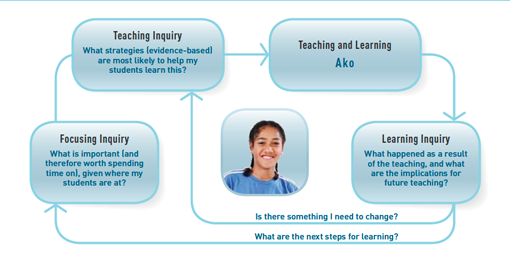
And then there is the professional game changer: inquiry. For the non educators amongst readers, this is the principle that teachers inquiring into what they do, investigating hunches about what will improve learning for their students, are far more likely to adapt and improve their practice. The process looks something like this:

Image result for teaching as inquiry"


Let's face it, NONE of us begins our lives in this profession knowing everything that we need to be successful. In fact, on a side note, I suggest that it is even worse than that, that much of what passes for initial teacher education in New Zealand is not fit for purpose, but that's a different issue. So, as teachers we all need to be curious learners. we need to ask ourselves how we can do this better.

At Hornby High School I believe that what I am seeing is the progressive adoption of inquiry as the driver behind improving what we do. As my colleagues have inquired, made changes, reflected, and then written of what they have done, I have seen reflection that I would describe as transformative. What's more, this has taken place with the support of Professional Learning Groups, many of which have involved collaboration across our Kāhui Ako. This means that we have had primary and secondary trained colleagues collaborating on their inquiries. This is a rich source of knowledge sharing and transfer, and the potential for impact on our learners is huge.

Amongst the benefits of being a Manaiakalani school are that we have a clearly articulated pedagogy (Learn Create Share) around which to focus all inquiry, with hunches often formed based around the mass of great data with which we are blessed. We are able to inquire into what we call 'high shift practices'. In short we are beginning to build a true inquiry culture that focusses on improving outcomes for learners.

That in itself is the high shift practice. I would suggest that while new buildings and digital devices are necessary for transformative school improvement, in and of themselves they are not sufficient. To create those big shifts we seek, we need inquiry, and a future focussed curriculum, and....


Wednesday, 23 October 2019

Helicoptering?

The annual Manaiakalani 'Wānanga' was held today. This year over 100 educators from Manaiakalani clusters from around the country got together to review data and progress and to share ideas on next steps. The day is always energising and inspirational, highlighting the incredible impact of what we do.

As is so often the case when groups of like-minded people come together (regardless of the interest or purpose) really useful conversations take place over the tea breaks, and today was no exception.

I had a fascinating conversation with Mark Maddren (the original Manaiakalani facilitator for Uru Mānuka), and Aaron Wilson (researcher with the Woolf Fisher Research Centre, Auckland University) and Mark put forward an idea that I hadn't considered before. He pitched it like this.

We are mostly familiar with the concept of 'helicopter parents', those who (with the best of intentions and motivations) hover far too closely over their children (always wanting the best for their children, as we are hardwired to do as parents) but as a consequence denying their children to the opportunity to stand on their own two feet, to make mistakes from which thy can learn, and develop their own coping strategies which will be essential in their adult lives.


Image result for helicopter


Mark proposed the idea of 'helicopter teachers'. If I understood Mark correctly, these are the teachers who try to make things as simple as possible for students but as a result of which they take away the challenge.

Now this is, it seems to me, a fine line. On the one hand a part of our core job is to make core skills and knowledge accessible for our rangatahi. On the other hand we must make sure that those rangatahi still develop and grow the necessary skills for their learning.

We do this by:

  • Scaffolding content to such an extent that challenge is removed from the task, or
  • Bullet-pointing text so much that there is very little actual reading required, 
We attempt to make success so certain that there is little risk of failure, the result of which is :

  • Students don't develop the resilience necessary to face future failure, 
  • They fail to learn the critical lesson that success in life rarely comes from those first attempts, but requires persistence in the face of failure, and
  • We need to take risks in order to learn, develop and grow

We all do this for the best of reasons. If you believe in the idea of personality types (not sure that I do, but that's a different story), then you'd mostly classify teachers as 'rescuers'. If you don't follow that approach, then maybe it's because we generally understand the moral imperative behind what we do. We have to make sure that every human being that crosses our professional path is able to achieve outcomes that match their potential.

The discussion arose as we were talking about progress in reading. The Manaiakalani data shows that while we are accelerating writing achievement for our tamariki by twice national averages, we are only accelerating reading by 1.5x the national averages. When we present content we will bullet point it, taking out a lot of the words necessary to fully convey meaning. As a consequence students do less reading. We make a judgement call that real authentic texts are too difficult for our students, and so we don't present them with these reading tasks.

All of this means that as teachers we do all the work, not the students. As a consequence we undermine critical learning opportunities.

I fear that this reflects a lack of aspiration for our learners, and possibly even some deficit theorising about our learners. Possibly a better approach is to develop the skills necessary to teach students how to deal with, to read, authentic texts, how to approach and read difficult stuff. I believe that this is more of a problem with those of use who have been trained as secondary teachers (myself included). Yet we are ALL teachers of literacy (reading and writing). So the challenge in our Uru Mānuka cluster oi to create a sharper focus on reading by improving teacher skills around how to support our learners to read more effectively, rather than simplifying the reading tasks in the first place

All of this came from a discussion of the incredible data that is being accumulated on the success of The Manaiakalani Programme in accelerating student success. This is one of the powers of good data, and one of the huge benefits of collaboration. It is an incredible testimony to the professionalism of our teachers.

Robin Sutton
Tumuaki

Wednesday, 4 September 2019

Democratisation of education: The Manaiakalani Project, and more ...

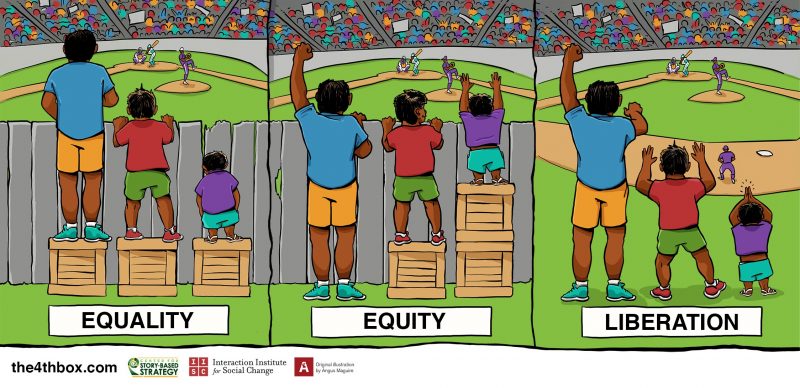
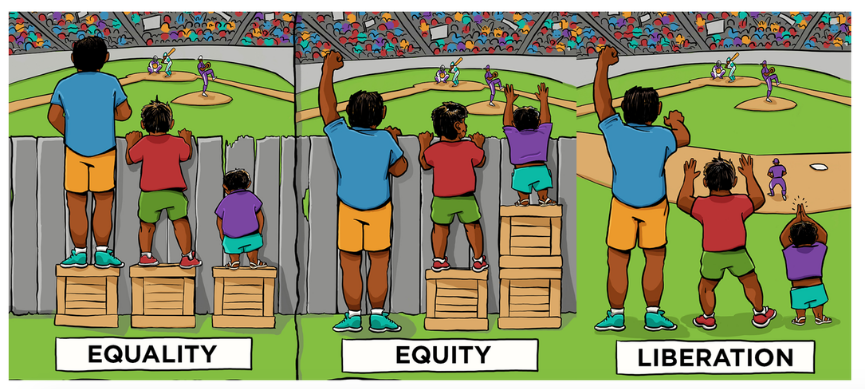
Nothing could capture the moral imperative of education better than this image:

Image result for equality equity liberation image

It captures the challenge that faces us better than anything else that I can think of, and I've used it repeatedly.

How can we reduce inequality, how can we improve equity? I believe that ONE strategy is the democratisation of education,  making education 'fit for purpose' for everyone, not just those from the European middle class, not just those who have traditionally benefited from our past educational systems. Education offers the opportunity for liberation.

That is the background to my thinking after another great meeting with Cheryl Doig. We discussed a really interesting piece of work that she is involved with called 'Learning City Christchurch'. The name speaks for itself. What does it involve? What would a 'learning city' look like? That's the million dollar question.

Here's my take on it: we want Christchurch to be a city in which learning is ''what we do', the 'we' being all citizens, regardless of age, race, religion, and regardless of the purpose or context of the learning. Such a 'construct' is a very complex thing with lots of inter-related parts.

In Christchurch we have a formal education system that is evolving in ways possibly unique in the country. Secondary schools are increasingly collaborating, working together, sharing practise in order to improve outcomes for learners. Much of this began post earthquakes through the work of the Ministry funded 'Grow Waitaha' organisation, and continues on to this day. This in itself is important work that the Ministry of Education needs to continue to fund.

I recently discovered another exciting piece of collaboration in the making when I had a delightful meeting with Cheryl de la Rey, the (new) current Vice Chancellor of University of Canterbury. She spoke of moves to improve collaboration between the four key tertiary providers in Christchurch. To get more learners into formal tertiary education, regardless of the institution, is winning for the city, for learners, and for the country. Her views were refreshing.

Back to the meeting with Cheryl Doig; we talked of a concept of 'supernodes'.. something that blew my mind, but if I understand correctly it involves systematic development of areas of advantage that the city already has - agri-technology for example with Lincoln University.

So, how does this connect with Hornby High School?

We are already doing great work in the democratisation of education with The Manaiakalani Programme. The outcomes for our learners, regardless of gender or ethnicity, are transformational. Students are encouraged to find their voice, to connect their learning to their own cultural world, to make their learning visible, to coach each other. We are also working to transform curriculum so that it is more relevant, engaging, and effective. These things support development of student agency and efficacy (that is, control and effectiveness). These two things improve achievement for learners.

In this journey we are not alone. Many secondary schools in Christchurch are working to improve the ways in which they cause learning so that they improve outcomes. Whether it is Haeata and their new learning paradigm, or Christ's College and their 'Inspire' programme for their year 10 boys, it is all a part of the innovative educational landscape that we have in Christchurch. I am aware of many other initiatives across the city (and across the country) that are seeing extraordinary transformation in learning. Beyond Christchurch, try Hobsonville Point Secondary School, or Rototuna High School.

What is holding us back? In my opinion one barrier is the media, ever ready to 'bag' any attempts at doing things differently. After all, growing a sense of outrage is the best way to sell advertisements and generate revenue. To hell with the truth. To hell with improvements in society. The net result is that schools and Principals tend to keep their heads down in their attempts to avoid that public media gaze, that pseudo-scorn that the media is so keen to heap on educational innovation. Thank goodness many schools and Principals have the moral courage to try new things.

Well, Dear Media, let me offer that famous Einstein wisdom "The definition of insanity is doing the same thing over and over and expecting different results."

In schools we are trying to do things differently. Whenever you see change and you 'bag it', you disincentivise that change and improvement. In doing so you create a push factor that resists change and maintains the status quo, that keeps those who have traditionally been poorly served by education down at the bottom on the economic heap. Perhaps most specifically you keep Māori at the bottom of the heap, because they are the people who have been least well served by our traditional euro-centric system. That sounds and looks a lot like institutional racism to me. Maybe I'm wrong, but that's certainly my perspective. And here's the fascinating thing in this regard: things that improve educational outcomes for Māori improve educational outcomes for all (He Kakano)

These are things that help to make a learning city, or to use a Christchurch City Council phrase, a city of opportunity. So too are moves to micro credentialing, to creating a system that 'badges' or recognises small pieces of learning that are important to the learner at a specific point in time, and that may well accumulate towards qualifications but which more importantly focus learning on what matters, not on gaining qualifications that may be largely irrelevant to the learner, and to society.

This looks a lot like democratisation of learning, and equity for learners. For Hornby High School, the democratisation of education comes in the form of The Manaiakalani Programme, in the shape of new connected curriculum, in the shape of a shift in pastoral practices and structures. Other schools have their own journey, as they should. This happens to be our journey. Many schools have the courage to change. Let's not be brow beaten by others into avoiding what is right.

Iti te matakahi, pangāia ke te tōtara pakaru ai (The wedge may be small but it will split the greatest tōtara).

At the very least we all bask in the economic benefits of this democratisation. By crikey, even the OECD agrees. And some of us even bask in the knowledge that what we are doing is morally right.

Ma te hururu, ka rere te manu

Robin Sutton
Tumuaki


Monday, 5 August 2019

The power of making learning visible 2

My last post looked at a class scenario in which some of our amazing rangatahi contacted a fave author after reading one of her books, and writing a series of reviews. The net result is Ella West's planned visit to our kura in September. When we make our learning visible, authentic connections occur and new opportunities are created, opportunities that most probably would not have existed without that visibility, without the blogging, without the affordances of the digital technology.

Here is another recent example. Natasha is a Year 10 Business Studies student in Mr Stokes' Business Studies class. Natasha put together a presentation on what we call the 'Triple Bottom Line', the idea that businesses need to focus not just on profits, but also people, and the planet. Her presentation was a mini case study about Van, the shoe manufacturer. She then posted her presentation on her blog for the world to see.


With a little 'engineering', a staff member from Van's in Australia read the presentation and commented on Natasha's blog post. You can see the reply if you scroll down to the bottom of Natasha's post.

This is a real and authentic connection, a connection with real world people in a real world context. Natasha has brought her thinking to the attention of the people who matter in this regard, she has been able to begin the process of tapping into real world expertise. The fact that her presentation has been shared across the Australian arm of this company is extraordinary. Imagine how Natasha feels. No, you don't need to imagine. In her own words:


Natasha's context is real, the expertise that she may now be able to learn from is real. Natasha's learning is real. The benefits of this visible learning go far beyond the improvements to thinking and writing that occur with the act of 'blogging', improvements that are well documented through the independent and authenticated research conducted by Woolf Fisher Research centre (Auckland University).

We can only guess at the possibilities that now exist, but we can be sure that they are possibilities that did not exist before.

Image result for equality equity liberation image


This is the power of visible learning, this is the liberation we want for our learners. This is what happens when learning focuses on real world situations, and is shared with an authentic audience.


Monday, 1 July 2019

It's all in the words we use - let's 'talk (educational) dirty'

Yesterday I attended one of those meetings that we seem to increasingly have in education these days. They are meetings filled with optimism, yet at the same time they can feel a little conspiratorial.

File:Schurz Conspirators.jpg
Source: https://commons.wikimedia.org/wiki/File:Schurz_Conspirators.jpg

We were there to talk about how we might get back to building collaboration across the secondary school network in Christchurch. This was something organised by Grow Waitaha that appeared on our 'landscape' in 2016/2017 and was, after its brief flourish, killed stone dead. We used words like collaborate, innovate, improve, as if we were a group of third world conspirators plotting the downfall of the world as we know it. Indeed you could be forgiven for thinking that using the word 'innovative' in education at the moment feels a little like 'talking dirty'. Such is the climate it would seem is being created by our media. Why research an issue in depth when you can make superficial sensational claims that will satisfy editors' demands for yet more click bait? I guess we shouldn't be too harsh on our reporters. Maybe what we are seeing is their initial responses to the disruptive influences of technology. Media owners seem intent on reducing reporter numbers in order to cut costs and drag in the advertising dollar. But that's another story.

Image result for conspirators
But here's the point: this is about our children, about their future (and ours), and superficial clickbait will NOT do.

If I use the word 'innovate' I am, it would seem, likely to be labelled as 'experimental'. If I talk about 'collaboration' it seems that I am likely to be labelled as someone who wants all children to learn in huge groups taught by several teachers in an out of control environment where mob rule is the norm. And of course that is the norm whenever a school is rebuilt, isn't it. Forgive me for cringing in the corner, won't you.

On the other hand, if I use the words 'school improvement' I am perhaps seen as being a moderate, nay conservative, educator who doesn't really intend to do more than tinker around the edges.

We all proclaim that we want better educational outcomes for our children. Well, helloooooo .. doing the same thing and expecting a different result is Einstein's definition of insanity. To get better educational outcomes things have to change. Who says that doing things the way we have for the past 150 years was the best anyway? Echoing the critics of change, show us your evidence that the past 150 years were 'best practice' and gave us the best outcomes we can hope for? It seems to me that it only ever worked for the privileged few, those of European descent and of middle class background.

All schools need to innovate, all schools need to be empowered to have the courage to innovate, to try new things. And most (if not all) schools have built into their structures and processes the innovative mechanisms that drive that improvement. It's just that some are taking bigger steps than others at any given point in time.

I had the privilege of sitting in on the mid year report back of members of our staff team from their Professional Learning Groups, as they fed back to colleagues the results of their inquiries so far this year. What I saw was 'gobsmackingly good', it was exciting. No one thing that I saw represented a quantum leap in change, each was a small incremental change in teaching practice. But here's the thing: small incremental change for each individual teacher represents large change for a kura.

For those who don't know (cue: take note, Media friends) Teaching as Inquiry is our key improvement process, our key way to generate teacher learning and better outcomes for learners. It is recognised as perhaps the best way to help teachers to learn, to up-skill, to better meet the individual needs of the learners they interact with daily. I could go on, but you get the idea. For those who don't know (yes, media .. this one is for you) the process looks like this:

Image result for teaching as inquiry

I saw teachers developing better ways to empower personalised learning. I saw teachers digging in to data to learn more about their learners. I saw teachers enhancing student mana by empowering them to become experts for their peers. I saw innovative use of technology to help students to read, write, and create, more effectively.  I saw teachers looking at how they can make more effective use of simple one on one face to face conversations to better engage students.

This is innovation. This is empowering. This is exciting. This is what leads to better outcomes for learners. It does also underpin more significant kura wide change. It empowers us as teachers to try new things, to be prepared to take risks, and risk taking is important because without it we get no change.

And all of those things I have described are informing our whole school evolution, whether it be Chromebooks and digital learning (Manaiakalani), curriculum change, or pastoral systems. Our school wide improvement data continues to be impressive. Take this writing data, tracked across a three year period form the beginning of 2016 to the beginning of 2019.

The data uses 'matched pairs', so a student had to be include in the testing at BOTH the beginning and the end to be counted. The right hand column is the one to focus on. If that number is 0, then students have made exactly the progress in their writing that you would expect over three years. If it were negative, then they would have made less progress than expected, and if it is positive then they have made more progress than expected. This is called acceleration. They are progressing faster than you would expect. A student can be expected to make 9.5 points of progress per term, on average. Our nYear 10 students made just under nine terms more progress than expected over that three year period. Framing that another way, we accelerated their writing progress by nine terms more than children of that peer group did on average across the country. This is extraordinary.

If by doing all of this we are, suddenly. an experimental school, then so be it.

And when undertaking inquiry, we all acknowledge that sometimes the hunches that teachers have are wrong, or the strategies they try out don't work. And do you know what? That's ok. Because learning that something doesn't work is just as useful as learning that it does. And it's better than doing nothing.

The media seems intent on beating teachers and schools over the head when they try new things. Schools come at this driven by the moral imperative to do better for our children. I am frankly not seeing much of that in the media these days. The climate being created by this approach will only serve to drive innovation out of the system. Or where it does occur, it will seem more like some sort of guerrilla activity, some clandestine operation undertaken in the dark of the night.

And this must be much like the innovators who began Manaiakalani must have felt in their early days. Maybe they didn't, or maybe the media had a different approach ten years ago. But thank goodness those innovators did. The outcomes for our rangatahi are amazing. We accelerate learning in writing by (on average) twice national averages. We accelerate improvement in reading and maths by (on average) one and a half times national averages.

We are out to liberate our young people from the tyranny of 150 years of educational practice that has served too many of them poorly. And that is NOT a plea to 'throw the baby out with the bath water'. There is much in what we have done that is good. However it is no longer enough. Here we go with this same image:

Image result for equality equity liberation cartoon

THAT is creativity. For our kura THAT is 'creative excellence' in action with teachers. THAT is the result of innovation. THAT is the result of moral courage. THAT is the result of some professional 'dirty talk'. If 'talking dirty' in professional terms is what it takes to give our rangatahi the better future they need and deserve, pass me the swear jar. I'm in!!!