Showing posts with label excellence. Show all posts

Sunday, 25 February 2024

'Like, it's the creative vibe, man' (5)

I've thought a little about what deliberate and intentional actions we can take if we are to generate a more creative city, a city in which learning is just how we are. It's a complex beast, one in which I am not at all qualified to make grand assertions. But I've been thinking about it. I've asked myself this question: what are the possible levers that we can use to get there?

Maybe these things can (in the language of economics) be classified as macro and micro 'levers'. 

The macro levers are those that operate at an institutional and system wide level. In Aotearoa New Zealand perhaps the best example is the impact on education of Tovey and Beeby, and their work with creatives in schools in the 1950s and 60's (one of the best examples of which must be Ralph Hotere, but there were a number of others). This was action that impacted directly on children and young people, action that (so the literature suggests) resulted in an epoch of creativity in our schools. Did it? Not sure, but it seems to be a reasonable assertion. This was also the time of Elwyn Richardson and his ground breaking work in leading learning through the lens of creativity.

Thinking about this macro level in education poses questions around our national curriculum, and the importance that it places (or doesn't place) on creativity. This then (presumably) impacts on  the mahi within individual kura. My experience was that regardless of whatever curriculum documents say, it is possible to foster an ethos of creativity in an individual kura, as long as there is leadership from the top.

Within the civic or public space we can question the commitment of civic leaders (both elected representatives and salaried professionals) to the creativity, to the efficacy of creativity, in generating economic activity, innovation, and wellbeing, amongst their citizenry. How easily swayed are they to the benefits of such a focus, especially in these cash constrained times when they are being told that the choice between roads and drains, or libraries, pools, and creative public services, is an 'either/or' rather than an 'and'.

That said, they are still able to consider how they fund libraries in particular, and also museums and galleries, and other public spaces and activities, to support creative thinking and endeavour amongst their citizenry. In Ōtautahi Christchurch the public library spaces at Tūranga, and the redevelopment of the network of suburban library spaces, gives us hope. I note that the soon to open Hornby library (the Matatiki Hornby Centre) will be an absolute delight in terms of the facilities that it offers to the locals that might foster and support creativity and innovation with its dedicated 'Creative Activities Room'. Included will be opportunities ranging from 3D printing to sound recording.

These are examples of those macro level levers which generally are out of the reach for most of us.
I wonder also about the degree to which we can pull the levers of civic and architectural design across civic and private projects? When I look at some of the building and space design that we have seen in Ōtautahi through the earthquake rebuild, we see some of the worst and best of building design in particular, from awful tilt slab monstrosities to the creation of quirky innovative spaces that are new, but have the feel of ancient spaces. These are part of that 'vibe' I am talking about.

A signal of the development of Gloucestor Street, and the 'arts precinct' that will include the new Court Theatre, plenty of hospitality, backstopped with Te Pae, a wonderful new convention and function centre at it's west end - more 'very cool vibe'


The old 'New Regent Street', strengthened and repurposed with less traditional retail, and more hospitality, business.. a delightful 'feel' on a sunny day

More relevant and accessible to us as individuals are those micro level actions that we can take. Organisations like Ako Ōtautahi Learning City Christchurch are very proactive in showing some of the possibilities. What happens when you 'join the dots', when you connect people and ideas? What happens when you find guerrilla bureaucrats, awesome people within organisations who are able to activate smaller parts of those organisations, and resources, to support the vision of a more creative city, a city that values and activates learning not only within the formal sector but across the informal sector of learning?

Are we joining enough of the dots? Are we telling the stories loudly enough? Often enough?

AO-LCC is one of several organisations that are working to leverage change. Others include the Greater Christchurch Schools Network, Risingholme providing Adult Community Education, and that group of smaller providers such as Egg Academy, and Creative Trust, the Christchurch Young Writers' School, and Christchurch Rock 'n' Roll Club, and .....  all those smaller rebels that I have mentioned previously,  all alongside an amazing public library network. Ōtautahi is not in any way different from or superior to any other city. It is simply the city I know.

At our individual level, perhaps the best thing we can do is to actively broker conversations with many and diverse groups, as many conversations as we can, about creativity, about learning. We need voices that will echo loud and clear over the top of those who would have us submit to endless machine-like lives. We need to amplify the messages. We need to be persistent and relentless in the messaging, in fostering the conversations.

We need more than words. Individual acts of creation matter, whatever they are, in what ever form or medium we choose.


Going back to my original contention, if we accept that creativity and learning go hand in hand, if we accept that learning can be generated more effectively formally and informally through a creative lens, if we accept that creativity and innovation enhance our lives and our communities as measured with both economic and wellbeing metrics, is there such a thing as a creative vibe in a city, does it enhance creativity and innovation generally in a community, and does it enhance learning in a city? Is it another piece of the puzzle of how we go about building a 'learning city? Could it, would it, help to create a 'learning vibe' in a city? And what would a 'learning vibe' look like, feel like, sound like, in a city?

Perhaps my biggest contention is that whatever we do, we need to be far more deliberate and intentional in doing it.

What is at stake? I couldn't put it any better than O'Connor and his associates:

Like Freire, McLaren (2000) offers critical pedagogy as an antidote to education
systems that “replicates social inequity and creates an unthinking consumer class” (p. 123).
A truly democratic society requires people who are fully conscious, or fully awake in the
world, and Maxine Greene argues it is arts-making which brings the individual into awaken-ness (Greene, 1997). Perhaps it is why some might call art or photography ‘a woke subject.’Martha Nussbaum (2010) argues the moral imperatives sitting beneath a democratic society are based on the creation of empathetic citizens. She argues that empathetic imagination has been systematically ignored, and severely repressed, by neo-liberal models of education.
(Page 15)

And with reference to our formal schooling system:

We argue how the true measure of public education is not in individual achievement, but in
the success of participatory democracy. What we risk with the current schooling is creating
classes of people disconnected from a sense that they are able to be active participants in
their own lives. We believe the dangers of such an approach during post-normal times is
obvious as new nationalisms and dehumanising ideologies find fertile ground in collapsing
economies.
(Page 16)

These words tell me that we face uncertain and worrying times. Let me finish with some words from the Ōtautahi Climate Action Campus:

"Climate Action Campus, Ōtautahi - Shifting young people’s sense of climate anxiety to climate hope. One of the biggest mitigators against climate anxiety is to take action." 

Source: https://www.growwaitaha.co.nz/our-stories/climate-action-campus-otautahi-shifting-young-people-s-sense-of-climate-anxiety-to-climate-hope

 ... which I'd like to adapt like this:

Could we be a "Creative Action Campus, Ōtautahi - Shifting people’s sense of anxiety to hope. One of the biggest mitigators against anxiety is to take action."


References

'Replanting creativity during post-normal times', O'Connor, Anderson, Freebody and Ginns, October 2020


Wednesday, 7 February 2024

Creatives in Libraries - could that kick off a Learning City?

I'm once again sitting in one of the Ōtautahi Christchurch City Libraries. It happen every now and then. They're not bad places to go, to 'be'. I'm there waiting, I'm there hoping to make productive use of my time, I'm there thinking about stuff. I'm there trying to read an article on creative cities. The literature I find usually focusses on the 'creative sector' of artists, dramatists, writers .. you get the idea. I like to imagine something much more, I like to imagine a creative city that is a'learning city', and I wrote about that here. 

I'd actually started today's session trying to 'polish' a poem I wrote, a part of a series in which I'm trying to focus on our lives under capitalism. I'll post it at the bottom of this piece in case you are interested. In doing that I spent a lot of time 'staring', thinking, imagining. It's easy to get distracted when in that state and so I noticed the people around me. There's the group of folk joining in the organised 'games' session. There are numerous parents and grandparents (at a guess) looking after pre schoolers for the afternoon. There's a succession of folk mostly of my age seeking help from library staff to find something or other.

But there's also the group of folk who look to me to be sitting lost in despair. Young people who ought to be in school, adults who are not in work, the sick, the elderly, people who (based purely on a visual judgement - yep, we can all be judgemental eh) are quite possibly living lives of poverty. They seem to carry a sense of hopelessness, of despair.

Our public libraries serve such an important role in our communities: connectors, listeners, carers, encouragers, sanctuaries, maybe even givers of hope. And the people who staff these places, people we have traditionally called 'librarians', are so important. They remind me so much of teachers too in this modern age, people from whom society now demands such a wide range of skills - knowledge specialists, communicators, listeners, carers, IT gurus.

I wonder if there is another role missing here today: maybe our libraries need trained social workers, on staff and available at all times, or... maybe ... our libraries need specially trained 'creatives' on staff. After a career in education, I think that being able to offer creative opportunities, creative encouragement and nurturing, to those who are perhaps overwhelmed with hopelessness and despair, or who are simply lonely or lost, has the potential to offer 'salvation', the potential to offer purpose and reconnection, that are not easily found elsewhere.

Sitting a couple of seats away from me is a young woman who is I suspect of school age, who appears to be restless, trying to fill her time with a phone, maybe waiting for her mates to come from school. Who knows.

As I sat silently polishing the poem, I wondered if that young woman sitting there might have a 'voice' that she'd like to use, to yell her despair at the world? Having just yesterday watched Tracey Chapman reprise 'Fast Car' at the 2024 Grammies, I wondered if sitting there two seats away might be another Tracey, or another Tusiata Avia, who has something to say to the world, if only she could find a way to realise her voice?


Perhaps what we need is a network of creatives who occupy every public library space in the city. How much new talent would we find? How many potential social problems would we head off, how many Justice dollars or social welfare dollars might we save, by giving a sense of purpose, of wholeness, to a whole new group of human beings? Yes, maybe for those under 16 they should be getting this from our schools, but these are people who for a range of reasons have already disengaged from that network. That doesn't make them worthless. That doesn't mean they ought to be consigned to the scrap heap. They still have that same human potential that we all carry.

Perhaps we could see a scheme similar to the Ministry of Education's 'Creatives in Schools' programme - now there's an idea.

And this needn't be limited to creatives. Why not a scientist exploring the natural world? Technologists ... but I get ahead of myself. What we are discussing is another potential piece of the puzzle of how we democratise learning. Those right wing libertarians amongst us would not have a bar of this, of course. Their free market ideology relies upon power imbalances, and winners and losers, despite the fact that economic theory does not say that. The model of perfect competition that lies at the heart of their thinking, for example, assumes 'Perfect Knowledge' for markets to operate efficiently.  How does that come about when we readily accept the disenfranchisement of some in society? If we were truly libertarian would we all be working to ensure that this 'perfect knowledge' was a reality? I'll switch my 'cynicism circuits' off right there.

We already see examples in which creatives inhabit library spaces. There's 'Egg Academy' that offers holiday (and other) programmes for young people, Kim's 'Creative Trust', and  Imagination Station that operates inside Tūranga. There are more, I'm just not well enough informed to list them. The first two certainly aren't available all the time, and that's what I'm wondering: what sort of social and economic impact could we have if we equipped libraries with this sort of additional talent and resource? Could we at the very least spark curiosity amongst some of our most disaffected, some of our most vulnerable, and so perhaps steer them towards the sight of their worth and their potential? I am excited about that whole idea of living in a city in which curiosity is rampant, where people want to know what, why, how, where about anything and everything in life.

This needn't be about some sort of altruistic 'do good' philosophy either, if that worries you. Every young person who fails to achieve their potential is an opportunity cost to society as in lost potential,  and possibly a direct dollar cost too. Why would we willingly accept, and in fact knowingly engineer, such things when we know the consequences, and we have alternatives?

I recently read a proposal from Dr Hafsa Ahmed, Lincoln University, and a trustee of Akō Ōtautahi - Learning City Christchurch, looking at what a learning city could look like if we think of it as a city wide learning campus? This is a grand vision, an exciting prospect, and not something that could happen overnight. But like any dream, it requires tangible first steps. What would happen if a tangible first step was to somehow fund creatives in every city library?

In the meantime, here's that poem...


Saturday, 16 December 2023

It's a matter of scale, isn't it?

I keep thinking about what it might mean, what it might look like, to have a learning city, and particularly a creative city.  You can probably tell that in my own head these two are inextricably entwined, rightly or wrongly.

This means that I keep looking around me for examples of creativity being developed, displayed, and valued, and there seem to be lots of them.  Here are a few examples.

There's Kim's 'Creative Trust' (an operation that she has scaled back somewhat to take on a different role in education). 

Kim at a recent CPPA meeting, with Nigel Latta

I was walking stridently towards an appointment a week or two ago and happened up this Street art project. I stopped and talked to Graeme, asking him some questions... wow is he an impressive human being. Tino pai to mahi, e hoa!!! The arts making a difference to lives.

There is the Manaiakalani Schools network whose kaupapa is 'learn create share', a kaupapa that tries to build student creative and critical thinking into their learning, all amplified with the affordances of digital technology.

Their vision of create' looks like this:


There's Kane Stewart's 'Egg Academy'

What about the Ōtautahi Christchurch Young Writers' school? Around and growing young writers' talents since1993

Our Ōtautahi Christchurch city libraries network offers plenty of opportunity to develop creative thinking and creative skills with holiday and after school programmes. The Ōtautahi Christchurch central library, Tūranga, and the network of suburban hubs being redeveloped, contain facilities that support creativity.


 Their support for creativity looks impressive. When I see a sign like this, I get kind of excited.

On Level 4 of Tūranga


There are communities of creatives, like the Art Box project in Ōtautahi. In their own words:
"Our exciting art space has its origins in the series of major earthquakes that devastated central and eastern areas of Christchurch. Since 2004 this modern, air conditioned, building has been the studio of well known local artist Beverley Frost. However, seismic events caused thoughts to meander and flow. Various artists began to talk about the need for a place where a creative renaissance could flourish following the loss of so many of the city's artistic outlets. The result was Art Box, a Christchurch Gallery where modern works can be viewed in a relaxed and friendly environment."
There is the Ministry of Education 'Creatives in Schools' programme. As Tumuaki of Hornby High School I had the privilege of working with Dr Claire Hughes on such a programme (well two, actually, over two years). The engagement with rangatahi was phenomenal, Claire a prodigious and inspiring talent.

As I said, there are lots of these activities, and with the exception of a city's library network, they are most often small ventures, often just one or two people, making a difference at that point in time with a small group of their fellow human beings.

My wondering is are they having sufficient impact? If not, is this a matter of scale? OR even if they can be scaled sufficiently to have any significant impact? In fact, are such things scaleable at all, or the idea of scaleable creative activities in itself an oxymoron?? If anyone could scale these, you'd think it would be a city's library network. 

And of course a lot has been written about the impact of the commodification of art.
"Living in a capitalist society, we are forced to pit ourselves against each other in a system we have no choice but to participate in. We are coerced into adapting ourselves and our skills into fitting the role of benefitting capitalist society. And unfortunately, the art world is no exception. While the businessperson and the manufacturer are rewarded, the writer and the artist are suppressed. Unless of course, that art is commodified."
Even Marx had something to say about the role of art in the capitalist society.

Is what we have now 'as good as it gets'? Is the current paradigm of the arts, and creativity more generally, the best we can hope for? Is it pointless to try and grow a whole community as a creative "collective? (Remember that I mean creativity in its broadest sense, not limited to the creative arts only, although definitely incorporating them).

Perhaps the best answer lies in collective action. Maybe it's a bit of the old gestalt psychology - the whole is more than the sum of the parts. If we bring the enormously diverse community ever closer together, we amplify the impact of each organisation. I've quoted Peter Korotkin before. And of course this beautiful whakataukī:

Nāu te rourou, nāku te rourou, ka ora ai te iwi
With your food basket and my food basket the people will thrive

What I do believe is that the mahi of an organisation like Ako Ōtautahi - Learning City Christchurch is essential. Someone needs to bring the diverse community together. 'Learning Days' is one of those things that might just start to make a difference.

Watch out for Learning Days 2024. This is such a promising initiative that might just scale this whole learning city/creative city thing.\

Friday, 2 December 2022

Learning the 'rules of the game': reconciling our rules based culture with creativity

One of the biggest philosophical tensions I have felt in leading a kura towards a vision as 'he puna auaha a centre of creative excellence' is what on the surface is the apparent conflict between our rules based culture and creativity. When creativity apparently demands the ability to think outside the square, to break the rules, it seems odd then (maybe even implausible) that we can do so when schools have so many 'rules'. It is a regular kōrero with some students .. 'why do I have to follow these rules, XXX (insert appropriate issue here) doesn't affect my learning'.

Perhaps it's all about the 'rules of the game'.


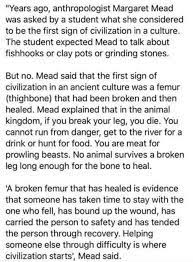
This has played on my mind. I have managed to come up with two arguments that reconcile these tensions. The first had been founded in what might turn out to be an 'urban myth', but I am still left wondering about the validity of the sentiment anyway. The story went like this.


Source: https://www.truthorfiction.com/margaret-mead-femur-quote/

I have had conversations with quite a few young people over the years in which I retold this story, making the point that for a group of hunter gatherer people to do this, there must have been some tacit agreement about how they would cooperate to 'feed the passenger', someone who was unable to do their share of hunting or gathering to feed themselves. Now there is a good argument to say that this story about Margaret Mead never happened. I'll go with that, but I still think there is some validity in the sentiment, and I would suggest that no group can be successful unless there is some tacit agreement about the rules that are necessary to ensure success. Regardless of the nature of the group - armed offenders squad, motorcycle gang, army platoon, school - I would posit that all groups need rules that are generally agreed upon and upheld if they are to be successful. If we then take the broader view of our purpose as schools, if we allow young people to walk out of our gates not understanding this need to follow a prescribed set of rules for success, then we have failed  in a very profound way. We have not equipped those young people to take their place in society. Maybe the devil is in the detail about exactly what the rules should be, and how we agree upon and enforce them?

There is another argument that I rehearse in my mind that reconciles a rules based culture in support of creativity.

If we accept that creativity is founded on deep knowledge of a particular 'discipline', implicit in that deep knowledge  must be an understanding of the rules of the discipline. What's more, if we intend to break the rules in a specific discipline in order to develop creative solutions, there is an argument that we need to know what those rules are. I'm less convinced by that last statement, but think that it is worth considering.

This takes me back to the latter years when I was teaching economics to senior students. I had fallen out of love with my discipline. I saw so many examples in which the theory and models I taught failed to match the real world. In order to continue to teach this material (required in NCEA standards) I would explain to students that the world needed them to challenge the orthodoxy, to challenge the rules, but in order to do so they needed to understand what those rules were in the first place. They needed deep knowledge of the theory and the models before they could critique them in any meaningful way (not that such a requirement seems to apply to journalists and politicians these days). It helped me, anyway.

So, where does this leave us? In my own mind I have been able to reconcile the rules based nature of kura as organisations and communities, with a vision that values and seeks to develop and grow creativity and creative thinking. Maybe I'm fooling myself?

Thursday, 1 December 2022

Is creativity hard wired?

Our most fundamental survival instinct is fight or flight. Within that context I am going to make a bold, uninformed claim: all human beings are hard wired to be creative. Why? Our very survival over the millenia has come down to our ability to flee from or to confront those existential dangers, those things that threaten our survival,  to our ability to creatively solve problems. 

If that contention is correct (it seems reasonable, but how often have things that seemed reasonable subsequently been shown to be utter tosh?) then for kura I would have thought a big question continues to be 'how do we nurture, feed, encourage, inspire, that creativity in every one of our students?'. I would have thought that we WOULD want to, since our students are the future, if I may use a well and truly hackneyed/over used cliche.

A stroll through our creative spaces, Te Pai Tūhura, gave me the opportunity to 'feast my eyes' on some gobsmackingly good mahi, the result of good teaching, combined with of all of those processes of engagement, of the opportunity work in good facilities, from our senior DVC (Design and Visual Communications) students.


Students created 3D virtual fly throughs of their projects


Our DVC teacher Oscar Richardson (a trained architect in a previous life) tells me this is effectively Stage 1 Architecture School work.... high praise indeed.  This is creative work, this is excellent work, this is a fabulous example of 'creative excellence'. To produce work like this also requires students and staff to have a good values foundation, and this work certainly demonstrates our values of commitment, achievement, resilience, and respect.

This stuff doesn't happen by accident. This stuff doesn't 'just happen'. It happens because we hold high expectations of all of our learners, it happens because we have good teaching taking place in good facilities. It happens because we are committed to Mana Orite, the need for equity for all learners regardless of background.

It also happens because we have clarity of vision about what we are 'about' as a kura, and because we have clarity around our foundational pedagogy 'Learn, Create, Share', which captures the centrality of creativity to learning, and implicitly to equity and wellbeing. 

Three words keep ringing in my head, three words that simply won't go away: clarity, coherence, and persistence, and I think that accurately describes a significant part of what good leadership looks like. Our staff know the story.. 'stay on the bus', as per the 'Helsinki bus theory.


Is creativity 'hard wired' into us as a survival instinct? I have noiidea, but it is an idea that appeals eh!!

Friday, 28 October 2022

The optimal adaptivity corridor and teacher creativity

Last week I attended the annual Manaiakalani Principals' wānanga, always a fantastic event, and the biggest yet. During the morning Dr Rebecca Jesson presented, with her usual array of evidence informed commentary and provocation, one of many aspects of this mahi that I absolutely love. In her presentation. she presented this model of professional growth.


I'd not seen this before, and before it disappeared into distant memory I wanted make sense of it, and contextualise it within my 'creativity' paradigm. What I'm about to say isn't a claim to 'correctness', but me trying to check that I have this right. I may not have!!!

When new teachers first begin, they try to innovate, but don't yet have the sorts of structures and routines that are good practice sufficiently embedded so that their innovation can 'grow wings and fly'. The result is the 'frustrated novice'. 

However the net result of developing the sorts of structures and routines necessary, but not pairing this with innovation or creativity, is the 'expert at routines'.

Professional growth along the 'optimal creativity corridor' occurs when the development of expert routines is paired with growing innovation or creativity.

My first 'reckon' on this is that in teaching (maybe most professions?) most teachers make it as far as the 'expert at routines', they introduce a little innovation or creativity (yes I know that these are technically different things) into their practice. They follow the red arrow on this next diagram.


I would like to suggest that, with an extant workforce, the more desirable path is one where as those routines are embedded, there is a growing amount of innovation and creativity that appears in teacher practice. The red arrows below are my attempt at describing what I think is perhaps the optimal pathway. 


Perhaps in an ideal world new entrants into the profession would simply head straight up the 'optimal adaptive corridor'.  My suspicion however is that this is not as likely in teaching. We enter the profession because we want to help, and once we see that we start  to make a difference, perhaps we become increasingly risk averse, for fear of losing the gains we have started to make. 

After all, innovating, being creative, requires a degree of risk taking (that's why its development is one of our areas of strategic intent at Hornby High School,) and by definition when we take risks there is the possibility of failure. But as I have said to our staff in the past: "you know what? That's okay!!!!".

This 'just enough' student progress paradigm may be the equivalent of the Bounded Rationality Model in decision making, in which we tend to gather what we think is 'just enough' information before making a decision.


(Source: https://open.lib.umn.edu/principlesmanagement/chapter/11-3-understanding-decision-making/ )

I am suggesting that maybe we see ourselves making what we think is just enough of a difference, and we stop innovating at that point. What we want (I reckon) is the 'Creative' model, but notice that this requires that you 'have time to immerse yourself in the issues'.

Anyway, I digress. We have an extant workforce, we have our Manaiakalani kaupapa, at Hornby High School we increasingly see the need, the driver, for creativity, and my contention (unsupported by any evidence) is that these all come together if/when we drive teacher creativity. How do we do this? I have arrived back at my current OCD: what are the deliberate acts of leadership that will create and nurture creativity in our kura? I've already written on a number of those, and here's another one ... the Manaiakalani Innovative Teacher programme.


We do our tauira a huge service when we support and nurture teacher professional creativity, and MIT is an outstanding way to do that, an outstanding vehicle to do that. 

It was a pleasure to sit and listen to presentations from this year's MIT teachers from across the motu. Their mahi was wide ranging and varied, but the commonality was teachers who were prepared to be creative, to try new things. What's more the MIT programme offers time for these teachers to immerse themselves in this stuff, that time to slow down. to engage in Peter O'Connor and Claudia Rozas Gomez' 'Slow Wonder'.

Our Manaiakalani kaupapa, our 'Learn Create Share' pedagogy, shouldn't just apply to our rangatahi.  These need to be a mindset, a way of being, for everyone in our kura, regardless of their 'formal role'.

I do think most teachers want to indulge their creativity in order to improve things for their learners. I just 'reckon' that we are a very risk averse group of people, because we think the stakes are too high to fail. Problem is the stakes are too high not to try.


Thursday, 15 September 2022

Celebrating increasing levels of creativity: the evidence

 It's not that I am obsessed with creativity in schools, you understand. Well, not much. Well I wasn't 20 years ago. Okay so maybe I am just a bit, now. That explains our Hornby High School vision is 'a centre of creative excellence, he puna auaha' .. sort of.


Why? I've written about this before, but my belief system leads me to the conclusion that with advancing technology it is more important than ever that, in schools,  we focus on what makes us human, and I believe that one attribute that makes us human is our inherent creativity. There is also good evidence that engaging in creative activity and thinking at school supports student wellbeing and improved academic outcomes ('Replanting creativity during post normal times', Professor Peter O’Connor, Director, Centre for Arts and Social Transformation, Professor Michael Anderson, Associate Professors Kelly Freebody and Paul Ginns, The University of Sydney, October 2020). 

We've been at this 'creativity thing' since 2017, when our vision was adopted by our Board in a move that in my opinion was visionary, and one that showed great faith. Those Board members were prepared to adopt what Euan McIntosh calls a 'BHAG', a Big Hairy Audacious Goal. It aligned perfectly with our work in adopting the Manaiakalani kaupapa, and the 'learn create share' pedagogy. I've written a lot about what creativity might look like, and what it does look like, in our setting. That all begs the question 'how are we doing'?

When I was made aware of the Creative Schools Index tool, I couldn't help myself, and convinced four other schools in our Uru Mānuka kāhui ako to join us in getting students to complete the survey tool. We saw the results some months ago, but only today managed to meet online with Professor O'Connor unpack the results.

Here is something of a summary. As a group of schools our data showed the conditions required for creativity, as assessed by our students, to be well ahead of schools generally in the overall sample (something like 100 schools, so not an insignificant sample size).

In secondary schools generally the levels of 'creativity' drop off dramatically. This drop-off begins in Year 7, and becomes pronounced from Year 9 onwards. I have no problem sharing our own overall data. Bearing in mind that at this stage the comparison is with all schools in the sample, mostly primary schools, our scores are just slightly below the 'average' (technically not the correct word, but you see what I mean). 


Year 9-13 students

Year 7 &b 8 students

Why is this exciting?

For Hornby High School, here is the 'kicker', as they say. Hornby High School did not follow that trend. There is NO profound drop that mirrors the data from secondary schools generally. The data does show students as rating their learning experience at Hornby High School as slightly lower than the sample overall against the 11 dimensions. This might be attributable to the ways in which we still, to some degree at least, separate out subjects, and the way we tend to focus more and more on 'the right answers' rather than thinking creatively as students head into their NCEA years. 

Here are the conclusions from the 2020 paper on creativity in schools:

In summary the data reveals:

  • •New Zealand schools do not actively foster or encourage creative environments to support student learning.
  • •Student perceptions of their school’s creative environment meaningfully declines across time.

  • The frequency of opportunities to be curious declines throughout schooling.
  • Children are less likely to take risks with their learning as they get older.
  • By the end of secondary schooling the physical environments of schools become less creative.
  • Children in schools have little time to be playful with ideas or to engage in
  • imaginative processes.
  • Learning increasingly becomes discipline siloed with decreasing opportunities tothink and work across knowledge boundaries.

  • A correlation exists between student perceptions of creativity, enjoyment and learning.

  • There are some meaningful differences between school’s creative environments.

  • There appears to be some meaningful differences between teachers in schools using

    creative pedagogies impacting on enjoyment and participation levels.

As a Principal, I'm hardwired to speculate on why we see this result. Bearing in mind the likelihood of confirmation bias on my part, my speculation includes these thoughts:

  • We have clarity of vision
  • The vision is articulated often
  • The vision is clearly encompassed in our pedagogy which itself is clearly articulated
  • We spend time and money building our staff capability in understanding and enacting the pedagogy
  • \We value and support risk taking
  • Staff often model risk taking (and the concomitant vulnerability) in their work, and their actions
  • As a kura we showcase and celebrate achievement and creativity, often
  • We work hard to build human relationships with students
  • Student culture is embraced and celebrated

 I could go on, but you get the idea.

This is something to be celebrated. I interpret this to mean that our collective work at Te Huruhuru Ao o Horomaka is indeed taking us in the right direction, we are indeed steering a course towards 'a centre of creative excellence'. Our staff team is 'on board', they are committed, they understand the coherence and consistency in what we are doing. 

In a word, they are 'awesome'. I am proud to be a part of the team!!!!!

Wednesday, 27 July 2022

Creative connected curriculum and culture

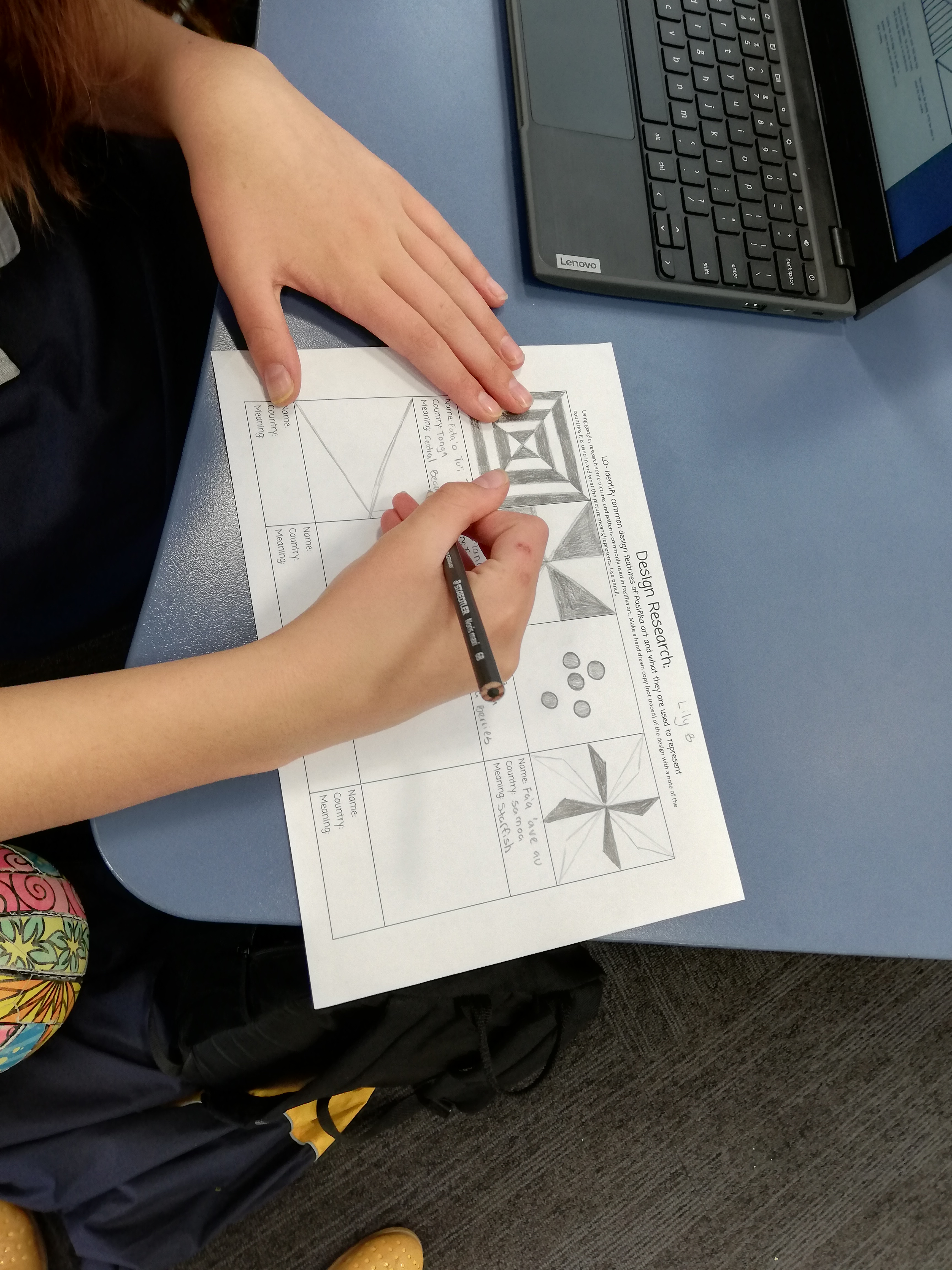
Towards the end of 2021 a group of Year 9 students worked on a Pasifika Art unit from our Creative Connected Curriculum. The 28 students in this group researched patterns and designs from Pasifika cultures before designing one of their own and painting it onto our class tapa cloth.

We were recently able to have the work 'framed' and put on display in Te Pae Rewa. It's a beautiful piece of work reflecting culture and belonging, and 'creative excellence', and an outstanding example of 'Create' from our 'Learn Create Share' pedagogy, made so delightfully explicit with our Manaiakalani kaupapa.

This is a bit of a short photo study showing some of the work that went into the development of the imagery, and the final product.


The completed work, with many of the students who contributed to its completion.

The completed work on display in Te Pae Rewa


Tuesday, 10 May 2022

It's what you do not what you say

There is an old adage 'people will judge you by what you do rather than what you say'. We see it often, don't we. The Principal says 'I expect you to be on time to class', and is then regularly late to meetings. The teacher tells students 'I expect you to respect me', and then proceeds to yell at them.

As I continue to think about the deliberate acts of leadership required to support the growth in creativity in schools, this became very apparent to me over the past two weeks. I've written previously that I want staff to practice, celebrate , and share, their. own creativity. I think this is important if teachers are similarly to support growth in creativity in their students. Having discovered my interest in writing free verse poetry I have taken to occasionally sharing one or two of those poems with staff to model risk taking, vulnerability, and creativity more generally.

Now there have often been outlets for staff to show their creativity on stage. Our leavers assembly regularly features a 'staff dance'. At performance evenings we often have staff who might sing (alone, or with others), and our choral group 'Voices with Soul' almost always has at least one or two staff singing in the group. 

However over the past two weeks (for reasons I cannot even guess sat) three staff have shared examples of their creativity with me. The first two shared poems with me, both of which were very cool. I was grateful (actually quite honoured.. 'chuffed' is a word my mother would have used) that they were prepared to share at all, and would definitely encourage them to share more widely in our community.

And then there was  today. One of our team, at the end of a regular meeting on more usual professional issues, drew out a ziplock plastic bag and said 'I want to show you these'. She does patchwork. As a part of her Professional Growth Cycle work, specifically around tikanga, she decided she didn't know enough about Matariki, and researched the stars. She then began creating a series of patchwork squares each dedicated to one of the stars. She had chosen patterns, and fabrics, to tell the story. This in itself was gobsmacking enough. The specific pieces, as yet not quite finished, showed creativity 'in spades'. The designs, the fabrics, the stories are beautifully told in fabric. And how creative is it to show the results of this small part of her tikanga journey in patchwork. That is b****y inspired.

As if that weren't enough, here's the 'kicker'. She thanked me for encouraging creativity in others, that she had been inspired to share this work as a result of my own acts in sharing my poems.  She expressed gratitude for my work in building an open culture that supported and nurtured creativity amongst staff and students.

My heart melted. I nearly 'teared up'. 

Putting aside my immediate emotional response, it strongly supported my. views on leadership and creativity. 

I do believe we can teach creativity, despite some views to the contrary. Ask any secondary school art or drama or music or technology teacher, or an English teacher. They do it every day. You can ALSO create the conditions in which creativity can thrive. I liken my work to that of a gardener. A gardener cannot 'make' a plant grow. But she can create the right conditions for the plants to grow. She can sow and water, fertilise and cultivate, so that plants are most likely to grow. So I think it is with creativity in schools.

Why is this important? Our Manaiakalani schools espouse the pedagogy 'Learn, Create, Share', creativity at the centre. If we want it to grow we have to be deliberate and intentional about it. We have to create the right conditions for it to sprout, to flourish, and grow, if we want to reap the harvest of improved wellbeing, and a generation of empathetic problem solvers.

Principalship has many component parts. It's complex work. It's hard to suggest that any one component is more important than any other, although I am a great support of Vivianne Robinson's 'Student Centred Leadership' work which defines the hard core of our work so well. However in the mix I 'reckon' (yes another 'reckon') there need to be those acts required to create the conditions in which creativity can thrive.

It appears that it is an open non judgmental response to risk taking, a willingness to share as a way to model risk taking, an explicit signal that overt acts of creativity are valued, that makes a difference. It's definitely what you do, not what you say, that makes a difference.

I took it from these three experiences of the past two weeks that I may actually be getting the hang of this 'Principalship' thing. 'He puna auaha a centre of creative excellence'.. maybe.. just maybe!!!


PS Once the patchwork is finished, I will ask the teacher's permission, and hopefully be able to share this splendid beautiful inspiring piece of creativity. And I hope to convince the two poets to share their wonderful words too.

Wednesday, 13 April 2022

World Poetry Day and creativity: Postscript - planting seeds

You never quite know, eh. When you scatter seeds you never quite know where they might land, nor what might sprout from them. To persist with the simile, as leaders and teachers we could be likened to gardeners. Our role is to plant seeds, to cultivate the soil, to create the conditions to grow strong roots and plants, to grow and sustain creative self actualising individuals and communities. 

The postscript to my previous two posts on World Poetry Day is that our student leaders took the idea, and created an inter-kāhui poetry competition, to create a poe-tree inn each kāhui, the 'leaves' on each 'poe-tree' to contain a poem written by a member of our kura community.

The results are outstanding, not only in terms of the volume of writing, but also the quality of the poetry that was submitted by students.


You get the idea .......

When you plant seeds, like the seed of creativity, of the acceptability of taking risks, and of possible failure, then you liberate minds.  It's interesting, isn't it, that when you value creativity, so do others, when you are prepared to take risks, and when you are accepting of the failures that others might experience, they become more willing to try to be creative, more open to the possibility of failure. Indeed, failures along the way are to be celebrated. There are sadly those with what I think is a fixed mindset, a mindset that is inherently negative when failure occurs. That mindset closes off the possibility of learning from past failures, and so the possibility of creating even more interesting and exciting possibilities for the future.

Our pedagogy 'Learn Create Share', and our work within the Manaiakalani kaupapa, is enhanced, it leverages ever greater benefit for our learners, if we sustain a growth mindset for both our colleagues and our students.

Over this past few weeks it's not the poetry itself that has mattered (although it does), it is the growth in creativity, the realisation of what can be achieved, especially in the minds of our amazing students, the possibility that perhaps just that few more students have recognised what their capabilities are, and so might have enhanced their growth mindset. Or maybe just a few moments joy at having genuinely created something, because for most of us our acts of creativity simply create a sense of joy. 

Because if anything matters in enhancing creativity, I am increasingly thinking it is a growth mindset.

Thursday, 24 March 2022

World Poetry Day, growing creativity (1)

 It was World Poetry Day last Monday. I had floated several ideas around about how we might celebrate, how we might leverage off the day for the benefit of our learners. I'd suggested a poetry 'smack down' featuring the 'new to the scene' wannabe 'Sutdog' taking on the well established 'Mr A' in a verbal duel on the outdoor stage, or posting huge printed versions of poems all around the campus to .. well, a few ideas ran riot. 

We were less ambitious than that in the finish. We published some poetry on our digital notice boards, and our wonderful prefects created a 'poe-tree' in each kāhui, with students writing poems on 'leaves' that will be used to assemble the trees.  The response form our students has been awesome. What I didn't pick up on was the natural energy that also took over, with quite a few staff getting our learners to do some poetry writing.

I've seen some wonderful work as a result. THE most outstanding amongst a lot of very cool pieces was this written by Alazae in Year 10.


This is truly outstanding. I called him out of class to congratulate him, and called his caregiver while he was sitting next to me to tell her about this wonderful work. Alazae is, in the words of his wānanga advisor Whāea Chris (one of our English teaching team), a natural lyricist. I love the poem not only for what it is, but also because in writing this Alazae breaks (actually smashes) some awful systemic stereotypes in our schooling system.

And there was this, from Rheanne in Year 9:

Cherry Blossom,
Elegant, Graceful
Floating, Falling, Fluttering
Flourishing in Beauty
Fleeting Nature of Life

- Rheanne (Year 9)

This is a 'cinquin', a poetic form I've never heard of. Beautiful!!!

Apart from expressing my excitement at what I have seen this week, what's my point?

When you have a unifying vision of what we want to be, when you chose a 'big hairy audacious goal ' (as globally renowned educator Ewan McGregor says), when you are ambitious enough to dream big, it is amazing what you get. This is what it takes to capture the imagination, the energy, the drive, of a team of people.

Our Te Huruhuru Ao o Horomaka Hornby High School vision is: 

'he puna auaha a centre of creative excellence'

This is one hell of a 'big hairy audacious goal' (a BHAG). It is an aspiration, a desired future state that we may never achievement in its completeness. That's not the point. It is as I have said before our guiding star in the heavens. It is to us what those stars were to those brave brave Polynesian navigators who set off across a vast ocean not knowing what lay ahead, but firm in their faith that if they followed those stars there were new things to be discovered. Their courage, their perseverance, paid off for them, and this poetry writing is an example of our own courage and persistence paying off for us.

It is also the advantage of having a coherent and consistent pedagogy with creativity at its centre, in 'Learn Create Share', and The Manaiakalani Programme kaupapa. 

Professor Peter O'Connor and his team at Auckland University have long promoted the benefits of creativity in learning and wellbeing for all. The gains in confidence as learners, the gains in literacy, in inspiration, in self belief, may not be readily measured in tests, but I'm damned sure Alazae was 10cm taller as he walked back into class yesterday.

Tuesday, 17 August 2021

How do you eat an elephant?

It might be a generational thing, but this was a saying my parents used to use when talking about tackling really big projects .. How do you eat an elephant? And the philosophical answer is of course 'one bite at a time'. 

I was reminded of this on Tuesday afternoon as I walked from presentation to presentation during our second Uru Mānuka Teacher Summit. The summit brought together 106 teachers from across the Uru Mānuka kāhui ako to share great ideas and good practice. It is one of the many many benefits of our membership of the Uru Mānuka cluster, and the Manaiakalani kaupapa that we embraced six years ago.

My ffirst response was a sense of excitement at the incredible range of ideas and practice, and the passion of the presenters presenting. The list was sufficiently long that I had to take three screen shots scrolling down the spreadsheet in order to capture them all. I did so to illustrate my point. Look at the diversity of presentations.


I was also excited by the number of our secondary colleagues who felt sufficiently confident to present to a diverse audience that spanned both primary and secondary sectors. Ka mau te wehi e hoa mā!! That's a tough gig, and I am incredibly proud of you all.

This is the second cluster wide Teacher Summit we have run. How is my Mum and Dad's saying relevant? The summits are a great example of how we crack this problem of improving student achievement across our kāhui ako, across our whole community .. we share practice one idea at a time. 

I keep repeating the same statement, we have many of the answers within our community of teachers. Our best 'bang for buck' in trying to improve achievement is to share the wonderful practice that already exists. 

There is a time and a place for external providers of professional learning, without a doubt (and Hornby High School has been lucky to have worked with an outstanding provider over the past five years). However we can tend to assume that we always need to go to external providers to find the answers.

These summits allow our teachers to come together and share these wonderful ideas. They cross fertilise the primary and secondary sectors, which in my head has always made sense. After all regardless of sector, regardless of shoe size of our akonga, we all share the same core business: causing learning.

The one piece of the puzzle which I feel is missing is the early childhood sector. In my opinion teachers in that sector have some of the best practice of all. We now need to evolve our Teacher Summits so that we engage more effectively in this pedagogical layer with our ECE colleagues. We have slowly been working to bring our Hornby ECE's into the Kāhui Sko. Maybe engagement in our future Teacher Summits is the logical next step.

If we truly want to support community wide change for our akonga, then I think this is an essential next step.

Do I think this just happens by accident? Hell, no! Do I think it happens in all Kāhui Ako? Possibly, I don't have enough knowledge of other kāhui ako to judge. Do I think it is highly likely to happen because Manaiakalani is a community building initiative? Hell, yes!!

How do you eat an elephant?  'One bite at a time'.  How do you secure improved educational success across a community? One good idea at a time.