Showing posts with label knowledge. Show all posts

Thursday, 19 September 2024

Creativity and pedagogy

I've been working out at Darfield High School in mid Canterbury in term 3, standing in for the awesome Andy while he takes a well deserved sabbatical. It has meant the inevitable Newsletter columns, in which I have often espoused the case for creativity in schools. Here is this week's missive which I thought had wider relevance than just the Darfield community. 

I remember back in the ‘80’s (yes, I am that old) when I was working in the not-for-profit sector, and often had interactions with accountants. At about that time, if I remember correctly (and yes memory is indeed a dodgy thing), the Society of Accountants changed the university requirements for accountants. They required students to take at least one paper in their degrees that was NOT from the accounting area of the university curriculum. Take some art history, or some music, a language or a science or …. they said. I reckoned this was in recognition that maybe the stereotype of accountants that seemed to rule at the time had some basis in truth. Maybe. Maybe not. The point was that for accountants to do their job effectively they needed breadth in their learning and in their lives beyond just profit and loss statements and balance sheets. They needed a broader understanding of the world in which they worked, in which their business clients worked. They also needed the ability to better understand the nature of the businesses they served, and to be able to think more critically and creatively about all of those things in order to better advise and serve their clients.

I recently saw this sentiment in a meme that popped up on my Facebook feed:

“The true purpose of arts education is not necessarily to create more professional artists. (It’s) to create more complete human beings who are critical thinkers, who have curious minds, who can lead productive lives.”

I’ve heard it said that if we want better scientists, better managers, better engineers, better farmers etc then we need to ensure some exposure to the arts in school in whatever shape or form children and teens like. I’d go that step further and say that everyone benefits from the explicit inclusion of a focus on creativity. That will give us better scientists, better managers, better engineers, better farmers.

Which brings me to the education ‘P’ word: pedagogy. It’s a bit of a silly word, a piece of education jargon which just means ‘how we cause learning’. The refreshed AotearoaNZ curriculum (the refresh started several years ago) contains, for the first time that I can ever recall, an explicitly stated ‘pedagogy’: ‘Understand, Know, Do’. That is, it outlines a consistent and intentional framework for how schools and teachers will cause learning. It’s not a linear or sequential thing, and the fact that it includes the word ‘Know’ tells us that it places importance on ‘knowing stuff’ (about which many of you will breathe a sigh of relief, as do many teachers). ‘Knowing’ stuff might come from direct instruction (Hattie identifies this as still having a large effect size. That is, it’s still regarded as highly effective), or it might come from doing, which might be as simple as repetitive practice of exercises, or it could come from the act of creation. In education we do need to shift our practice to embrace a far wider range of ‘doing’ activities.

As an aside, that does leave us with the question of what we mean by ‘knowledge’. To most of us it probably means having recall from our own brains of facts, formulae, processes etc. In 2005 Jane Gilbert, researcher with NZ Council for Education Research, published a book called ‘Catching the knowledge wave’ in which she said that knowledge is now a verb, not a noun—something we do rather than something we have. That is, while we still need to have recall of facts, ideas, and processes, that’s no longer enough. She was saying that ‘knowledge’ is having that information in our brains, AND doing something with it. We want people who think creatively and critically about that ‘stuff’. You can’t think in a vacuum. You need to know stuff to be able to think about it.

What also matters is that the school’s pedagogy is made obvious for everyone (Tumuaki/Principals, teachers/kaiako, and learners/ako and whānau alike). It needs to be very visible for everyone to see, and teachers need to constantly ’unpack’ what it means and what it could look like.

In my previous principalship I lived, worked, and breathed, a slightly different pedagogy. That it was different doesn’t matter. What mattered was that we knew what it was, we knew how we did things in that kura, and we were deliberate and intentional in thinking about it, in unpacking it, in using it, to the benefit of all learners. And it worked!!!!!

My point is that this pedagogy (Understand, Know, Do) values creative thinking, and it values it across the whole curriculum, across the entire ‘lived experience’ of every learner.  That might be through an arts course, but it equally might be anywhere across the learning experiences of learners in every kura, every kura kaupapa, every ECE. This is visionary stuff. If we value creativity, if we are deliberate and intentional in making it a part of the experience of every learner, then one likely outcome is that we will indeed get even better scientists, even better managers, even better engineers, even better farmers. 


I’m all for that.


Tuesday, 2 April 2024

Karpool (karaoke) interview: my thoughts on creativity

Anyone who followed any part of my professional journey over the 7 years I was Tumuaki leading Te Huruhuru Ao o Horomaka Hornby High School (2016-2023) will know that the most essential component of the change I tried to engineer was to embed creativity into the kura, to make creativity the essential ethos of all that we did. 

Was I successful? It's not for me to judge, but for others... the akonga, the kaiako, the whānau .. but I tried. On the back of that, I was recently invited to be a part of a carpool interview with Steve Zonneville, who along with along with Dave Armstrong has pioneered the 'Forty Hour Principal' project.

Apologies in advance for the quality, I had to compress the video significantly to get it onto the blog. The video speaks for itself.


My answers (I hope) capture a lot of what I believe about creativity and education, and creativity and life. Here is the post in which I talked about creativity as an act of rebellion.

It's time we rebelled, it's time we nurtured and celebrated what makes us human. I reckon!!!

Sunday, 25 February 2024

'Like, it's the creative vibe, man' (5)

I've thought a little about what deliberate and intentional actions we can take if we are to generate a more creative city, a city in which learning is just how we are. It's a complex beast, one in which I am not at all qualified to make grand assertions. But I've been thinking about it. I've asked myself this question: what are the possible levers that we can use to get there?

Maybe these things can (in the language of economics) be classified as macro and micro 'levers'. 

The macro levers are those that operate at an institutional and system wide level. In Aotearoa New Zealand perhaps the best example is the impact on education of Tovey and Beeby, and their work with creatives in schools in the 1950s and 60's (one of the best examples of which must be Ralph Hotere, but there were a number of others). This was action that impacted directly on children and young people, action that (so the literature suggests) resulted in an epoch of creativity in our schools. Did it? Not sure, but it seems to be a reasonable assertion. This was also the time of Elwyn Richardson and his ground breaking work in leading learning through the lens of creativity.

Thinking about this macro level in education poses questions around our national curriculum, and the importance that it places (or doesn't place) on creativity. This then (presumably) impacts on  the mahi within individual kura. My experience was that regardless of whatever curriculum documents say, it is possible to foster an ethos of creativity in an individual kura, as long as there is leadership from the top.

Within the civic or public space we can question the commitment of civic leaders (both elected representatives and salaried professionals) to the creativity, to the efficacy of creativity, in generating economic activity, innovation, and wellbeing, amongst their citizenry. How easily swayed are they to the benefits of such a focus, especially in these cash constrained times when they are being told that the choice between roads and drains, or libraries, pools, and creative public services, is an 'either/or' rather than an 'and'.

That said, they are still able to consider how they fund libraries in particular, and also museums and galleries, and other public spaces and activities, to support creative thinking and endeavour amongst their citizenry. In Ōtautahi Christchurch the public library spaces at Tūranga, and the redevelopment of the network of suburban library spaces, gives us hope. I note that the soon to open Hornby library (the Matatiki Hornby Centre) will be an absolute delight in terms of the facilities that it offers to the locals that might foster and support creativity and innovation with its dedicated 'Creative Activities Room'. Included will be opportunities ranging from 3D printing to sound recording.

These are examples of those macro level levers which generally are out of the reach for most of us.
I wonder also about the degree to which we can pull the levers of civic and architectural design across civic and private projects? When I look at some of the building and space design that we have seen in Ōtautahi through the earthquake rebuild, we see some of the worst and best of building design in particular, from awful tilt slab monstrosities to the creation of quirky innovative spaces that are new, but have the feel of ancient spaces. These are part of that 'vibe' I am talking about.

A signal of the development of Gloucestor Street, and the 'arts precinct' that will include the new Court Theatre, plenty of hospitality, backstopped with Te Pae, a wonderful new convention and function centre at it's west end - more 'very cool vibe'


The old 'New Regent Street', strengthened and repurposed with less traditional retail, and more hospitality, business.. a delightful 'feel' on a sunny day

More relevant and accessible to us as individuals are those micro level actions that we can take. Organisations like Ako Ōtautahi Learning City Christchurch are very proactive in showing some of the possibilities. What happens when you 'join the dots', when you connect people and ideas? What happens when you find guerrilla bureaucrats, awesome people within organisations who are able to activate smaller parts of those organisations, and resources, to support the vision of a more creative city, a city that values and activates learning not only within the formal sector but across the informal sector of learning?

Are we joining enough of the dots? Are we telling the stories loudly enough? Often enough?

AO-LCC is one of several organisations that are working to leverage change. Others include the Greater Christchurch Schools Network, Risingholme providing Adult Community Education, and that group of smaller providers such as Egg Academy, and Creative Trust, the Christchurch Young Writers' School, and Christchurch Rock 'n' Roll Club, and .....  all those smaller rebels that I have mentioned previously,  all alongside an amazing public library network. Ōtautahi is not in any way different from or superior to any other city. It is simply the city I know.

At our individual level, perhaps the best thing we can do is to actively broker conversations with many and diverse groups, as many conversations as we can, about creativity, about learning. We need voices that will echo loud and clear over the top of those who would have us submit to endless machine-like lives. We need to amplify the messages. We need to be persistent and relentless in the messaging, in fostering the conversations.

We need more than words. Individual acts of creation matter, whatever they are, in what ever form or medium we choose.


Going back to my original contention, if we accept that creativity and learning go hand in hand, if we accept that learning can be generated more effectively formally and informally through a creative lens, if we accept that creativity and innovation enhance our lives and our communities as measured with both economic and wellbeing metrics, is there such a thing as a creative vibe in a city, does it enhance creativity and innovation generally in a community, and does it enhance learning in a city? Is it another piece of the puzzle of how we go about building a 'learning city? Could it, would it, help to create a 'learning vibe' in a city? And what would a 'learning vibe' look like, feel like, sound like, in a city?

Perhaps my biggest contention is that whatever we do, we need to be far more deliberate and intentional in doing it.

What is at stake? I couldn't put it any better than O'Connor and his associates:

Like Freire, McLaren (2000) offers critical pedagogy as an antidote to education
systems that “replicates social inequity and creates an unthinking consumer class” (p. 123).
A truly democratic society requires people who are fully conscious, or fully awake in the
world, and Maxine Greene argues it is arts-making which brings the individual into awaken-ness (Greene, 1997). Perhaps it is why some might call art or photography ‘a woke subject.’Martha Nussbaum (2010) argues the moral imperatives sitting beneath a democratic society are based on the creation of empathetic citizens. She argues that empathetic imagination has been systematically ignored, and severely repressed, by neo-liberal models of education.
(Page 15)

And with reference to our formal schooling system:

We argue how the true measure of public education is not in individual achievement, but in
the success of participatory democracy. What we risk with the current schooling is creating
classes of people disconnected from a sense that they are able to be active participants in
their own lives. We believe the dangers of such an approach during post-normal times is
obvious as new nationalisms and dehumanising ideologies find fertile ground in collapsing
economies.
(Page 16)

These words tell me that we face uncertain and worrying times. Let me finish with some words from the Ōtautahi Climate Action Campus:

"Climate Action Campus, Ōtautahi - Shifting young people’s sense of climate anxiety to climate hope. One of the biggest mitigators against climate anxiety is to take action." 

Source: https://www.growwaitaha.co.nz/our-stories/climate-action-campus-otautahi-shifting-young-people-s-sense-of-climate-anxiety-to-climate-hope

 ... which I'd like to adapt like this:

Could we be a "Creative Action Campus, Ōtautahi - Shifting people’s sense of anxiety to hope. One of the biggest mitigators against anxiety is to take action."


References

'Replanting creativity during post-normal times', O'Connor, Anderson, Freebody and Ginns, October 2020


'Like, it's the creative vibe, man' (3)

In this series of posts my aim is to argue for deliberate and intentional actions that support creativity in cities and towns, in schools, everywhere.  I am arguing for public art, for public education, for public library services .. the list could go on.


I can already hear the libertarians arguing that this is all a waste of money, that public art and public education means we have to tax people and so we take away their freedom of choice (in terms of how they might choose to spend the money that they lose in taxes). In doing so they show that they either cannot or will not understand some fundamental aspects of their own free market models. They completely miss the mark in understanding anything at all about public and merit goods in a market economy.

Public goods are defined as follows:

"A public good has two characteristics:
Non-rivalry: This means that when a good is consumed, it doesn’t reduce the amount available for others. e.g. benefiting from a street light doesn’t reduce the light available for others but eating an apple would.
Non-excludability: This occurs when it is not possible to provide a good without it being possible for others to enjoy. For example, if you erect a dam to stop flooding – you protect everyone in the area (whether they contributed to flooding defences or not.
A public good is often (though not always) under-provided in a free market because its characteristics of non-rivalry and non-excludability mean there is an incentive not to pay. In a free market, firms may not provide the good as they have difficulty charging people for their use."   
(Source: https://www.economicshelp.org/micro-economic-essays/marketfailure/public-goods/ )

While the street light example is perhaps the economics teacher's classic example of a public good, public art is also a public good under the economic definition. The fact that I look at a piece of public art doesn't in any way diminish anyone else's experience in looking at it (provided I don't get in the way). It isn't 'used up' when I gain its benefit, it isn't 'used up' by my own act of consumption, so it is non-depletable, and non-rival. It is also difficult or impossible for a private provider to charge for its use because by definition these works are in public spaces. 

Merit goods are defined as follows: 

"A merit good has two characteristics:

People do not realise the true personal benefit. For example, people underestimate the benefit of education or getting a vaccination.

Usually, these goods also have a positive externality.

Therefore in a free market, there will be under consumption of merit goods." 

(Source: https://www.economicshelp.org/micro-economic-essays/marketfailure/merit-demerit-goods/ )

The spill over benefits of increased education will not typically be recognised by those consuming it, and so it will be under consumed.  Increased levels of education are for example related to greater worker productivity, and decreased crime. There does seem to be a causal link rather than a simple correlation with regard to crime. Yet these benefits are often not directly available to the consumer of that education, and so are not factored into decisions about the quantity of education that an individual will consume.

Put simply, to use the jargon of the free market, these are examples of market failure. i.e. the market fails to provide the quantities of these goods that are optimal for society. This is exactly WHY it falls to governments (central and local) to provide these goods. The argument most often is not about whether or not to provide these goods, but rather about how much of these goods to provide. I suspect that many libertarians might argue for none at all.

I won't go into the graphical analysis of externalities of consumption as they relate to this issue. Feel free to dig deeper yourself.


Saturday, 16 December 2023

It's a matter of scale, isn't it?

I keep thinking about what it might mean, what it might look like, to have a learning city, and particularly a creative city.  You can probably tell that in my own head these two are inextricably entwined, rightly or wrongly.

This means that I keep looking around me for examples of creativity being developed, displayed, and valued, and there seem to be lots of them.  Here are a few examples.

There's Kim's 'Creative Trust' (an operation that she has scaled back somewhat to take on a different role in education). 

Kim at a recent CPPA meeting, with Nigel Latta

I was walking stridently towards an appointment a week or two ago and happened up this Street art project. I stopped and talked to Graeme, asking him some questions... wow is he an impressive human being. Tino pai to mahi, e hoa!!! The arts making a difference to lives.

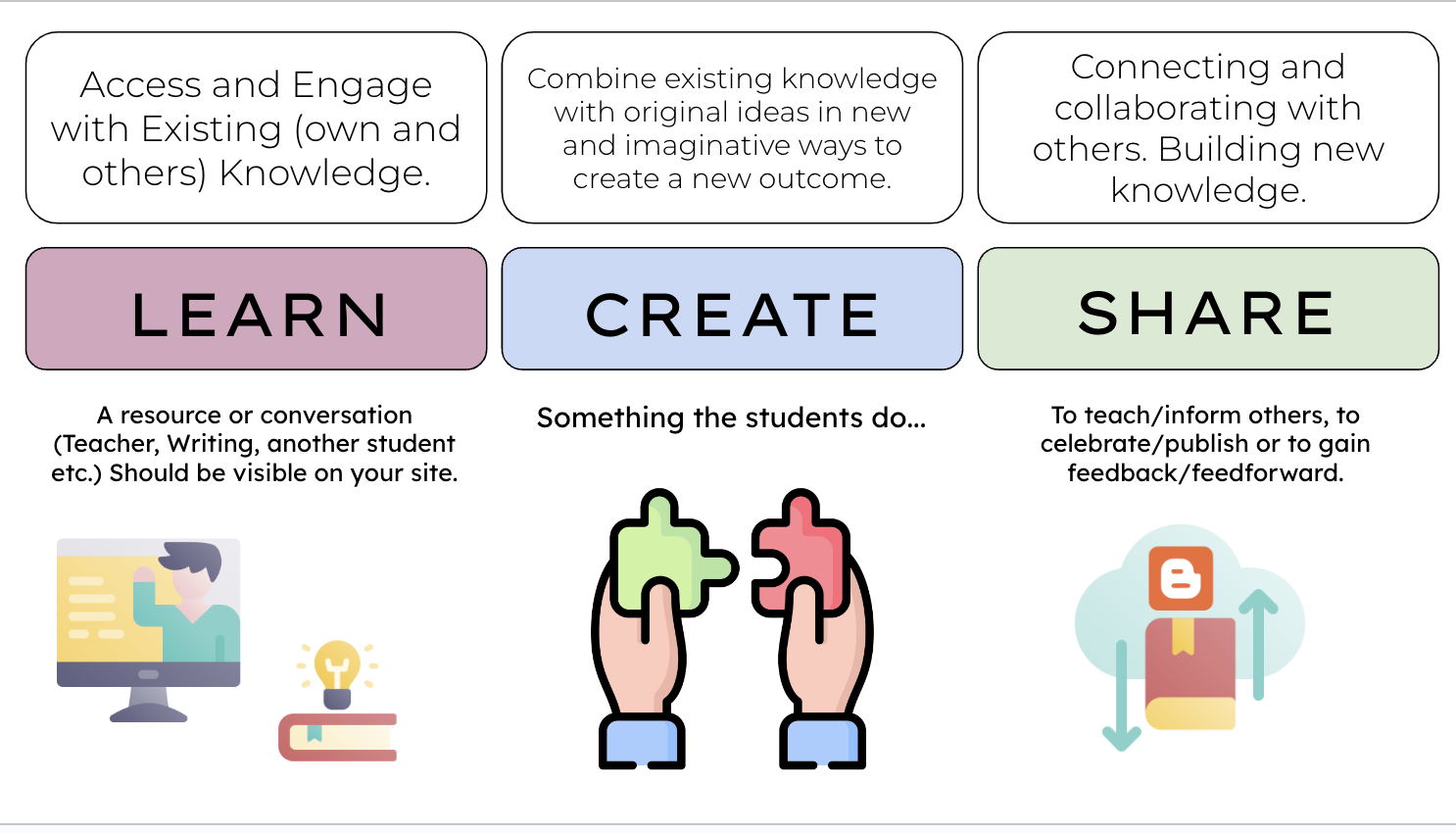
There is the Manaiakalani Schools network whose kaupapa is 'learn create share', a kaupapa that tries to build student creative and critical thinking into their learning, all amplified with the affordances of digital technology.

Their vision of create' looks like this:


There's Kane Stewart's 'Egg Academy'

What about the Ōtautahi Christchurch Young Writers' school? Around and growing young writers' talents since1993

Our Ōtautahi Christchurch city libraries network offers plenty of opportunity to develop creative thinking and creative skills with holiday and after school programmes. The Ōtautahi Christchurch central library, Tūranga, and the network of suburban hubs being redeveloped, contain facilities that support creativity.


 Their support for creativity looks impressive. When I see a sign like this, I get kind of excited.

On Level 4 of Tūranga


There are communities of creatives, like the Art Box project in Ōtautahi. In their own words:
"Our exciting art space has its origins in the series of major earthquakes that devastated central and eastern areas of Christchurch. Since 2004 this modern, air conditioned, building has been the studio of well known local artist Beverley Frost. However, seismic events caused thoughts to meander and flow. Various artists began to talk about the need for a place where a creative renaissance could flourish following the loss of so many of the city's artistic outlets. The result was Art Box, a Christchurch Gallery where modern works can be viewed in a relaxed and friendly environment."
There is the Ministry of Education 'Creatives in Schools' programme. As Tumuaki of Hornby High School I had the privilege of working with Dr Claire Hughes on such a programme (well two, actually, over two years). The engagement with rangatahi was phenomenal, Claire a prodigious and inspiring talent.

As I said, there are lots of these activities, and with the exception of a city's library network, they are most often small ventures, often just one or two people, making a difference at that point in time with a small group of their fellow human beings.

My wondering is are they having sufficient impact? If not, is this a matter of scale? OR even if they can be scaled sufficiently to have any significant impact? In fact, are such things scaleable at all, or the idea of scaleable creative activities in itself an oxymoron?? If anyone could scale these, you'd think it would be a city's library network. 

And of course a lot has been written about the impact of the commodification of art.
"Living in a capitalist society, we are forced to pit ourselves against each other in a system we have no choice but to participate in. We are coerced into adapting ourselves and our skills into fitting the role of benefitting capitalist society. And unfortunately, the art world is no exception. While the businessperson and the manufacturer are rewarded, the writer and the artist are suppressed. Unless of course, that art is commodified."
Even Marx had something to say about the role of art in the capitalist society.

Is what we have now 'as good as it gets'? Is the current paradigm of the arts, and creativity more generally, the best we can hope for? Is it pointless to try and grow a whole community as a creative "collective? (Remember that I mean creativity in its broadest sense, not limited to the creative arts only, although definitely incorporating them).

Perhaps the best answer lies in collective action. Maybe it's a bit of the old gestalt psychology - the whole is more than the sum of the parts. If we bring the enormously diverse community ever closer together, we amplify the impact of each organisation. I've quoted Peter Korotkin before. And of course this beautiful whakataukī:

Nāu te rourou, nāku te rourou, ka ora ai te iwi
With your food basket and my food basket the people will thrive

What I do believe is that the mahi of an organisation like Ako Ōtautahi - Learning City Christchurch is essential. Someone needs to bring the diverse community together. 'Learning Days' is one of those things that might just start to make a difference.

Watch out for Learning Days 2024. This is such a promising initiative that might just scale this whole learning city/creative city thing.\

Thursday, 12 October 2023

Some tangible steps towards more creative schools

I continue to have an abiding interest in what leadership might need to look like if we are to build and sustain kura that nurture and grow more creative young people for our society. I need no further convincing of the 'why'. Many of the arguments are well summarised in the paper I've cited before - 'Replanting creativity during post normal times" (https://www.teritotoi.org/wp-content/uploads/2021/03/Replanting-Creativity-during-post-normal-times_FINAL-2021.pdf)

Susnea and Tataro give us an economic 'why':

"By comparing the Forbes list of most powerful brands (http://www.forbes.com/powerful-brands/list/ ), and the list of most innovative companies according to Boston Consulting Group (http://www.forbes.com/sites/susanadams/2013/09/27/is- apple-the-worlds-most-innovative-company-still/), as shown in Table 1, two things become obvious: first that there is a strong correlation between the capacity of the companies to generate (and absorb) innovation, and their economic power, and on the other hand, that there is a large disparity between the USA and the rest of the world in this direction.This conclusion is almost a literal transcription of an idea formulated 10 years ago by Hargreaves7: ìwe live in a knowledge economy, a knowledge society. Knowledge economies are stimulated and driven by creativity and ingenuity. Knowledge society schools have to create these qualities, otherwise their people and their nations will be left behind."

And it's worth reminding ourselves of what we mean by creativity, and also how it differs from innovation.

"Creativity is typically centered around original thought and knowledge, which unleashes potential and is an integral part of idea generation. Innovation, on the other hand, is used to turn the creative idea that you come up with into a viable solution." (https://online.stanford.edu/creativity-and-innovation-management, accessed 12.10.2023)

In an article by James C. Kaufman & Ronald A. Beghetto (2013) I came across this framework which helps to unpack this very large idea.

Kaufman & Beghetto 

Susnea and Tataru make the point that creative thinking and the development of creativity require deep knowledge, or subject knowledge, with their enhanced model of creativity in education.


Susnea & Tataru


This all connects really nicely with the Manaiakalani 'Learn Create Share' pedagogy. 


For students in the Manaiakalani kura generally, much of their 'create' will be what Kaufman and Beghetto call 'Mini-c'. It also reinforces the point that creativity (regardless of the level) happens when we also have rich knowledge and skills. 

But I think this begs the question of whether or not you can teach for creativity, or what kaiako might be doing if they are to sustain creative growth and creative thinking for our rangatahi.

Susnea and Tataru begin their piece with the fairly definitive statement that it most definitely can: 

"Thus, creativity training appears beneficial for a variety of people, not just elementary school students or the unusually gifted. Taken as a whole, these observations lead to a relatively unambiguous conclusion: Creativity training works." 

They list the following inhibitors to creativity in schools:
"In summary, the main factors that act as inhibitors of creativity in the educational process are (see also Cachia, and Craft):
· The prescriptive environment of the school;
· The curriculum oriented towards quantity rather than quality of the information;
· The lack of consensus regarding the definition and the model of mental processes
associated with creativity;
· A certain confusion of values: teachers frequently perceive some behaviours or
personality traits specific to creative students (e.g. stubbornness, hyperactivity,
argumentiveness, and independence) as misbehaviors.
· Teachers are not trained to foster creativity of students: though most of them claim they encourage students to be creative, they simply donít know how to do this;
· The lack of quality educational content for teaching creativity. Teachers and students are equally in need of such materials;
· The lack of simple and easy to use instruments for the assessment of creativity;
· The lack of IT&C tools to support teaching for creativity."

They also identify factors in the environment that could promote creativity.

"Davies et al. count the following positive factors:
· Flexible use of time and space;
· availability of appropriate materials;
· working outside the classroom/school;
· playful or games-bases approaches with a degree of learner autonomy;
· respectful relationships between teachers and learners;
· opportunities for peer collaboration;
· partnerships with outside agencies;
· awareness of learners needs, and non-prescriptive planning.
Other researchers indicate a variety of other factors that can influence creativity in
school:
· Moods and emotions ;
· Pattern recognition and visual thinking;
· Organizational and institutional influences;
· Teamwork;
· Some cultural factors;
· The ability to use certain heuristics, e.g. TRIZ.
And, last but not least, an essential factor that could dramatically impact the future of teaching for creativity is the use of ICT in education (Ala-Mutka, Loveless, Jahnke, Roschelle, Thompson). "

 They conclude with a list of possible actions that we might take:

"By analyzing the factors that influence in both positive and negative directions the education for creativity, the following action directions for fostering creativity through education become obvious:
  • Eliminate the factors that inhibit creativity. The responsibility for this lies with the decision makers at the European, national, and organizational level, and to a certain degree with the teachers, who should contribute to the creation of a less-prescriptive educational environment. In this category of measures, we count: the reform of the curriculum, defining and promoting a respectable social status for the teachers, which includes decent salarization, increasing the autonomy of the public schools, etc.
  • Attract teachers in CPD (Continuous Professional Development ) courses to help them understand the psychological mechanisms involved in creativity.

  • Develop educational content specially aimed for the education for creativity. This includes both courses for teachers, and specific courses for students designed to improve their creative thinking skills, and help them acquire certain specific heuristics.

  • Develop solutions based on IT&C to promote creative problem solving in education.

  • Develop simple and easy to use IT&C tools for the assessment of creativity.

    Ala-Mutka et al33. extend the responsibility from teachers to policymakers, researchers, and other practitioners, who should engage in developing a common vision of future learning for innovation, as a tool to guide their joint effort. "

Ala-Mutka, Punie, and Redecker, in their 2008 paper primarily focussed on helping learners to understand when it's right to be creative, and when it's not, also make this point:

"Support innovative organizations
• Open and networked institutions. Policies should encourage institutions to embrace the networking opportunities available. By opening their learning materials (open educational resources), institutions can attract learners and also support informal learning outside institutions. Networking between institutions can enrich the curricula provided for students and transfer subject-related knowledge between practitioners. Institutions should promote collaborative networks between teachers, researchers, and professional networks, in order to support the emergence and sharing of learning innovations."
Innovation is to be embraced and supported, so if we can network organisations, and build communities of shared practice, we are more likely to see greater student success, and enhanced creativity. That odes assume however that those communities are able to build environments that all (whether principals or front line teachers) feel safe, feel valued, in sharing their practice.

The Manaiakalani pedagogy and kaupapa is an independent piece of work that addresses several of these suggestions.

The pedagogy leans heavily on a strong ICT base in order to 'magnify' the impact of the pedagogy. Significant resources are put into the support of 'Education Programme Leaders' for each cluster, the job of whom is to up skill teachers in both the pedagogy and ICT skills generally. In that work is included the enhancement of teacher understanding of the drivers behind creativity. EPLs generally run one staff meeting a term in each participating kura, the focus shifting term by term between learn, create, and share. (It should be noted that once a cluster has moved on from the initial 'Outreach' programme, it has to fund the funding itself to employ its EPL, a significant drain on resources, and one often met with the support of a local Trust that seeks the necessary funding. The trustees that do this mahi are indeed heroes!).

At the time that I stepped back from Principalship, the Manaiakalani Education Trust was leading work to build effective and sustainable teacher practice in the teaching of reading and maths, with the appointment of well qualified leads in both of these areas. This work supplements the work that has already taken place to build good writing practice, work that sees learners in Manaiakalani schools make progress in their writing at twice national averages (when those students had been in the Manaiakalani environment for three or more years). The fact that teachers are generally deficient in much of this speaks to the work that does (or doesn't) go on in initial teacher education.

All of the Manaiakalani kaupapa is driven by a commitment to shared practice, to identifying what works and spreading the word. Whether it be 'Class on Air', or the Manaiakalani Innovative Teacher programme, their colective;ly developed and implemented Cybersmart programme or the Digital Fluency Intensive, the work of those involved ticks so many of the boxes that could enhance creativity for learners in our kura.

And.. ALL of this requires consistent, committed, focussed, leadership from Principals, leadership that is unrelenting in its messaging, unrelenting in that focus on creativity, leadership and everything that is required to see it through.

This still leaves the issue of curriculum reform, and I am not convinced that our reform in Aotearoa meets these needs. It does well to ensure kaupapa Māori is increasingly embedded, as is the teaching of New Zealand histories. A shift to the political right will in my opinion further remove us from the necessary focus on creativity, with it's nineteenth century view that 'an hour a day of reading, writing, and 'rithmetic;' will solve all of our educational woes. That doesn't mean I think these things are unimportant. It is an insult to teachers to suggest that such practices don't already go on. It does in my opinion presage a return to a system that privileged pakeha middle and upper class learners, thus depriving us as a society of so much richness and talent that, by virtue of race, culture, and impoverished means, is condemned to lie undiscovered, undeveloped. Our society is the poorer for this.


References

Kirsti Ala-Mutka, Yves Punie, and Christine Redecker (2008) "ICT for Learning, Innovation and Creativity" Policy Brief for European Commission Joint Research Centre, Institute for Prospective Technological Studies

James C. Kaufman & Ronald A. Beghetto (2013) "In Praise of Clark Kent: Creative Metacognition and the Importance of Teaching Kids When (Not) to Be Creative", Roeper Review, 35:3, 155-165, DOI: 10.1080/ 02783193.2013.799413

Ioan Susnea and Alexandru Tataru (2014) "Fostering Creativity Through Education: Key Factors, And Action Directions", Research and Science Today No. 1(7)/2014

'Manaiakalani 2023' https://www.manaiakalani.org/home last accessed 13.10.2023

Thursday, 18 May 2023

Experiencing our world as 'visual white noise'

We are daily surrounded by a material world that 'someone' had to create. We daily experience the results of the creativity of others, and much of this in our daily lived experience we take for granted. We pass these things all the time, but pay them no mind at all.

Last night I joined a group of friends and former colleagues for a meal (Quartz Restaurant, Rolleston), and my attention was caught by these quite overt examples of creativity that I suspect, for almost all diners, are simply visual 'background noise', perhaps we could describe these things as the material world equivalent of 'white noise'. (I would add that there is no judgement on the quality of these pieces, merely on their presence).


This morning I sat in the waiting area of my doctor's surgery. I was making an effort NOT to look at my phone but rather to notice the world around me, and my eye was caught by these lovely shapes.


These are all examples of some act of creativity from someone, somewhere, some time. It struck me that these things merge into a world of 'visual white noise' unless we are deliberate and intentional in 'noticing' them, in really looking at the world around us.

Now I was not trained in the visual arts. I was trained into the world of economics, the 'dismal science', a world with which I fell out of love some years ago. 

You may have heard some of the jokes about economists:

"Did you know that economists have successfully predicted 5 of the last 3 recessions?"

or ..

"If you put all of the economists in the world end to end, they still wouldn't reach a conclusion."

It's not a profession with which one normally associates 'noticing', even though it bases its understandings on large volumes of statistical data and creatively imagined theoretical models. It's just a shame that the two don't coincide more often.

In contrast, my very incomplete understanding of the teaching of the creative arts involves cultivating the deliberate and intentional 'noticing', the observation, of the world around us. I believe this to be true of the poetry that I try to write, based as it so often is on the 'noticing' of emotion, or people, or events.

Elwyn Richardson made direct reference to this, when he encouraged the children in his care to observe the world, and to capture what they saw, whether in clay, on paper, or in movement. In his book 'In the early world', he says:

"A great deal of the school work was directed towards establishing attitudes of awareness in the children. Thus in art and poetry we had come to see that accuracy was an important part of the work and that it was closely linked with the individual's awareness of his environment. .... Some were observers of nature and showed a keener observation of scientific detail; others had a feeling for space relationships and noticed, for example, that a bird can fly within the bare branches of a winter tree. I think this awareness is also the basis of learning processes such as those found in arithmetic and spelling." (Richardson, Pge 125)

I think it is one of the benefits of learning in the 'arts' generally that we learn to notice, to observe, to see (or hear, or feel) the detail, or more generally to simply 'see'. I have become an advocate for arts education because it supports the development of such skills which are then transferable to whatever other area of learning we care to name: sciences, mathematics, technology... etc

Perhaps more particularly though, a broader arts education allows us to better appreciate the world in which we live, to appreciate beauty, cleverness, and problem solving, to appreciate creativity, rather than walk 'zombie like' through our lives experiencing our world as 'visual white noise'. Perhaps this is one of the secrets behind the impact of creativity on our wellbeing.

Thursday, 4 May 2023

Creative synergies, creative cities, that 'learn, create, share'

I'm a bit of a dreamer, eh. At the mere thought of an idea, my mind's off out into space, to look back at what could be. Does anyone remember when the City Council used the phrase 'a city of possibility' as it's marketing phrase? I love the idea of 'possibility'. And I love the idea of system change. I love Ewan MacIntosh's concept of the BHAG, the Big Hairy Audacious Goal. (As Steve W would say of me, I have a tendency to try to boil the ocean, and as a consequence I then need around me people who can say 'righto, jolly good Robin, now sit down and have a cup of tea, and let's look at what we can actually achieve').

Over the past seven years I've been involved as Tumuaki of Hornby High School, and in to The Manaiakalani Programme (TMP) boots and all. The programme is a pedagogically driven one, employing the pedagogy 'learn, create, share'. The impact of the pedagogy is 'amplified' through the application of digital technologies and devices. I've written extensively on this blog about the significance of creativity at the heart of the pedagogy, and worked assiduously to make creativity the centre of the kura itself.

I have over that time been a Board member of the Greater Christchurch Schools Network (GCSN) trust board, an organisation committed to bridging the digital divide in Ōtautahi Christchurch. This has amongst other things involved mahi to support the most vulnerable in Ōtautahi with digital connection, and devices, and also to the building of technological skills and capability with young people whānau, and schools.

I have also been involved in a minor capacity with the work of Dr Cheryl Doig and Ako Ōtautahi - Learning City Christchurch (AO-LCC), an organisation that "champions learning as a way to transform lives, communities, organisations and cities". AO-LCC works proactively with other organisations focussed on digital equity - DECA and DEAA for example. My own involvement has just 'ramped up' as I have accepted a role as a Trustee with AO-LCC. 

Having stepped back from Principalship I find myself able to take the time to think about these 'organisations' and their kaupapa in ways that I wanted to do before, but for which I rarely found the mental resources. I tried to capture their relative roles in this diagram. 


This doesn't capture the full breadth and complexity of what they each do, just some key points. You can check out their web sites to gather a full and complete view. The intersection of the mahi of all three is the aspiration to improve digital equity for those most vulnerable in our communities.

With the time for some uninterrupted thinking, it occurred to me that there is much much more to this. The heart of the matter for all three organisations is the promotion of better more fulfilling lives created by better learning. I wondered then if the unspoken ingredient of the work of all three organisations is creativity. It may be more or less explicit, maybe more or less overt, for each organisation, but I think it's right in there. I wonder if it looks like this:


There is much that has been written about 'creative cities', a concept that does appear to have progressed from the initial conceptions focussed on cultural creative industries, to the wider focus on creativity and innovation in all that we do. Charles Landry wrote about this in his piece 'Lineages of the Creative City'. 1 
Landy says: 

"The creativity of the creative city is about lateral and horizontal thinking, the capacity to see parts and the whole simultaneously as well as the woods and the trees at once." (Landy, Pge 13). There is a growing literature around this concept. A search in GoogleScholar on 4 May 2023 yielded 4,890,000 hits.... <gulp>

That sounds familiar..  at Hornby High School I wanted to try to take creativity beyond the traditional creative and performing arts, and technologies. We saw it explicitly in maths last year, for example. 

The wellbeing benefits of including creativity in our lives and our learning are also well covered, in particular with the work in Aotearoa New Zealand by Professor Peter O'Connor (University of Auckland). In the 2020 paper 'Replanting creativity in post normal times' 2  (worth quoting at length) he said:

"Increased interest in the relationship between arts, health and well-being has resulted in the emergence of a distinct field of practice over the last 60 years. The term, arts for health and wellbeing, is now used internationally as an umbrella for a diverse, interdisciplinary field of activity which draws from arts, health, psychology, education, community and youth development practices and theories. Growth of the field has been so rapid that when charting the rise of arts in community health practice in the UK, Mike White (2016) described the arts for health movement broadly as a “small-scale global phenomenon” (p. 41)." (O'Connor Page 18)

What ties these ideas together?  I am wondering if it is the 'learn, create, share' pedagogy? Here is a simple explanation of how these three words are interpreted within the school context.


Would these three words, explained in this way, grab more attention, open up more opportunities, increase engagement, across the incredibly diverse communities that are cities? Would this make the AO-LCC message easier to sell? 

Cities generally, and ours specifically, already have many wonderful learning opportunities. We have great pre-schools and schools, multiple universities, Polytechnics and research establishments, a multitude of private training establishments, a vibrant civic library service and a wonderful creative sector. We have many 'creatives' resident in 'our place'. 

Is the key to bring them all together under one banner (AO-LCC, for example), the opportunities unpacked using the Manaiakalani kaupapa?  I don't mean the occasional one page advertisement in the city newspapers (to coin a very old fashioned phrase). I mean something vibrant, ongoing, consistent and coherent, something that is regular, overt, and helpful

Is the issue less about what opportunities there are, than about promoting their coherence for the population at large? If we had more people learning, creating, sharing, would we then be able to shift more overtly to be a 'creative city'? Here's the thing: I genuinely believe we KNOW how to do this stuff, the knowledge, the awareness, the capability, are 'already in the room'. We need to 'own' this fact, we need to network, to magnify our impact. There are quite a number of 'connectors' or networkers already in the city (and I don't mean business networkers whose aim is enhanced private profit). People like Cheryl Doig and Vicki Buck, Steve Wakefield and .. goodness me.. that would be a very long list. You get the idea.

What could it look like if we thought about this across a whole city, a 'learning City', a city where the digital divide has been reduced significantly? Maybe then we would be a city of possibility? Or, as AO-LCC has pitched its 'Learning Days' this year ... a city of curiosity?

**************

1. 'Lineages of the Creative City', Charles Landry , http://charleslandry.com/panel/wp-content/uploads/downloads/2013/03/Lineages-of-the-Creative-City.pdf , last accessed 4 May 2023. 

2. 'Replanting creativity in post normal times', Peter O’Connor (Director, Centre for Arts and Social Transformation), Professor Michael Anderson, Associate Professors Kelly Freebody and Paul Ginns, The University of Sydney, October 2020 


Tuesday, 18 October 2022

Creativity, focus, engagement .. all there for everyone to see

 I have previously written on the idea that you get what you constantly think about. Similarly you see what you constantly look for. Today I wandered through our tech and arts spaces, simply wandering as I love to do. It keeps me connected, chatting with students and staff, and looking at the awesome mahi they are doing. These photos were typical of what I saw. Now you can argue that this is what you'd expect to see in these spaces, and I hope that's true.  It was reassuring to see it, the absolute evidence of creative endeavour, but also to see the level of engagement of the students. The students in the photos below were absolutely typical of what I saw everywhere I walked, as is almost always the case.


Product of a 'wearable arts' unit

Similarly 'wearable arts'

Senior students focussed on their visual arts portfolios

Virtual reality and world creation, with our awesome 'Creatives in Schools' teacher Dr Claire Hughes

I've also written before that technical knowledge and skill are an essential precursor to creativity. You have to 'know' stuff before you can engage in higher order thinking, before you can be creative .. here some trigonometry in the engineering workshop. In the 'real world' knowledge isn't silo'd. Bodies of knowledge 'integrate'.

Senior 'Design and Visual Communication' students are required to build architectural models of their designs. Here those models can be seen in development, where the technology of laser cutting has been integrated to give 3D rendering to the design work.


A technology project developed in conjunction with Josh and the ChCh City Libraries team, in which students are designing and building a 60's arcade game and machine (with some funding from GCSN - Greater Christchurch Schools Network .. many thanks GCSN)

The outputs and outcomes for these students are of a very high quality. That's what you get when you focus on creativity. That's what the research evidence says. When students are required to 'create', they are giving form to their learning, they are reinforcing their learning, and by sharing their end products they create the classic design thinking feedback loop that accelerates learning and achievement. This is the very stuff of our Manaiakalani kaupapa, or our 'Learn Create Share' pedagogy. It's also a core tenet of the UDL (Universal design for Learning) framework.

It's not that this stuff doesn't happen elsewhere. It's not that it can't happen elsewhere. It's just that when you make the creativity explicit, when you more deliberate and intentional about using creativity as a 'lever' that you can pull to support learning, you are much more likely to get these outcomes, you are much more likely to get agentic learners, learners who are engaged, learners who are learning!!! 

It's what you get when you have a simple vision grounded in the research on the impact of creativity in education, and it's what you get when you have a dedicated committed staff who understand and share the vision. 'He puna auaha a centre of creative excellence' has power and impact in education.

Creativity, focus and engagement .. all there for everyone to see.


Wednesday, 19 January 2022

Flirting with creativity

I've spent some time over the summer break thinking about creativity, and practising one manifestation of creativity that works for me. I have several reasons for thinking a lot about creativity in our educational mahi.

  1. Our manaiakalani pedagogy 'Learn Create Share' puts creativity at its centre. It reflects the re-imaging of knowledge that Jane Gilbert wrote of in the early 2000s in her book 'Catching the Knowledge wave' in which she theorised that in the 21st century we need to redefine knowledge as not only knowing stuff, but being able to 'do something with that stuff', that is, to create. In our Manaiakalani kaupapa the act of creation doesn't;'t mean creating something new to humanity, but rather something new to the learner, creating a new understanding, a new product that uses the 'stuff' that the learner now knows.
  2. As technology, and artificial intelligence, increasingly replace people in mundane tasks, I find us left with the basic question: what then is the purpose of education? What matters, if AI can replace much that was a mainstay of the 19th and 20th century workforce? To which my answer is empathy and relationships, and creativity (although eve this latter is being challenged by AI!!)
  3. There is some fantastic research coming our of University of Auckland, via Professor Peter O'Connor and his team, on the impact of creativity on wellbeing.
Some of this this thinking lead me to lead the re-imagine our Hornby High School vision as 'a centre of creative excellence". A vision isn't a statement of what we are, nor is it (probably) a statement of what we will ever become. However it is a statement of aspiration, and as such it helps to guide us in what we choose to deliberately and intentionally do to support the growth of our rangatahi to be functioning and contributing members of a caring and empathetic society.

An aspirational vision also gives staff and students some sense of what we, of what they, could be. There is nothing more powerful than an idea whose time has come, and when one of our head students in 2021 made direct reference to how this vision has impacted his educational journey at HHS and inspired him I felt vindicated that we had chosen a powerful idea on which to focus. A vision is there to inspire people, to motivate them, and we ignore such forces at our peril.

None of this of course detracts from the need for quality teaching, for powerful and focussed direct instruction, for engaging cross curriculum work and activity that engage the learner. ALL of that goes without saying.. although I fear we need to say it loud and often because for some it is not as obvious as it ought to be.

For each of us creativity will look very different. It may mean creating a painting or a poem, but equally it may mean restoring an old car (or something else), it may mean solving an IT problem, building a bookcase, creating or cooking a new recipe, or finding a new way to defeat an opponent in an on-line game, or... you see what I mean.

At the moment one of my creative outlets (amongst several) is writing 'free verse' poetry. I've done quite a bit of writing in my time, including four successful text and work books which were published in the early 2000s. I also like to do some creative writing. This free verse poetry is a relatively recent thing. 

Now what fascinates me about ALL of this is the creative process.. what is it that drives the human brain in its creative work, where do ideas come from etc.  I have no doubt that neuroscientists will be able to explain much of that to me. I am mostly interested in my own experiences of it, and while trying to crystallise a fleeting idea for a poem yesterday, something. totally different just dropped into my head, on this very subject of creativity.


I still haven't 'captured' that other idea, by the way. It is still lurking like that dark dark shadow.

Thursday, 23 December 2021

The education 'lineout'

A headline last week left this mental image in my head: a rugby player, on the sideline, throwing the ball in to a line out. The player on the sideline was John Luxton, and the players in the line out were all politicians, mostly from the right. The 'ball' being thrown had the word 'education' written on it in childish crayon handwriting.

Source: https://www.shutterstock.com/editorial/image-editorial/jamie-george-saracens-throws-ball-into-lineout-10010888o


The words 'here we go again' have kept going round and round in my head. Of course our politicians know exactly what is wrong with our education system, and of course they know exactly how to fix it, in the same way that our local plumber knows how to do the heart valve bypass that a whānau member of mine will need in the next year or two.

Am I sceptical? Yes. Am I more than a little concerned? Damned right, I am. I suspect that a part of the answer will include .. yes, you guessed it.. 'more testing'. What annoys me is that no-one thinks to ask teachers how to improve education once it gets thrown into the political scrum. No-one thinks to look at the weight of evidence that is the 'teachers' 'front row' before suggesting improvements, once education gets thrown into the political scrum.

Yet as a profession we can tell you pretty much all of what is required, and perhaps unsurprisingly there are dissimilarities between what we would say. and what policy makers might suggest. Similarly there will likely be significant differences between what we would say and what the right wing neo liberals would suggest. Their solutions often involve greater choice for whānau. Sadly this in itself is based on.a flawed market model, flawed because it is based on a series of totally unrealistic assumptions like perfect knowledge, and consumer sovereignty.

You see, few educators would try to tell you that we have it right. However lots of educators can point you in the direction of the right answers. Take for example the current poor reading and numeracy outcomes for our learners. Solving this problem is not rocket science. Professor Stuart McNaughton (the PM;s education advisor), in his recent paper on reading, clearly points out that one of the biggest issues on reading in Aotearoa is that there is no systematic and universal approach to teaching reading. The conclusion must be that a good solution would be to adopt a universal approach to teaching reading. Even in this there is no one solution. There seem to be two sides to that argument, both flawed because they assume that the solution is a binary one. The answer isn't EITHER A and B. The loud voices seem incapable fo believing that the answer might actually be a little of A AND a little of B. Similarly with mathematics. Reflection on my own past is depressing when I think that I cam to teaching out of Initial teacher Education with NO (yes that's right ZERO) preparation for h[w to support literacy for learners!!!

The right wing desire to go back to what we have done in the past is another way of condemning the most vulnerable in our society to continuing failure. Our tail of underachievement is largely those of Pasifika and Māori origin, and those on low incomes. This is the result of what we have done over the past, whether it be silo'd subject teaching in secondary schools, or high stakes testing, or the belief that whānau choice will support successful schools and eliminate ineffective ones (educational Darwinism). Those schools that many think are 'successful' are those higher decile schools in which children start life with so many advantages. The success of those children has less to do with the school than with that comparative wealth of households. In this regard, the impact of the Manaiakalani pedagogy in those lower decile schools shows that we CAN make a difference, a big difference, for those children from poorer homes. 

Perhaps the biggest problem is that as a profession we allow ourselves to be taken in by the 'latest shiny thing', without stopping to think about the usefulness, the efficacy, of what we already do.

So .. what would my 'reckons' be (based on the weight of evidence, which is too vast to try to summarise in a simple pre-Christmas post like this) on what we need? Try these:

  1. Develop and adopt universal approaches to teaching reading and mathematics. Resource roll out, and insist that these approaches are used. Too many teachers think they know better, with views that are nothing more than 'myth'.
  2. Support the roll out of the Manaiakalani pedagogy across all lower decile schools (for those that wish)
  3. Deliberately and intentionally support and embed creative and critical thinking (and creativity more generakly.. go back to those wonderful programme Beeby programmes of the 60s) across schools, especially in initial teacher education
  4. Reform initial teacher education so that it supports strong behaviour management skills, and the entree into those universal approaches to teaching literacy and numeracy for ALL teachers (not just primary trained teachers). We already know how to do this, just take a look at the NZ Graduate School of Education model.. it WORKS!!!
  5. Reform the funding and staffing models for all schools so that they support the demands of 21st century schooling, nit 19th century schooling.
  6. STOP politicising education.. we are NOT your political football with which to capture the votes of the right wing, we are our children's futures, our nation';s future.


Well, that's all I want for Christmas.. is it too much to ask? Sadly, yes..