Showing posts with label project based learning. Show all posts

Thursday, 1 December 2022

Is creativity hard wired?

Our most fundamental survival instinct is fight or flight. Within that context I am going to make a bold, uninformed claim: all human beings are hard wired to be creative. Why? Our very survival over the millenia has come down to our ability to flee from or to confront those existential dangers, those things that threaten our survival,  to our ability to creatively solve problems. 

If that contention is correct (it seems reasonable, but how often have things that seemed reasonable subsequently been shown to be utter tosh?) then for kura I would have thought a big question continues to be 'how do we nurture, feed, encourage, inspire, that creativity in every one of our students?'. I would have thought that we WOULD want to, since our students are the future, if I may use a well and truly hackneyed/over used cliche.

A stroll through our creative spaces, Te Pai Tūhura, gave me the opportunity to 'feast my eyes' on some gobsmackingly good mahi, the result of good teaching, combined with of all of those processes of engagement, of the opportunity work in good facilities, from our senior DVC (Design and Visual Communications) students.


Students created 3D virtual fly throughs of their projects


Our DVC teacher Oscar Richardson (a trained architect in a previous life) tells me this is effectively Stage 1 Architecture School work.... high praise indeed.  This is creative work, this is excellent work, this is a fabulous example of 'creative excellence'. To produce work like this also requires students and staff to have a good values foundation, and this work certainly demonstrates our values of commitment, achievement, resilience, and respect.

This stuff doesn't happen by accident. This stuff doesn't 'just happen'. It happens because we hold high expectations of all of our learners, it happens because we have good teaching taking place in good facilities. It happens because we are committed to Mana Orite, the need for equity for all learners regardless of background.

It also happens because we have clarity of vision about what we are 'about' as a kura, and because we have clarity around our foundational pedagogy 'Learn, Create, Share', which captures the centrality of creativity to learning, and implicitly to equity and wellbeing. 

Three words keep ringing in my head, three words that simply won't go away: clarity, coherence, and persistence, and I think that accurately describes a significant part of what good leadership looks like. Our staff know the story.. 'stay on the bus', as per the 'Helsinki bus theory.


Is creativity 'hard wired' into us as a survival instinct? I have noiidea, but it is an idea that appeals eh!!

Wednesday, 27 July 2022

Creative connected curriculum and culture

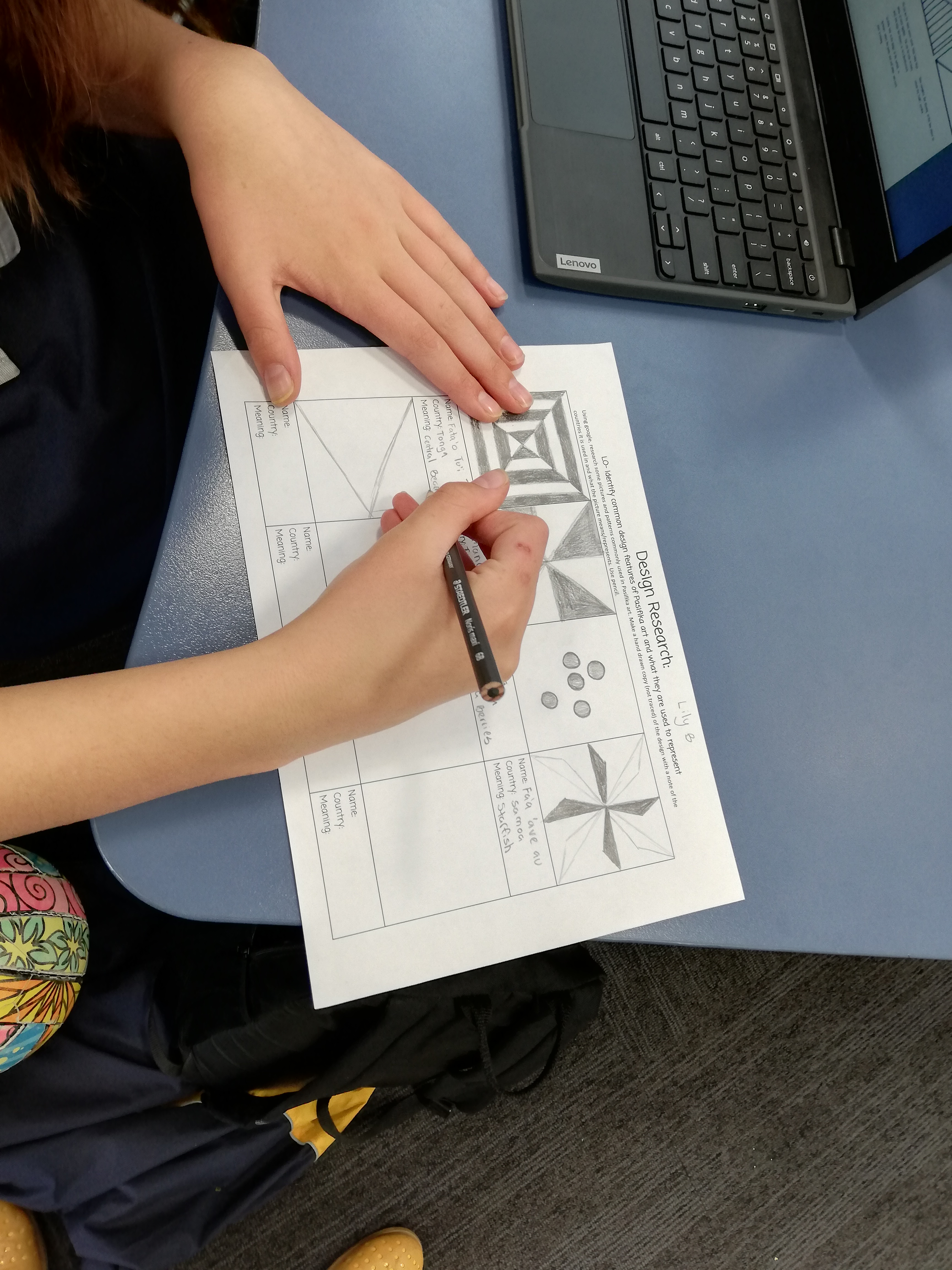
Towards the end of 2021 a group of Year 9 students worked on a Pasifika Art unit from our Creative Connected Curriculum. The 28 students in this group researched patterns and designs from Pasifika cultures before designing one of their own and painting it onto our class tapa cloth.

We were recently able to have the work 'framed' and put on display in Te Pae Rewa. It's a beautiful piece of work reflecting culture and belonging, and 'creative excellence', and an outstanding example of 'Create' from our 'Learn Create Share' pedagogy, made so delightfully explicit with our Manaiakalani kaupapa.

This is a bit of a short photo study showing some of the work that went into the development of the imagery, and the final product.


The completed work, with many of the students who contributed to its completion.

The completed work on display in Te Pae Rewa


Thursday, 11 November 2021

Deep knowledge, collaboration, and creativity

In conversation with a long time friend, we turned to education. To put some perspective on this, he is a recently retired university professor, currently holding the title 'Emeritus Professor,' someone who began life as a secondary teacher before progressing into doctoral study. He has lots of experience at the 'pointy end' of our sector in both secondary and tertiary teaching, study, and research. He is also NOT a 'boring old **', NOT one of those reactionary 'things were better in my day' people - refreshing, to say the least.

The kōrero got around to the issue of research, and how high level research, at doctoral level and beyond especially, often involves multiple perspectives that are brought to bear through collaboration, and how this is often a case of making connections between existing ideas, of creating new understanding by synthesising what we already know. He had a wonderful example of how a fresh water ecologist and a geneticist had combined their expertise to develop a method of DNA testing of fresh water stream water using DNA testing to build a picture of the biodiversity of life in fresh water. All of this requires what I was initially going to describe as 'expert subject knowledge', but I think I actually mean 'deep subject knowledge'. Our world seems to me to be filled with too may self proclaimed 'experts' who in fact operate from a very shallow knowledge base.

As he described some of his work, my mind fired off in all sorts of directions. The first is the importance of subject knowledge. One of the criticisms I still hear of NCEA is that it not longer values content knowledge (and by default that we as a teaching profession no longer value knowledge). For the record let me restate my position: NCEA focuses on thinking. However you can't think in a vacuum. So to teach deeper thinking you have to build knowledge. I suggest that the deeper the knowledge you can develop, the deeper the thinking you can attempt. However for that to happen teachers have to be 'deliberate and intentional' in teaching for both the deeper knowledge AND the deeper thinking. This is one of the reasons that in our Manaiakalani clusters across Aotearoa we share our mahi around the development of critical literacy skills, regardless of the age and stage of our learners.

If we refer back to Professor Peter O'Connor's Creative Schools Index, one of the eleven dimensions of the index is "Discipline knowledge: To develop expertise in a domain of knowledge that involves specialised content and process understandings." I've written about this idea before here.

But another idea struck me: how could we better leverage off the differing levels of 'deeper knowledge' that our kaiako, and our students, each have in order to build creativity, or 'creative capacity', in our learners? Here are some of my 'wonderings' (I'm still trying to decide if I love or hate that word!!) on the question.

Perhaps first and foremost this is a matter of leadership. By that I refer to leadership at all levels in our kura: the leadership of the Principal, the leadership of the teachers, and the leadership of our learners, our akonga. So, what would a Principal's leadership look like if that leadership were seeking to build collaboration amongst teachers, collaboration that might build new understandings of how to cause learning, and how to build new knowledge? What would a teacher's leadership look like as they sought to collaborate with others, and to build collaboration amongst and between akonga? And what would we be encouraging as attributes and habits amongst our akonga if we are trying to help them to understand the benefits, the power, of collaboration in their lives? 

Perhaps passion projects, project based learning, genius hour, call it what you will, is an important component, particularly where that work is undertaken in groups. Perhaps our Business and Enterprise kete is a great example because of requires students to collaborate in groups. Equally, participation in drama, in sports teams, or kapahaka, are important  and powerful ways to build the habits, the attributes, that akonga need to be able to collaborate later in their lives.

I always recall comments from Professor Eric Mazur of Harvard University in a conference address where he said (and I am paraphrasing here) that in his career to that point he had authored 84 academic papers, and not a single one of them was his work alone. Every one of them was a collaboration.

As a specific thought, it does seem to me that at the senior leadership level in secondary kura, encouraging and supporting thinking that connects traditional subject silos would do that. Encouraging new senior courses that leverage off the amazing flexibility of NCEA, where we recombine standards to create new cross-disciplinary courses, might also be an example of leadership. That thought in itself I hope will help inform an understanding of our own Hornby High School journey as we build cross curriculum courses for our learners.

And one final point: this all requires deep subject knowledge. Therefore we will still require subject specialists. We will still require the mathematics teachers, the biology teachers, the English teachers, the Te Reo teachers. It's just that their expertise needs to be layered across our curriculum and our mahi in a way that is different to what we have done for the last 150 years.

Friday, 29 October 2021

Creativity abounds.. more than just a cliche

Presumably in the beginning a cliche wasn't a cliche, but an observation of something that appeared to be true. It became a cliche because it seemed to be so true that people used it often, often as in a lot, and so it became over used, it became a cliche. Social media, and its tendency to cut every thought down to as few words as possible, has meant that a lot of our lives seems to be described in a series of cliches.

So something like 'If you do what you've always done, you'll get what you've always got', was once someone's observation of what they thought they were seeing often  in the world around them., and so thought this was a wisdom about their world. I have come to the point where there is also another way of saying this: "If you think what you've always thought, you'll do what you've always done, and you'll get what you've always got". And in our mahi to improve learning and educational outcomes for learners, this has never been truer.

In this case however there is good research data to back this up. In a Manaiakalani wānanga yesterday I was reminded (as I often am) of Hattie's meta analyses that show (amongst a huge number of profound things) that teacher expectations have a very large effect size in terms of their impact on learners.

"With an average effect size of 0.4, Hattie finds the effect size of teacher estimates of achievement is 1.62 and the effect size of collective teacher efficacy is 1.57."

Reference: https://www.k12dive.com/news/teacher-expectations-top-list-of-effects-on-student-achievement/422029/

So its effect size is even greater than that of collective teacher efficacy, which I've written about before. So it should be no surprise that when you expect creativity, that's what you get. That ought to be exactly what you expect. That ought to be exactly what you get when a kura increasingly immerses itself in the Manaiakalani pedagogy 'Learn Create Share'.

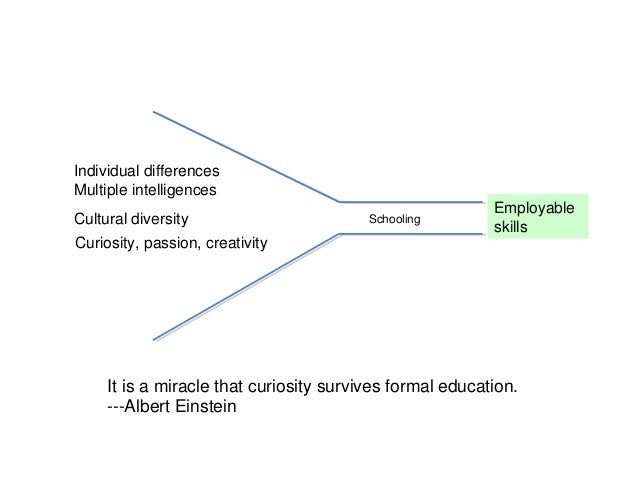
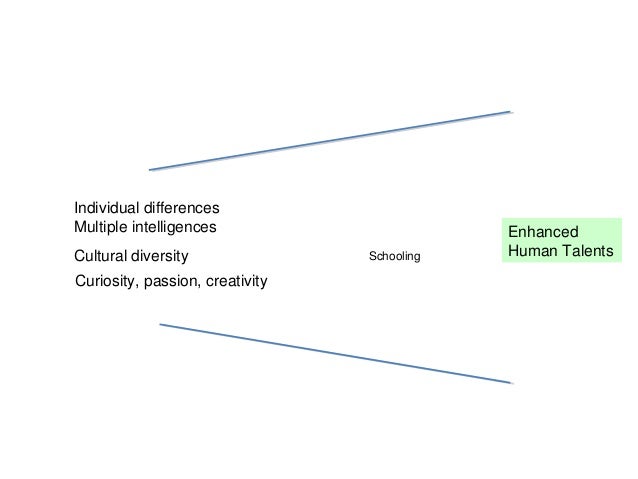
And.. lo and behold (cue dramatic music, here!!), that seems to be what I am seeing at Hornby High School.  Over this term, our Year 10 and 11 students, as a part of their wānanga time, have been engaged in personalised passion projects (PPPs). Our aim here has been to improve student engagement with their learning, to harness their inner creativity, whatever that looks like. It's time for that reminder that we don't mean creativity in only the creative arts sense (although we definitely mean that too), but creativity across all learning areas for all learners. The PPP approach in wānanga has been an illustration of us not just expecting creativity, but also putting in place those systems, structures, and routines, that are necessary to support it. It offers student agency, it offers the possibility of doing just what Yong Zhao says we should.

He suggests that at the moment we do this:


Whereas we should be doing this:

This is a notion that sits at the centre of our Kāhui Ako plan and achievement challenges.

The net result? My feeling is that creativity is flourishing. I have dipped in to Year 10 and 11 blogs and gained an interesting insight into that flourishing creativity.

Here for example is the work of Lauren and Louise who set out to create a graphic book based around a story that Lauren had written.

Or here, the work of Johanna and Genica, who crated bubble tea, and designed a cafe in Minecraft.

There's Mya who designed and created a quilted blanket in the textiles room.

Or Tamsyn who looked at drawing as a means to improving wellbeing.

There are so many more, and my sample is purely random. I just jumped around on our list and 'browsed'.

And then outside of the PPPs, Nadia of Year 12 was chosen to be a "Member of the Shakespeare Globe Centre New Zealand Young Shakespeare Company 2022 (SGCNZ YSC 2022)", for which she will travel to London.


Creativity everywhere. Is this happening by pure chance? I suspect not. It happens because we have clarity around our pedagogy, a pedagogy that places creativity at its centre. It happens when we place creativity at the centre of much of teachers' thinking, and I hope at the centre of their expectations.

You get what you expect, you see what you are looking for.. the cliches go on, but you get the meaning.


Saturday, 16 May 2020

The answer lies in pushing diversity and creativity

There is a lot to be learned from our 7 weeks of 'learning from home', and the ether is alive with speculation on what education might look like as we come out of our home learning time. There are lots of ideas and opinions out there, but the trend I think I see (one which fits with my own thinking about 'undergraduate and postgraduate' models) is that our desirable next state might be a blended environment in which students mix face to face/synchronous/relational time with online/distance/asynchronous time.

Of course what perhaps matters more than anything right now to to gather the voices of the key stakeholders or participants in this whole education thing. In common with (probably) every other kura in th country e are planning on gathering that voice, to hear what our whānau, our students, and our teachers all think. I think tis will be a largely qualitative data gathering exercise, one in hich we need to be quite deliberate and intentional in our work.

It was fantastic to receive, entirely unsolicited, this email from a Mum of one of our junior boys. It is copied here with permission, with anonymity preserved.

I am writing in regard to my concerns of XXXX returning to school.
While being home & doing the online work, I have been able to see firsthand how he works & I must say I was & wasn’t shocked.
XXXX as we know is not a fan of school (never has been) due to struggling, being overwhelmed by the work and he just doesn’t enjoy it.  Hands on work however is a difference matter entirely as we know!
I noticed with the online work he was more engaged and interested in the work.  He also got the work done.  Not completely (math’s) but he did it.
I asked XXXX how he enjoyed this work.  He replied with its more interesting for me and I also don’t have the feeling of having to get it all done in one period.
With this is mind I was wondering if there was a way that we could incorporate something similar for XXXX while at school.  Meaning he doesn’t feel the overwhelming feeling.  When he gets that he shuts down, becomes uninterested and the work & lesson is wasted on him.
..... as you know he has been like this all the way thru school and we only want him to do his best.
I will be the first to admit he could try harder at school & we have told him that.
We are concerned considering he only has a few years left at school before he can leave & it terrifies us that he will leave with not education or qualifications.
I would love to be able to discuss this with you asap as XXXX is really not interested in returning on Monday (which he will be) and already that is a wall going up.

Now, don't get me wrong. At the moment I don't think there is one single answer to how we might want our kura to evolve, but I do think there is a pretty strong mandate for some of our students at least to have greater agency in their learning. This Mum's email brought me straight back to the writing of  Young Zhao, an educator of whom I hold the highest opinion, a theorist and a pragmatist (I don't think that's a contradiction in terms?), a voice of moral and educational commonsense.

Bio

Source: http://zhaolearning.com/

In a great lecture/slide show titled "Redefining Excellence" he described our current system in this way:

#PSP2012 | Yong Zhao, "Redefining 'Excellence'"
He then went on to say that especially now in the 21st century we need to do the opposite, that we need to do this:
#PSP2012 | Yong Zhao, "Redefining 'Excellence'"
Huh? That is, we need to stop constricting students' thinking and creativity, we need to celebrate and support growing divergence. We don't need more people who think the same, we need more people who think differently. This doesn't happen when we push students into boxes, it doesn't happen when we try to force students into the SAME box. It happens when we allow students to be themselves -  culturally, intellectually, emotionally.

Our job is to allow students to be themselves more than ever before. The question in most peoples' minds I suspect is not should we, but HOW do we? What does this look like on the ground within our kura on a daily basis? I think it will look different from kura to kura, but what do we think will be the general trends? Here's my speculation:

  1. More flexibility in time, with kura timetabled in a different way to what we have been used to 
  2. A blend of face to face and online learning, requiring a redefinition from the Ministry on what constitutes attendance
  3. More time spent allowing students to pursue their passions, meaning that at senior level in particular our key task is to attach assessment to work and learning, not the other way around
  4. Less didactic 'lecturing from the front', but acknowledging that the power of direct teaching, of deliberate acts of teaching, should never be lost
  5. An imperative for schools to ensure that they have a clear pedagogy around how we cause learning, both face to face and distance. My suspicion is that when you ask educators what their underlying pedagogy is, they will give you a blank stare. Last year I challenged a class of teaching grads with that very question, and saw far too many of those blank stares for my own liking. In this regard our work with Manaiakalani leaves us well placed with our 'Learn Create Share' pedagogy, leveraging the affordances of digital technology. The underlying factors of distance learning have been through our work with Manaiakalani

If we accept Yong Zhao's view (clearly I do), then the need to promote a focus on creativity is vital. Our Hornby High School vision 'A centre of creative excellence' captures the essence of Yong Zhao's philosophy of developing human diversity, not constraining it.  It is more important, and more urgent, than ever that we drive ahead with this work.

I want to hear at least some of the many voices on this. What is your view? To our community, to our students, to our staff, what do you think? Does this truly sound like, look like, feel like, the sort of educational future that you want for your tamariki, for your whānau, for our communities, for our nation of Aotearoa New Zealand? And are you with me on this?

Robin Sutton
Tumuaki

Thursday, 12 March 2020

The power of collaboration

I have written before expressing my opinion that the media, by attacking schools that attempt to be innovative, are simply demonstrating institutional racism. In short the argument goes like this: our education system has historically failed Māori and Pasifika learners disproportionately. There is nothing wrong with those learners, but rather there is something wrong with the system. If our society is to realize the benefits of the skill, the talents, and the humanity, of that section of our population, the system has to change. Attacks on those proposed changes are therefore attacks on attempts to create real equity in society. Economically, socially, and morally, we shoot ourselves in the foot, it is something of an 'own goal' to attack those attempting to create change in our current education systems and structures. Some say why change a system that has worked? To which my response would be 'worked for whom"? Who says it has worked given that there has previously been nothing to compare it with? And anyway, can we seriously claim it has worked when it has failed significant groups in our society?

Today I was privileged to be present when educators from 23 secondary kura from across our region got together to share their evolving practice under the title 'Secondary Flexibility'.  We were brought together under the banner of Grow Waitaha, This is an organisation set up to help schools transform their practice, to make themselves fit for purpose in this new age where the future is so uncertain, in an age when we have much less idea than we ever had about what learners need in order to survive in their future because the pace of change is so rapid. This was an amazing exercise in collaboration that is not normal in the world of education. The previous competitive schools model meant that schools were afraid to share practice in case they gave away an edge to their competitors. We were left with small pockets of innovation that in themselves were limited because it is often difficult to see the bigger picture when trapped in our own bubble. However we continue to see that education at least is stronger when we collaborate, when we share knowledge and expertise. In short, OUR CHILDREN ARE BETTER OFF when we share our expertise. The competitive schools model simply created winner and loser children.

You could observe stuff at the surface level like the passion in the atmosphere, like the desire for change that was visceral to say the least. These are people who totally understand the moral imperative, who understand that we can no longer tolerate leaving a growing proportion of our population behind. These educators were unashamedly sharing their work on the sorts of innovations that they believe will create greater equity in our system. And there were lots of cool things happening. Interestingly we are all on the same journey. It's not as if each school is following a significantly different journey. Rather we are all on the same journey, but adapting the thinking to suit our communities, things like the readiness of community, or staff, or students, to adapt to change, or the capacity to resource change.

We are all talking about systems that build stronger relationships with learners (at Hornby High School we call this Wānanga time). We are all talking about changes that connect subjects across the curriculum (at Hornby High School this is Hurumanu), destroying the subject silos that have been the feature of secondary learning in our secondary schools since.. well , since forever as our teenagers might say.

At a deeper level though I think there is something much more significant happening. I previously wrote that schools are often afraid to put their heads above the parapet for fear of being sniped, of being shot down, by a contemptuous and hideously ill-informed media. Today was different. Today we stood shoulder to shoulder, announcing for the whole world that we are committed to a better education for ALL rangatahi, that we no longer believe the lie that the western education tradition is the best and only way to cause learning. We all acknowledged without saying that there is stuff we don't want to get rid of, but we were all also acknowledging that what we do now is no longer enough, if it ever was.

You see, the impact of this stuff is real. In achievement Hornby High School accelerates writing achievement at twice (yes that's TWICE) national averages as a result of our engagement with The Manaiakalani Programme and its 'Learn Create Share' pedagogy. Hornby High School has maintained attendances at an average of over 90% when attendance rates across the country have been declining. That's called engagement. Maybe, just maybe, we DO know what we are doing.  Maybe, JUST MAYBE, the profession of educators does know what it is doing.

I am proud to be a part of a kura that is pushing the boundaries, a kura that wants the best for all learners, not just a privileged few. And today we saw that we are not alone, and in fact never have been. We now know that we have good company on this amazing journey. We have a whole community of educators with us in this work to change lives and communities.

This is the power of professional collaboration. This is the way of the world, this is the. way forward in our work to empower and embolden our rangatahi, to set them on their journey to better lives for themselves, and for all.

You see, the whole IS more than the sum of the parts. As one famous thinker once said 'you can judge the quality of a society by the way it treats its weakest members.' Today showed that as educators we are determined to treat our young people, some of our weakest and most vulnerable members, in the best way we can imagine.

Saturday, 21 December 2019

Necessary but not sufficient ...

What's the secret to school improvement? If I knew the definitive answer to that, I'd probably be on the global speaking circuit earning significant dollops of cash, I suspect. Mind you, I think we all know that there ISN'T one single answer to that, and there never has been.

I have come to believe however that there are a series of factors, some necessary but not sufficient, and then others from which we leverage the significant learning gains for our rangatahi.

I think we begin with the Viviane Robinson framework for student centred leadership. This has been my 'bible' for thinking and for action around leadership since I took up Principalship in 2016, and continues to be my guiding framework. It looks like this:


Image result for viviane robinson leadership dimensions"


What do I think this has looked like in our Hornby High School context?

The "necessary' factors I mentioned in my opening paragraph have been, I think, a relentless focus on:

  • Relationship building
  • Valuing all students' cultures in our school community
  • Strong vision, consistently articulated and applied
  • Quality physical infrastructure with our whole school rebuild
  • Strategic resourcing of key initiatives with suitable staffing
  • Effective use of digital technology that is founded on a consistent  and overt/completely visible pedagogy
  • Consistency and coherence in everything that we do. That is, there has been NO jumping from one fad to the next. We call this 'staying on the bus'. This metaphor comes from the 'Helsinki bus theory'.
  • The demand that we have clarity in our values, and that all of us (staff and students alike) live and apply those values in all that we do, as a basis for strong positive relationships. In our case, we apply PB4L, restorative practices, and restorative circles, to conflict resolution and relationship building. I have consistently talked up the need for kindness.

These things are essential to school improvement, and there are more that we do that I have just not mentioned. Our new school buildings have had a significant impact on the mindsets of our students. I would like to think that more of our students now generally feel valued by our kura, and our country, because they have been given the chance to live and learn in the school facilities that they always deserved. The design we chose for our spaces, a mix of collaborative and single cell spaces, has allowed staff the opportunity to review their pedagogy, and to put into effect things they learned when we encouraged them to 'play in the sandpit' between 2016 and 2019, to try out ideas that ranged from project based learning to passion projects, from knocking out walls in classrooms due for demolition to cross curriculum learning opportunities.

We have seen the dramatic impact of digital technology, and our Learn Create Share pedagogy, on student outcomes, with writing progress accelerated at twice national averages, and reading and maths accelerating at 1.5x national averages.

My current opinion is that these are all things that have been necessary to improvement in our kura. However I suspect that on their own they would have relatively limited impact unless combined with what I think are THE game changers in schools:

  • Embedded inquiry
  • Curriculum shift
  • The Manaiakalani Porgramme

Our curriculum shift is already significant. If anything, this is where e are disrupting education. I often say that I am a believer in evolution not revolution when it comes to organisational change. Why? When we have revolution we are, far too often, left with bodies in the streets. I'd rather we embark on a change journey that sees everyone who wants to 'stay on the bus' still standing at the end (if there is ever an end, that is). So our curriculum is evolving, perhaps more quickly than some would like, perhaps less quickly than others would like, but nevertheless it is evolving. Our junior 'connected curriculum' is more adaptive, more engaging, more relevant. It connects more clearly with the front end of the national curriculum, supporting as it does the development of the five key competencies that we still think are essential to success. In one of this year's junior prize giving speeches, I said this:
I have chosen to talk about this today because your ability to be successful at school is in part determined by your ability to manage your emotions. The fancy phrase we use is your ability to self regulate. Work hard to get better at that. We all struggle with the challenge, regardless of age.
The Manaiakalani Programme has provided Hornby High School with a visible and clearly articulated pedagogy that is proven to make a difference. Without this, the application of digital devices is unlikely to have made much of a difference. My opinion on this mater is strong: placing digital technology into the hands of students and teachers without changing the way teachers work, without changing the way learning is caused (the pedagogy), is doomed to failure. TMP gives us the pedagogy and the visibility that is necessary to make a difference.

And then there is the professional game changer: inquiry. For the non educators amongst readers, this is the principle that teachers inquiring into what they do, investigating hunches about what will improve learning for their students, are far more likely to adapt and improve their practice. The process looks something like this:

Image result for teaching as inquiry"


Let's face it, NONE of us begins our lives in this profession knowing everything that we need to be successful. In fact, on a side note, I suggest that it is even worse than that, that much of what passes for initial teacher education in New Zealand is not fit for purpose, but that's a different issue. So, as teachers we all need to be curious learners. we need to ask ourselves how we can do this better.

At Hornby High School I believe that what I am seeing is the progressive adoption of inquiry as the driver behind improving what we do. As my colleagues have inquired, made changes, reflected, and then written of what they have done, I have seen reflection that I would describe as transformative. What's more, this has taken place with the support of Professional Learning Groups, many of which have involved collaboration across our Kāhui Ako. This means that we have had primary and secondary trained colleagues collaborating on their inquiries. This is a rich source of knowledge sharing and transfer, and the potential for impact on our learners is huge.

Amongst the benefits of being a Manaiakalani school are that we have a clearly articulated pedagogy (Learn Create Share) around which to focus all inquiry, with hunches often formed based around the mass of great data with which we are blessed. We are able to inquire into what we call 'high shift practices'. In short we are beginning to build a true inquiry culture that focusses on improving outcomes for learners.

That in itself is the high shift practice. I would suggest that while new buildings and digital devices are necessary for transformative school improvement, in and of themselves they are not sufficient. To create those big shifts we seek, we need inquiry, and a future focussed curriculum, and....


Wednesday, 4 September 2019

Democratisation of education: The Manaiakalani Project, and more ...

Nothing could capture the moral imperative of education better than this image:

Image result for equality equity liberation image

It captures the challenge that faces us better than anything else that I can think of, and I've used it repeatedly.

How can we reduce inequality, how can we improve equity? I believe that ONE strategy is the democratisation of education,  making education 'fit for purpose' for everyone, not just those from the European middle class, not just those who have traditionally benefited from our past educational systems. Education offers the opportunity for liberation.

That is the background to my thinking after another great meeting with Cheryl Doig. We discussed a really interesting piece of work that she is involved with called 'Learning City Christchurch'. The name speaks for itself. What does it involve? What would a 'learning city' look like? That's the million dollar question.

Here's my take on it: we want Christchurch to be a city in which learning is ''what we do', the 'we' being all citizens, regardless of age, race, religion, and regardless of the purpose or context of the learning. Such a 'construct' is a very complex thing with lots of inter-related parts.

In Christchurch we have a formal education system that is evolving in ways possibly unique in the country. Secondary schools are increasingly collaborating, working together, sharing practise in order to improve outcomes for learners. Much of this began post earthquakes through the work of the Ministry funded 'Grow Waitaha' organisation, and continues on to this day. This in itself is important work that the Ministry of Education needs to continue to fund.

I recently discovered another exciting piece of collaboration in the making when I had a delightful meeting with Cheryl de la Rey, the (new) current Vice Chancellor of University of Canterbury. She spoke of moves to improve collaboration between the four key tertiary providers in Christchurch. To get more learners into formal tertiary education, regardless of the institution, is winning for the city, for learners, and for the country. Her views were refreshing.

Back to the meeting with Cheryl Doig; we talked of a concept of 'supernodes'.. something that blew my mind, but if I understand correctly it involves systematic development of areas of advantage that the city already has - agri-technology for example with Lincoln University.

So, how does this connect with Hornby High School?

We are already doing great work in the democratisation of education with The Manaiakalani Programme. The outcomes for our learners, regardless of gender or ethnicity, are transformational. Students are encouraged to find their voice, to connect their learning to their own cultural world, to make their learning visible, to coach each other. We are also working to transform curriculum so that it is more relevant, engaging, and effective. These things support development of student agency and efficacy (that is, control and effectiveness). These two things improve achievement for learners.

In this journey we are not alone. Many secondary schools in Christchurch are working to improve the ways in which they cause learning so that they improve outcomes. Whether it is Haeata and their new learning paradigm, or Christ's College and their 'Inspire' programme for their year 10 boys, it is all a part of the innovative educational landscape that we have in Christchurch. I am aware of many other initiatives across the city (and across the country) that are seeing extraordinary transformation in learning. Beyond Christchurch, try Hobsonville Point Secondary School, or Rototuna High School.

What is holding us back? In my opinion one barrier is the media, ever ready to 'bag' any attempts at doing things differently. After all, growing a sense of outrage is the best way to sell advertisements and generate revenue. To hell with the truth. To hell with improvements in society. The net result is that schools and Principals tend to keep their heads down in their attempts to avoid that public media gaze, that pseudo-scorn that the media is so keen to heap on educational innovation. Thank goodness many schools and Principals have the moral courage to try new things.

Well, Dear Media, let me offer that famous Einstein wisdom "The definition of insanity is doing the same thing over and over and expecting different results."

In schools we are trying to do things differently. Whenever you see change and you 'bag it', you disincentivise that change and improvement. In doing so you create a push factor that resists change and maintains the status quo, that keeps those who have traditionally been poorly served by education down at the bottom on the economic heap. Perhaps most specifically you keep Māori at the bottom of the heap, because they are the people who have been least well served by our traditional euro-centric system. That sounds and looks a lot like institutional racism to me. Maybe I'm wrong, but that's certainly my perspective. And here's the fascinating thing in this regard: things that improve educational outcomes for Māori improve educational outcomes for all (He Kakano)

These are things that help to make a learning city, or to use a Christchurch City Council phrase, a city of opportunity. So too are moves to micro credentialing, to creating a system that 'badges' or recognises small pieces of learning that are important to the learner at a specific point in time, and that may well accumulate towards qualifications but which more importantly focus learning on what matters, not on gaining qualifications that may be largely irrelevant to the learner, and to society.

This looks a lot like democratisation of learning, and equity for learners. For Hornby High School, the democratisation of education comes in the form of The Manaiakalani Programme, in the shape of new connected curriculum, in the shape of a shift in pastoral practices and structures. Other schools have their own journey, as they should. This happens to be our journey. Many schools have the courage to change. Let's not be brow beaten by others into avoiding what is right.

Iti te matakahi, pangāia ke te tōtara pakaru ai (The wedge may be small but it will split the greatest tōtara).

At the very least we all bask in the economic benefits of this democratisation. By crikey, even the OECD agrees. And some of us even bask in the knowledge that what we are doing is morally right.

Ma te hururu, ka rere te manu

Robin Sutton
Tumuaki


Tuesday, 30 October 2018

Passion projects, risk taking, and creativity

This is the text from my address to the junior school in assembly this morning.

******

Ki te kura te Huruhuru Ao o Horomaka - tena koe

‘Mā te huruhuru, ka rere te manu’
‘Feathers enable the bird to fly’

I’m maybe not much of a poetry person. My university creative writing work saw my lower marks in writing poetry, and higher marks writing short stories. However I have a number of fave poems, and I thought I’d read done of these to you today. For staff present here today, my apologies because you will hear this in my prize giving speech too..  ao be warned.

The Road Not Taken
BY ROBERT FROST
Two roads diverged in a yellow wood,
And sorry I could not travel both
And be one traveler, long I stood
And looked down one as far as I could
To where it bent in the undergrowth;

Then took the other, as just as fair,
And having perhaps the better claim,
Because it was grassy and wanted wear;
Though as for that the passing there
Had worn them really about the same,

And both that morning equally lay
In leaves no step had trodden black.
Oh, I kept the first for another day!
Yet knowing how way leads on to way,
I doubted if I should ever come back.

I shall be telling this with a sigh
Somewhere ages and ages hence:
Two roads diverged in a wood, and I—
I took the one less traveled by,
And that has made all the difference.

You may remember me talking to you last term about how learning is changing. I’ve talked about the kinds of skills we need for our future. Teachers are still your guides, they are still a source of knowledge, but they are no longer the only source of knowledge, as they were thought to be fifty or a hundred years ago.

I’ve also talked many times about our vision as a school, to be ‘a centre of creative excellence’. In thinking about what it takes to become that centre of creative excellence, we decided that being prepared to take risks was really important. That suggestion, by the way, came from the student rep on the Board of Trustees at the time. Whenever we try to be creative we have to take risks. We all put ourselves up there in front of others in a way that invites comment, and maybe criticism.

And creativity is really important to our way of causing learning at Hornby High School: our ‘Learn Create Share’ approach to learning. In educational jargon, we talk about ‘student engagement’. This is our way of talking about how interested in your work you are, about how connected to your learning you are, about how enthusiastic you are about your learning. And when we are following our passions, we are more likely to be engaged with what we are doing.

Where am I going with all of this?

Over the coming weeks you will be challenged in quite a different way, as we introduce something entirely new to Hornby High School: ‘passion projects’. These are projects devised as a result of asking you what you would like to do, asking staff what they would like to do, and then putting the two together.  The projects invite you to “follow your passion”, to attempt something that you find really interesting, something about which you (hopefully) have a passion. Why? Because when we are passionate about something we are more likely to take risks, we are more likely to be creative.

For us as a staff, this represents a big risk, because it’s not the way we have done things before. Similarly, for you it represents a risk because it’s not the way you have done things in school before. Our own journey to these passion projects begana couple of years ago when Mr Aitken asked us to take risks by trying a concept called Project based Learning. We didn’t flinch. He didn’t flinch. And neither should you.

And let’s not forget that when we take risks, that means that sometimes we fail. But failure is useful, as it tells us what didn’t work, and therefore gives us an insight into what might work better next time. There’s that famous Thomas Edison quote. Edison was inventor of a huge number of different things we take for granted, amongst which was the first lightbulb. The myth says that he tried 10000 different ways before he was successful, and of that he said:

“I have not failed. I've just found 10,000 ways that won't work.”


We all need to draw upon our school values as we take these risks, we all need to show Commitment, Achievement,. Resilience, and Respect, in the face of either success or failure. You may fail. Be resilient - get back up and try again. Be committed to your end goal, stay the course, don’t flinch in the face of challenge.

This commitment to taking risks, takes us a little closer to our vision as ‘a centre of creative excellence’.

‘Mā te huruhuru, ka rere te manu’


Robin Sutton
Principal