Thursday, 6 May 2021

Te Rito Toi 4 .. why creativity, and what does it look like, anyway?

Understanding our 'Learn Create Share' pedagogy in the Manaiakalani framework can be difficult . Each word seems to have a common sense meaning that we try to draw from our everyday understandings. Yet understanding what each of these terms means is really important if we are all, whānau, learner, and teachers,  to engage successfully with this 'pedagogy,' this 'way of causing learning that appears to be so successful.

Regardless of whether we are learner, whānau, or teacher,  perhaps the hardest to understand is the 'create' component. Yet it is really important that we do,. It is no coincidence that it is the middle word, it is central to this whole pedagogy. 

Why is creativity so important? If you had a chance to read the paper by Professor Peter O'Connor and his team, you will have seen that the act or process of appealing to, feeding. and developing, our human ability to be creative feeds all of our other essential needs - our wellbeing, our learning (whether it be basic literacies, or our more advanced knowledge needs), our sense of self and our identity as human beings. Without these things no meaningful learning will occur.

So what does it look like? What IS creativity? That is a HUGE question, one not easily aaswered, A question that is perhaps more easily answered is 'what do we mean by 'create' in our Manaiakalani pedagogy?'. What would it look like if it were happening? How would I recognise it? These are all different ways of asking the same question, and I am not convinced that there is a widespread understanding of the answer, regardless of how you frame the question. Yet the answer is, I think, not too difficult to understand. It is important that the meaning is 'visible' to everyone, that we can all recognise what 'create' looks like in practice, whether we are learner, teacher, or whānau.

The generally accepted meaning of the term 'create' in the Manaiakalani kaupapa is:

“Combine existing knowledge with original ideas in new and imaginative ways to create a new outcome.” I'd like to take a little time to 'unpack', to explain, to make clear, what that looks like, what that means.

I'd begin by going back to the notion of knowledge proposed by Jane Gilbert in the early 2000s in her book 'Catching the knowledge wave'


She suggested that we need to redefine knowledge. Most adults today grew up with the idea that knowledge was 'facts' tor 'stuff' hat we needed to know. Jane suggested that knowledge needed to be redefined to be facts, AND what we did with them. Knowing stuff was no longer enough. Rather it was a matter of what we did with that 'stuff'. Note that this DOESN'T suggest that knowing stuff is not longer important. Quite the opposite. Knowing stuff continues to be vital. However that is NO LONGER ENOUGH!! So in the context of the current maths eduction debate, it is saying that you DO still need to know stuff like basic number facts, times tables etc. It's just that this is no longer enough. You need to be able to do stuff with this.

In the Manaiakalani pedagogy, 'create' means to create new meaning with what you know. This does NOT need to be new meaning for humanity. Rather it just needs to be new meaning for the learner. THAT is creativity. So a learner creates new meaning for themselves, and then the question is 'what do they do with it?'

Here is an example drawn from my own economics teaching background. I teach a student how to use a supply and demand graph/market model. That is the 'lean' part of the pedagogy. I then supply the learner with an article on the housing market in Aotearoa that talks about accelerating house prices. The learner takes the market model and uses it to explain WHY house prices are accelerating, and what could be done to solve the problem of accelerating  house prices. The learner has 'explained' and 'synthesised'. The learner has demonstrated insight into the problem. The learner has created new understanding for her/him self. 

That is 'creativity'. That is the 'create' portion of our pedagogy. To put this in context for the educationalists, this shifts the learner from the Multistructural to the Relational or Extended Abstract levels of thinking in the SOLO framework, or in NCEA terms to the Merit and Excellence levels of achievement.

To 'share' this the learner then writes a blog post that outlines/explains all of this. The blog post is written with a purpose. The purpose is to demonstrate the learner's insight and understanding, it is perhaps written to inform the reader. It is vital to understand that blogging must have a purpose, and that that purpose must go beyond (for example) recording a lesson. That in itself achieves little, The blog post as a piece of writing MUST reflect new understanding, new learning. THAT is its power. And ideally that blog post will receive comment from whānau, teachers, and the world more generally.

This does not exclude the more generally accepted ideas of creativity. Indeed these are crucial for the learner. And creativity is like a muscle: it can be exercised, and in doing so it will strengthen. But more on that soon.

In the meantime, my thanks to Kelsey Clifford, our Education Programme Leader in our Uru Mānuka kāhui ako, for supporting my own growing understanding of creativity. This post in itself is an example of the reflection of the growth in my own understanding of the Manaiakalani pedagogy, an example of 'create'. Kia ora Kelsey.

R Sutton

Tumuaki

Te Huruhuru Ao o Horomaka Hornby High School


Friday, 23 April 2021

Part 3 - Te Rito Toi and the crisis of leadership

My very good friend and colleague Gary Roberts (Principal of Hornby Primary School) often says that we have the best job in the world, and I struggle to disagree. He expresses the view that we have such freedom in our positions as leaders of kura in Aotearoa, and I think he's right. While there are clearly some limits on our actions as Principals, we have a huge amount of freedom as leaders of self managing schools.

Within the limits of the direction set by our governance bodies (Boards of Trustees) we have the capacity to determine so much about the direction of our individual kura. Even then, we have the capacity to work with our Boards as education leaders to set the direction of our kura.  New Zealand education leadership researcher/writer Vivianne Robinson created an outstanding model for student centred leadership, one that is still my 'go to', my gold standard, in this regard:


Why then do we see so little attention given to the types of future focussed thinking and leadership that our society and our economy need? Why do we not see the focus on creativity that evidence suggests we need?

I guess you could say that as leaders we all bring our own individual flavour and values to our roles as educational leaders, and rightly so. And I guess it would be silly to think that we could and would all see things the same way. However in the face of a massive body of evidence and thinking I struggle to see how some key trends are not now forming the basis for our educational leadership in Aotearoa. 

Whether it be the thinking of thought leaders like Jane Gilbert and Yong Zhao, the work of the thinkers from Deloittes about what society and the economy needs from learners in the future, or practitioners and academics like Peter O'Connor, there are compelling arguments for embedding creativity more firmly in our kura. Creativity appears to support literacy and numeracy, and improved science and engineering achievement, rather than the other way around (although I suspect the jury is still out on that one?). Yet we are not seeing this across our system, and within our kura., Of course there are pockets of exception, and I'd like to think that our Manaiakalani schools form one of those pockets with our underlying pedagogy 'Learn Create Share'. But even there, it takes leadership that exhibits a relentless focus on this work for change to happen.

So why not? My suspicion is that this is a crisis, a failure in fact, of leadership. My fear is that all too often school leadership is confused with school management. Both are essential, but they are fundamentally different. I also fear that what I am seeing more and more often is leadership that is ego focussed rather than learner focussed, informed by myth rather than evidence.  I worry that I am seeing leadership that is driven by the 'what's in it for me' drive rather than the 'how can I improve the lives of the earners that I serve'. If you like, I think that we have lost sight of the concept of servant leadership.

A belief in and commitment to big ideas is absolutely essential in these times of exponential change. In my opinion we are not seeing the emergence of leaders who are willing or capable of committing to the big ideas. We are not seeing leaders prepared to commit to a big vision for our future. We are seeing leaders who buy into the comfortable, who buy into the idea that what worked 30 years ago is what we need to return to now. Except that it didn't work 30 years ago.

At Hornby High School Te Huruhuru Ao o Horomaka we have adopted a bold vision, one that is future focussed:


"He puna auaha a centre of creative excellence" (yes we have corrected the typo). We believe that creativity is essential to our future.  That may mean the creative arts, but it most definitely does mean creativity in any and every curriculum area.  

That doesn't mean that we have forsworn the idea of knowledge and skills. Quite the contrary. However we understand that education now demands much much more. 

As leaders we actually DO have the freedom to lead our kura in the direction required to create the exponential change that we need. We have the capacity to deliver on the promise that is offered by the work of the Auckland University Centre for Arts and Social Transformation, to embed creativity into our kura at every turn, in every thing that we do. We need to listen to Professor Peter O'Connor and his team. We need to be bold, we need to be visionary. 

I am just not sure that we have the individual nor the collective b***s to do so.


Thursday, 22 April 2021

Te Rito Toi 2 - some pre-conditions for creativity

Amongst the many things about Te Rito Toi that has grabbed my attention are the 'Creative Schools Index' (a central part of this paper) and the 10 dimensions of creativity that are at its core. I prefer to think of these as possible preconditions for creativity, or perhaps enablers of creativity. 

The dimensions of creativity that informed the development of our research instruments are:
Collaboration: To work in a group of two or more to develop shared understandings and achieve shared goals.
Problem solving: To identify and articulate problems and devise strategies for their solutions and/or management considering consequences and outcomes.
Critical thinking: To investigate the wider social and cultural context of ideas.
Playfulness: To use imagination to create made up worlds and situations. This
capacity is often associated with enjoyment and fun.
Environments: The qualities of the environment, including physical, emotional and
intellectual, and their adaptability for a diversity of classroom-based activities.
Divergent thinking: To think differently about known problems; to evaluate the
knowledge students have from different perspectives and to find new ways of
understanding.
Innovation: To realise creative ideas in tangible ways.
Discipline knowledge: To develop expertise in a domain of knowledge that involves
specialised content and process understandings.
Risk-taking: To be supported when trialling unconventional or previously
unconsidered approaches.
Synthesis: To connect ideas to develop new understandings or approaches.
Curiosity: A desire to explore, examine and understand how things are and how
things work.

Yes these are the basis for the evaluation, for the index, but more importantly they offer an insight into possible causal factors that we can intentionally influence within our kura to support and enhance creativity. This is perhaps the biggest issue for kura in general. I have for a long time held the view that teachers don't actively resist change or improvement. Rather they react to change similarly to most human beings in thinking 'yes, I get what you are saying, it makes sense when you describe it like that, but I don't know what it looks like. Show me and I'll give it a go.' These dimensions show teachers what this could look like.

It will please many of the conservatives amongst us to know that 'Discipline knowledge' is right there in the mix. Critics of NCEA have often argued that the qualification is symptomatic of the view that we no longer value knowledge.  I have long argued that this is nonsense. NCEA requires deeper thinking, and you cannot think in a vacuum. You require 'stuff' to think about, specifically you require content knowledge. So in fact NCEA is a much tougher qualification than what came before ... our previous iterations of qualifications appeared to focus on remembering stuff. Under NCEA you need to know stuff AND be able to demonstrate that you can think about it .. a much tougher gig. (That's not to argue that NCEA does it perfectly, but you get the idea).

So here is one way of describing what 'it looks like'. That is, these are things that we can deliberately and intentionally target to support, to grow, creativity with our rangatahi. This rubric offers ways to think about our deliberate acts of leadership, and our deliberate acts of teaching, that make use of any of these dimensions to support creativity.

These dimensions certainly mesh well with our vision at Hornby High School, and our three areas of strategic intent, for Hornby High School.

Our vision (you will hopefully recall) is 'he puna auaha a centre of creative excellence. Our three areas of strategic intent are:


Our understanding of the need to develop an appetite for risk taking stands out as a signifiant area of commonality. I think I'll be asking our staff to self evaluate on the 10 dimensions. Not because the outcome in itself is useful, but because of the conversations that it might generate and more importantly the ways in which it might empower staff to progress towards our vision. 


Wednesday, 21 April 2021

Te Rito Toi - The Twice Born Seed

My explicit interest in creativity in schools began a decade or so ago when, as a consequence of working in a technology rich school environment, I began to think about the future of schools. The conclusion I reached over time was that schools in their 19t/20th century incarnation perhaps didn't have too much of a future, given that much of what they had to offer was now accessible quite independently of school institutions. My conclusion back then was that the long term future of schools lay in focussing on those things that make us human, because other 'stuff' that we thought important could and quite possibly would be replaced by technology. In that mix I placed (amongst other things) the ability to empathise and to relate to others, and the ability to be creative. At that time I could see no way in which technology could replace those attributes.

At this stage I still don't see technology doing so, hence my ongoing interest in creativity in schools. Along the way I then found the famous Sir Ken Robinson TeD talk 'Do schools kill creativity?'.  I was fortunate enough to hear Sir Ken speak in person at a couple of conferences before his unfortunate passing in 2020.


Fast forward to 2016 when I was privileged to take up the positon as Principal of Hornby High School Te Huruhuru Ao o Horomaka. Some of my early work in our kura lay in leading Board and staff to a new vision for the school: 'A centre of creative excellence he puna auaha'. Amongst many other work streams since then we have been engaged in an ongoing conversation about what that creativity looks like in our daily work, because we did NOT mean the vision to be restricted to the traditional creative arts, although we have always seen those as an essential part of what we seek to be.

In 2020 I stumbled upon a paper that has had significant impact on my thinking. Titled 'Replanting creativity in post-normal times Te rito toi', the paper was authored by a team lead by professor Peter O'Connor of Auckland University's Centre for Arts and Social Transformation.


Even the existence of this group came as a pleasant surprise to me - it effected the reassuring notion that we were not alone at Hornby High School.

As if the universe was directing me towards this with intent, over the summer break I read the new Vincent IOSullivan biography of Ralph Hotere in which I learned for the first time of the work of Beeby, Tovey, et al,  that place arts advisors (Hotere included) in schools across the country in a move that created a richness of creative experience for tamariki.

This quote from the paper in particular resonated more than most:

Nussbaum (2010) recognises that the increasingly precarious place of the arts in education in Western schooling poses a direct threat to democracy. She contends:

the insatiable drive for increased profit is at the expense of every other indicator of human value and worth; creating people who are less than fully human:If this trend continues, nations all over the world will soon be producing generations of useful machines, rather than complete citizens who can think for themselves, criticize tradition, and understand the significance of another person’s sufferings and achievements. The future of the world’s democracies hangs in the balance. (p. 2).

The paper also built the case for the positive impact of creativity and the arts on wellbeing, on economic productivity, and on our ability to think our way out of global problems the like of which we have never seen before. As it suggests, when we think about the 2020 Covid lockdown, what was it that so many of us turned to, to get ourselves through that time? The creative arts, and the creative people, in our society. 

This week I attended a public panel discussion in Wellington in which Professor O'Connor and a panel of four were joined by what I think may have been several hundred others interested in education, where the place of creativity and the arts in education in Aotearoa was discussed. yes it was an echo chamber, we all felt the same, but yes also it gave strength to the wairua that I feel towards this work. It was a good investment of time. 

From the 'long blog posts never get read' school of thinking, I'll discuss some of the issues as I see in successive shorter posts


Wednesday, 7 October 2020

Creativity, cultural inclusion, and Hornby High School

With a little more time on my hands I've been thinking. I do that. Actually I've been reading and thinking, First on the reading list was a re-read of Sir Ken Robinson's book 'Creative Schools'. Several years ago I gifted a copy to every staff member, and try to continue this tradition, although supplies ran a little short this year so I have a few copies to catch up on. But the book captures a lot of what I think is important to schools. 


Before I come to my main observation, allow me to list some readily apparent points that come from Sir Ken's writing:

  • Creativity comes directly from our individual cultures, so it is essential that every one of us is able to connect with our own culture and heritage
  • Personalisation is essential to creativity. That is, learners need to be able to find their 'element' (Sir Ken's term for that thing which excites us more than anything else)
  • Relationships are absolutely essential to this personalisation.

Sir Ken defines creativity as ".. the process of having original ideas that have value." (Robinson, page 118). He goes on to say 'There are two other concepts to keep in mind: imagination and innovation. Imagination id the root of creativity. It is the ability to bring to ind things that aren't present to our senses. Creativity is putting your imagination to work. It is applied imagination. Innovation is putting new ideas into practice." (Robinson Page 118). He goes on to attack the myth that only some of us are creative, and comments that ".. Creativity is possible in all areas of human life, in science, the arts, mathematics, technology, cuisine, teaching, politics, business, you name it." (Robinson, Page 119).

The final piece of Sir Ken wisdom I;'d like to bring to this post is this. He says "Creativity is about fresh thinking. It doesn't have to be new to the whole of humanity - although that's always a bonus - but certainly to the person whose work it is" (Robinson, Page 119)

I now want to tie this in to our Manaiakalani pedagogy 'Learn Create Share'. 

Here's how we define "Create|Hanga" within our Manaiakalani context: “Combine existing knowledge with original ideas in new and imaginative ways to create a new outcome.”


(Source: Staff presentation , Kelsey Morgan, 2020)

In my opinion the important synthesis of these ideas is this: when a learner brings together the ideas that she has come to understand, and develops a new insight into a specific topic, this is creativity. From my own subject discipline, if a learner brings together concepts of supply and demand, to arrive at the notion of the market, and its role in setting pieces and allocating resources, this is creativity. As Sir Ken observes, this is not an idea new to humanity, but it is new to the learner. Alternatively, if a learner studies a dramatic role, and then performs it with his own characterisation, that is creativity, even of the characterisation simply mimics that of another.  Or if a learner suddenly understands the power of bisecting angles to slip through the defensive line of the opposing league or rugby team, this is creativity.

Creativity may well be seen directly in the 'creative arts (painting, music, drama, dance) but it can also be seen regularly in all other areas of human endeavour and study.

A group of students planing, and initiating, a community impact project that has them go out and plant 200 trees in a wetland is creativity if it represents a shift in their understanding that allows them to understand the importance of those trees to the local environment.

Our Hornby High School experiences along the path of being 'a centre of creative excellence' encompass a broad spectrum of what might be termed creative activity and experience.

There is the aspect of 'creative teaching' Staff at Hornby High School are part the way along their own journey as we explore new and more effective ways of causing learning. A significant driver behind the changes that we have made is the desire, nay the absolute necessity, of increasing student engagement in their own learning. As Sir Ken says "The real driver of creativity is an appetite for discovery and a passion for the work itself." (Robinson, Page 120). We have so far restructured the school experiences of our Year 7-9 students, so that subjects are by and large not taught in isolation, but rather in a connected way. Our 'Hurumanu' are not yet perfect (and arguably never will be) but as we adapt and change we are modelling an essential ingredient of creativity, the willing ness to take risks, and to fail. We have already evolved our practice in this area in response to what has worked and what ha not. I continue to advocate for staff being prepared to take risks, and to fail. I continue to make the point that failure is more than OK, it is essential to everyone's learning.

We have carved time out of the week to build more meaningful relationships, relationships for learning, that will support student agency and efficacy. And we continue to work hard to build our cultural competence as a kura. "Cultural diversity is one of the glories of human existence." (Robinson, Page 49). All learners have a right to be themselves, to be able to express themselves as their own true authentic selves, at all times they are in our kura.

Then there is the quite different issue of teaching creativity. While on the surface this may have seemed to be the easiest of the two tasks, it is I suspect the more difficult. However when I see mathematics teachers encouraging students to have a go, focusing on method rather than the right or wrong answer, I know that even in what traditionally some might think as the most staid of disciplines we have the essential elements of creativity. After all the beauty and creativity implicit in mathematics is boundless.

Encouraging insight and imagination, encouraging risk taking and the willingness to put those new ideas out ther efor others to see, is essential to this work. As I write this I am sitting at a local suburban library where, right in front of me, are Year 3/4 students visualisations s of wintery trees. Look at this:


The sad thing is that we become less willing to do this as we grow older. There is a delightful story in one of the Sir Ken's TeD talks where he describes talking with a 5(?) year old who is intently drawing. He asks what she is drawing and she replies that she is drawing a picture of God. He responds that no one knows what God looks like, to which she says 'They will in a moment'. This unbounded willingness to take risks is something that we need to nurture and sustain as we grow.

My purpose in writing this is to try and give my colleagues the benefit of the brief time I have had to step back and look at what we are doing, what we are achieving. Are we 'a centre of creative excellence'? No. Are we on a journey that reflects pursuit of that as our vision? Yes, as we seek to try new things, as we seek to support our learners to take risks, as we undertake to be risk takers ourselves.

As I write this yet another report has been published criticising our schooling system, claiming that it has failed to improve results for learners in Aotearoa. In my opinion it reflects much more the degree to which the authors are out of touch with the new reality of the world around us in 2020, and the demands of that world as we embrace technologies that weren't even imagined beyond the minds of science fiction writers 20 years ago. That technology is rapidly replacing so many previously human tasks, in fact anything that is repetitive and at all predictable in our daily work. This is already accelerating in our current Covid world, as businesses are pushed ever faster to find new ways of doing things.

As the technology progresses we increasingly need to focus on those things that technology cannot replace, on those things that make us uniquely human, and it has been my contention for a number of years that one of those things is our creativity. Another of course is our ability to understand ourselves as human beings (to be introspective), and to empathise with each other. This requires a connection with who we are, what our origins are, our culture and our sense of belonging. These are the big jobs of our kura as we continue to forge ahead into this century.

The cultural component of this challenge is perhaps the most pertinent. The new report cites PISA data (something that I am frankly NOT enamoured with). My understanding of our PISA achievement data is that we are a population of two halves. Those of European origin in particular continue to perform as well as any students in the world. Our issue is our tail of under achievement, in which Māori and Pasifika learners are over represented. The challenge for us at both a systemic and a kura level is NOT the quality of the 'instruction' per se, it is a question of the cultural capability of our schools, one that I suggest goes back to our underlying structures. The current system does not work for all, it works for some. I would go as far as to express the opinion that it works for the privileged few. To persist with the system we have had, as the report writer might have us believe, is in my opinion little more than structural racism, as historical systems have continued to fail our Māori and Pasifka learners.'What's good for Māori is good for all'. 

This includes an acceptance and celebration of the 'Māori world view' in science and maths, in literature and performing arts. We would be conceited indeed if we denied the power and efficacy of Māori mathematics and astronomy for example when as a people our Polynesian forebears were navigating and voyaging across vast tracts of the Pacific Ocean in ways Europeans dared not across their own oceans and seas, and mostly at times often well before Europeans were prepared to try. As I quoted above - "Cultural diversity is one of the glories of human existence."

So, for my colleagues at Hornby High School.. ka mau te wehi, he waka eke noa. Our progress has been significant, and I thank you for and celebrate your work, and your willingness to imagine and try new things. 

As I often say, I am not interested in revolution for its own sake - revolutions all too often leave blood and bodies in the streets, I would much rather we take the path of evolution, as I am keen that we are all standing together along the way of this journey. One step at a time.

Ehara taku toa, he takitahi, he toa takitini (My success should not be bestowed onto me alone, as it was not individual success but success of a collective). 

WE are the collective.

Robin Sutton

Tumuaki


Bibliography

Robinson, Kenneth 'Creative Schools", Penguin Books, 2015

Friday, 14 August 2020

Does Creativity thrive under the 'Learn Create Share' pedagogy?

I'm not sure if it's even a hunch. Maybe it's more of a 'wondering' (as if 'intuiting' happens along some sort of sliding scale), but you see there's this amazing piece of work that three of our Year 13 students completed as a Media Studies assignment. It tells the story of the dangerous state of Waterloo Road, the road onto which our kura fronts.

My 'wondering' sits with the efficacy of our 'Learn Create Share' pedagogy in the creation of the video.  Does creativity thrive under the 'Learn Create Share' pedagogy? Specifically my wondering is: did this delightful piece of work come about because of The Manaiakalani programme, and our 'Learn Create Share' pedagogy?

You see, pieces of work like this are not the sole prerogative of TMP schools, and pieces of work like this don't just happen. Work like this is created when there are motivated students, or when there are amazing inspirational teachers, or when whānau values, support, and upbringing in general, are incredibly strong, or (most likely, I think) some combination of these.

And in the case of Zoe, Caleb, and Kim (the students who created this work) my opinion is that all three of these are present.

BUT - my wondering is still about the part that 'Learn Create Share' played in leading up to this point where three students felt inspired, equipped, enabled, and supported, to produce something of such quality, and what's more something that has and is sending shockwaves through our local community. The video has pricked the consciences of local civic decision makers, and has become a clarion call to action. We showed it in assemblies, and there were audible gasps as students watched some of the scenes of pedestrian/vehicle conflict that the team so competently and effectively captured.

My 'suspicion' (my hunch, if you like) is that this piece of work, and some of the other amazing pieces we are increasingly seeing from students now, have come about because we have a clear school vision (A centre of creative excellence), and an increasingly consistent and coherent pedagogy (Learn Create Share).

Our Year 13 students have seen, been exposed to, and used, this pedagogy for the past 5 years of their schooling (our Kāhui Ako is in its 6th year of participation in The Manaiakalani Programme), and as the next few years go by we will increasingly see students who have used this pedagogy for a significant part of their schooling career. Such is the benefit of the cluster wide application of the pedagogy. 

So, is the creation of work like this the result of 'Learn Create Share'? I cannot say for certain. Do I feel that 'The Manaiakalani Programme', and it's 'Learn Create Share' pedagogy, have been instrumental in these higher levels of creativity? Does creativity thrive under the 'Learn Create Share' pedagogy? My opinion: 'Hell Yes'!!!


Saturday, 16 May 2020

The answer lies in pushing diversity and creativity

There is a lot to be learned from our 7 weeks of 'learning from home', and the ether is alive with speculation on what education might look like as we come out of our home learning time. There are lots of ideas and opinions out there, but the trend I think I see (one which fits with my own thinking about 'undergraduate and postgraduate' models) is that our desirable next state might be a blended environment in which students mix face to face/synchronous/relational time with online/distance/asynchronous time.

Of course what perhaps matters more than anything right now to to gather the voices of the key stakeholders or participants in this whole education thing. In common with (probably) every other kura in th country e are planning on gathering that voice, to hear what our whānau, our students, and our teachers all think. I think tis will be a largely qualitative data gathering exercise, one in hich we need to be quite deliberate and intentional in our work.

It was fantastic to receive, entirely unsolicited, this email from a Mum of one of our junior boys. It is copied here with permission, with anonymity preserved.

I am writing in regard to my concerns of XXXX returning to school.
While being home & doing the online work, I have been able to see firsthand how he works & I must say I was & wasn’t shocked.
XXXX as we know is not a fan of school (never has been) due to struggling, being overwhelmed by the work and he just doesn’t enjoy it.  Hands on work however is a difference matter entirely as we know!
I noticed with the online work he was more engaged and interested in the work.  He also got the work done.  Not completely (math’s) but he did it.
I asked XXXX how he enjoyed this work.  He replied with its more interesting for me and I also don’t have the feeling of having to get it all done in one period.
With this is mind I was wondering if there was a way that we could incorporate something similar for XXXX while at school.  Meaning he doesn’t feel the overwhelming feeling.  When he gets that he shuts down, becomes uninterested and the work & lesson is wasted on him.
..... as you know he has been like this all the way thru school and we only want him to do his best.
I will be the first to admit he could try harder at school & we have told him that.
We are concerned considering he only has a few years left at school before he can leave & it terrifies us that he will leave with not education or qualifications.
I would love to be able to discuss this with you asap as XXXX is really not interested in returning on Monday (which he will be) and already that is a wall going up.

Now, don't get me wrong. At the moment I don't think there is one single answer to how we might want our kura to evolve, but I do think there is a pretty strong mandate for some of our students at least to have greater agency in their learning. This Mum's email brought me straight back to the writing of  Young Zhao, an educator of whom I hold the highest opinion, a theorist and a pragmatist (I don't think that's a contradiction in terms?), a voice of moral and educational commonsense.

Bio

Source: http://zhaolearning.com/

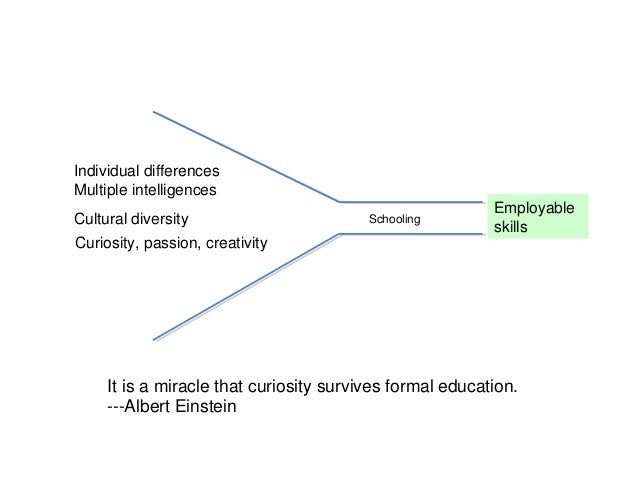
In a great lecture/slide show titled "Redefining Excellence" he described our current system in this way:

#PSP2012 | Yong Zhao, "Redefining 'Excellence'"
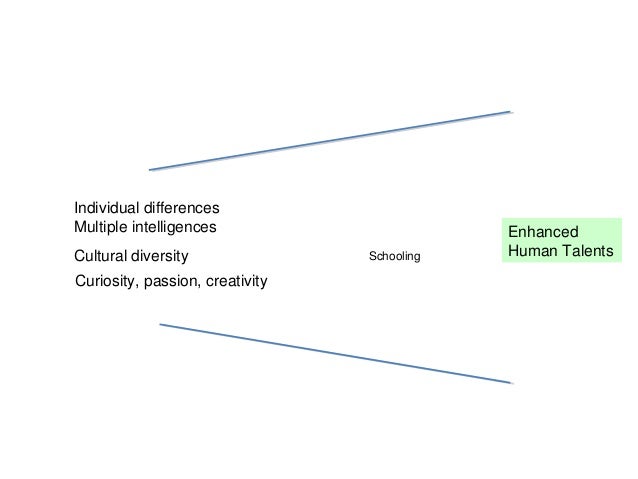
He then went on to say that especially now in the 21st century we need to do the opposite, that we need to do this:
#PSP2012 | Yong Zhao, "Redefining 'Excellence'"
Huh? That is, we need to stop constricting students' thinking and creativity, we need to celebrate and support growing divergence. We don't need more people who think the same, we need more people who think differently. This doesn't happen when we push students into boxes, it doesn't happen when we try to force students into the SAME box. It happens when we allow students to be themselves -  culturally, intellectually, emotionally.

Our job is to allow students to be themselves more than ever before. The question in most peoples' minds I suspect is not should we, but HOW do we? What does this look like on the ground within our kura on a daily basis? I think it will look different from kura to kura, but what do we think will be the general trends? Here's my speculation:

  1. More flexibility in time, with kura timetabled in a different way to what we have been used to 
  2. A blend of face to face and online learning, requiring a redefinition from the Ministry on what constitutes attendance
  3. More time spent allowing students to pursue their passions, meaning that at senior level in particular our key task is to attach assessment to work and learning, not the other way around
  4. Less didactic 'lecturing from the front', but acknowledging that the power of direct teaching, of deliberate acts of teaching, should never be lost
  5. An imperative for schools to ensure that they have a clear pedagogy around how we cause learning, both face to face and distance. My suspicion is that when you ask educators what their underlying pedagogy is, they will give you a blank stare. Last year I challenged a class of teaching grads with that very question, and saw far too many of those blank stares for my own liking. In this regard our work with Manaiakalani leaves us well placed with our 'Learn Create Share' pedagogy, leveraging the affordances of digital technology. The underlying factors of distance learning have been through our work with Manaiakalani

If we accept Yong Zhao's view (clearly I do), then the need to promote a focus on creativity is vital. Our Hornby High School vision 'A centre of creative excellence' captures the essence of Yong Zhao's philosophy of developing human diversity, not constraining it.  It is more important, and more urgent, than ever that we drive ahead with this work.

I want to hear at least some of the many voices on this. What is your view? To our community, to our students, to our staff, what do you think? Does this truly sound like, look like, feel like, the sort of educational future that you want for your tamariki, for your whānau, for our communities, for our nation of Aotearoa New Zealand? And are you with me on this?

Robin Sutton
Tumuaki