Friday, 22 April 2022

A little obsession and our creativity

 We all have our obsessions, eh. Well, we do, don't we? Like Van Gogh, who liked to splotch a bit of oil paint around, and who seemed singularly obsessed with his ear for some reason. Or Michelangelo who had this thing about painting church ceilings. Or... ... nope, that would be an endless list, so trying to write it would be hopeless. We all have our obsessions. One of mine currently is writing free verse poetry, like this:


I am however also more than a little bit interested in creativity, what drives it, how we get more of it, what stops it.. that's another endless list. Of particular interest to me (I've avoided suggesting I'm obsessed with it, but maybe I am?) is what leadership for creativity looks like in schools. I recently discovered this 2019 article "Why You Should Work Less and Spend More Time on Hobbies", by Gaetano DiNardi, (Harvard Business Review, February 07, 2019).

Here is the HBR summary in case you find yourself in the TLDR camp:

"As professionals around the world feel increasingly pressed for time, they’re giving up on things that matter to them. A recent HBR article noted that in surveys, most people “could name several activities, such as pursuing a hobby, that they’d like to have time for.” This is more significant than it may sound, because it isn’t just individuals who are missing out. When people don’t have time for hobbies, businesses pay a price. Hobbies can make employees substantially better at their jobs for three reasons: they reawaken your creativity, give you a fresh perspective, and bolster your confidence."

There is, it seems, a case for supporting teacher creativity as one of the deliberate and intentional strategies that leaders might pursue if they want greater creativity to be a part of the normal mahi, the organisational culture, of our schools. I particularly liked this quote from the article:

"A creative hobby pulls you out of all that. Whether you’re a musician, artist, writer, or cook, you often start with a blank canvas in your mind. You simply think: What will I create that will evoke the emotion I’m going for?

"It’s no surprise that by giving yourself this mental space, and focusing on feelings, you can reawaken your creativity. Neuroscientists have found that rational thought and emotions involve different parts of the brain. For the floodgates of creativity to open, both must be in play."

I do note that the HBR article doesn't appear to be based on quality research, and there's many a bad decision been taken in education because it seemed like a good idea, based on common sense, at the time. However it is an intuitively appealing idea, and it's one I am keen to nudge along at Te Huruhuru Ao o Horomaka Hornby High School. Unleashing the creative powers of teachers has an enormous intuitive appeal, because (in my opinion) many many teachers are fundamentally highly creative people. I 'reckon' that many teachers love trying to come up with new ways of causing learning, for example. 

There is a warning and a contradiction there of course. On the one hand, don't throw the baby out with the bathwater, do what we know works, follow the evidence. I think that we have got to where we have today with reading and maths in schools as a result of that. The contradiction, the 'on the other hand', is that improvement comes from taking risks, trying new things, seeing if they work. Our incredibly efficacious Manaiakalani kaupapa wouldn't be benefiting tamariki in 120 schools in Aotearoa if no-one had been prepared to try something new, and this is a kaupapa now well backed by a large body of robust research and achievement data, but that's another story.

But anyway, I currently believe that supporting the creativity of teachers is a good thing, and a potentially powerful way of growing creativity amongst our young people. The question is how. What deliberate acts can I undertake that will support that creativity? I wrote recently about my motivation to publish pieces of poetry, about role modelling creativity and risk taking, about normalising those behaviours in the hope that my colleagues (the wonderful bunch that they are)  will do the same with their own 'creative bents'. I'm working on that, trying to 'hatch some plans' that might help. We do see this most commonly already in the creative arts, with our drama, music, and visual arts teachers, and also our English and technology teachers. They are not afraid to put up examples of their work. They just need to be encouraged to do it a little more often, for both colleagues and students to see. Now how about our maths and science teachers, our social science teachers, our health and PE and language teachers? 

If we are serious about the 'create' component of our 'Learn Create Share' pedagogy, then as individual teachers we also need to be serious about our own creativity, We need to nurture it, to not be afraid of it, to invest in it, to invest in ourselves.

As the writer of the HBR article says, "It’s no surprise that by giving yourself this mental space, and focusing on feelings, you can reawaken your creativity."

Let's give ourselves the mental space.

As something of a footnote however: I think that as long as we continue to adhere to the short term pursuit of money and profit as an end goal in life, as long as we continue to worship wealth as the marker of success, as long as we tolerate a society that allows huge disparities in wealth, we will fail spectacularly to uncover and benefit from the creative potential that we all harbour. I often wonder how many more Sir Angus Taits, or Neil Finns, Denis Glovers or Ritchie McCaws, we would find in life if we were able to guarantee sufficient income for every adult such that they could pursue their passions? I am a 'Universal Basic Income' fan... but that's another story too.


Wednesday, 13 April 2022

World Poetry Day and creativity: Postscript - planting seeds

You never quite know, eh. When you scatter seeds you never quite know where they might land, nor what might sprout from them. To persist with the simile, as leaders and teachers we could be likened to gardeners. Our role is to plant seeds, to cultivate the soil, to create the conditions to grow strong roots and plants, to grow and sustain creative self actualising individuals and communities. 

The postscript to my previous two posts on World Poetry Day is that our student leaders took the idea, and created an inter-kāhui poetry competition, to create a poe-tree inn each kāhui, the 'leaves' on each 'poe-tree' to contain a poem written by a member of our kura community.

The results are outstanding, not only in terms of the volume of writing, but also the quality of the poetry that was submitted by students.


You get the idea .......

When you plant seeds, like the seed of creativity, of the acceptability of taking risks, and of possible failure, then you liberate minds.  It's interesting, isn't it, that when you value creativity, so do others, when you are prepared to take risks, and when you are accepting of the failures that others might experience, they become more willing to try to be creative, more open to the possibility of failure. Indeed, failures along the way are to be celebrated. There are sadly those with what I think is a fixed mindset, a mindset that is inherently negative when failure occurs. That mindset closes off the possibility of learning from past failures, and so the possibility of creating even more interesting and exciting possibilities for the future.

Our pedagogy 'Learn Create Share', and our work within the Manaiakalani kaupapa, is enhanced, it leverages ever greater benefit for our learners, if we sustain a growth mindset for both our colleagues and our students.

Over this past few weeks it's not the poetry itself that has mattered (although it does), it is the growth in creativity, the realisation of what can be achieved, especially in the minds of our amazing students, the possibility that perhaps just that few more students have recognised what their capabilities are, and so might have enhanced their growth mindset. Or maybe just a few moments joy at having genuinely created something, because for most of us our acts of creativity simply create a sense of joy. 

Because if anything matters in enhancing creativity, I am increasingly thinking it is a growth mindset.

Thursday, 24 March 2022

World Poetry Day, growing creativity (2): Leadership and creativity

This whole poetry thing has had me thinking about something that I find hugely interesting: leading for creativity. How do we 'lead for creativity'? What works? A HUGE question, and not one to be answered in a brief blog post, but it's had me reflecting on our Te Huruhuru Ao o Horomaka Hornby High School experience, and what I think I might have learned. 

Warning: this post contains plenty of 'reckons', plenty of speculation and opinion based solely upon personal experience and observation.

At the start of most years, in the good old fashioned 'Principal's state of the nation address' to staff, I always talk about creativity. Each year I reveal a little more of myself. I ask staff what creativity looks like for them personally, and how it might reflect in their practice for the coming year. I'm a bit of a 'broken record'  in that regard.

Late last year I discovered my own 'poetic voice' (despite not doing too well in the poetry section of a creative writing paper at Massey Uni a few years ago), inspired by the possibly less than reputable American poet Charles Bukowski. I discovered free verse poetry, and find it liberating. In the past 6 months I have written over 80 pieces ... they just 'come to me' at odd times, inspired by strong emotion. Finding a tear in your eye as you watch a small child covered in wounds lying in a hospital bed in the Ukraine does interesting things to the brain, I find.

I have taken to posting the occasional poem for staff, and have thought about why I'm doing that. Is it ego? Is it a 'look at me' thing? I hope not; it's much more important than any of that. 

When we re-imagined out vision as 'he puna auaha a centre of creative excellence', we supported that with a strategic intent to support greater risk taking amongst our students. Our student Board rep at the time was strong in his advocacy in this regard, telling us loud and clear that HHS students were often unwilling to take risks. If we are to ask our students to take risks, we have to model that behaviour ourselves, and my own acts of posting poetry are just that. It is incredibly nerve wracking to post your work in front of your peers. You lay your soul bare before them, open to criticism. I want my colleagues to be prepared to do the same.

As a leader, for me it is a matter of 'If I'm going to ask you to do that, then I have to be prepared to do it myself, so here it is, this is what it looks like'. I am NOT expecting my colleagues to become poets. I am hopeful that they will model risk taking and creativity for our rangatahi, supporting and encouraging them to do the same.

There is a deeper issue here. How do you grow a creative organisation if the leader(s) do not believe it is important? Duh.., simple!! You don't!!!! A possibly related question is 'does leader creativity matter'?

To me, the first question is anathema. I led our re-imaging because I believe that creativity is central to our humanity, central to what will continue to separate us out from artificial intelligence, central to our capacity to be truly human, to be fulfilled, and I am completely convinced by and committed to the belief that creativity supports well-being and achievement.

At the risk of doing their significant body of work a disservice, I would like to quote from 'Replanting creativity during post normal times' (October 2920) ©Professor Peter O’Connor Director, Centre for Arts and Social Transformation Professor Michael Anderson, Associate Professors Kelly Freebody and Paul Ginns, The University of Sydney October 2020:

Beyond increasing recognition of the role of creativity in a successful, globalised citizenry, there are many direct and indirect benefits of developing creative skills in and with students. Upitis (2014) discusses how 

"Fostering creativity in students helps them to develop resilience, resourcefulness, and confidence—preparing them to address life’s challenges. Creativity also carries its own intrinsic value. Developing creative sensibilities and habits enhances quality of life for teachers and students." (p. 2).

The team also documents the economic gains to be had from enhanced creativity across the population, but that is a story for another day.

I reckon that if we are to enhance creativity in schools, we need to put into positions of leadership those who understand the importance of creativity, those who are committed to its value and its development. We need less ego and more moral purpose, less focus on testing and more focus on inspiration. 

I had originally wondered if leader creativity is important. Not sure, it may or may not be, but certainly an unwavering commitment to creativity and its intrinsic and extrinsic value to our rangatahi and our society are essential, I reckon.

I would like to link this back to our Manaiakalani kaupapa. Our kaupapa bases all that we do around the pedagogy 'Learn Create Share'. Creativity sits in the middle, essential to liberating our learners, to harnessing their talent, to growing their self belief, and to driving up achievement. It does just that, Nationally we know that we accelerate writing progress by twice national averages. 

The pedagogy unites kura and teachers in a coherent consistent evidence based practice that works. Surely you couldn't ask for more than that?


World Poetry Day, growing creativity (1)

 It was World Poetry Day last Monday. I had floated several ideas around about how we might celebrate, how we might leverage off the day for the benefit of our learners. I'd suggested a poetry 'smack down' featuring the 'new to the scene' wannabe 'Sutdog' taking on the well established 'Mr A' in a verbal duel on the outdoor stage, or posting huge printed versions of poems all around the campus to .. well, a few ideas ran riot. 

We were less ambitious than that in the finish. We published some poetry on our digital notice boards, and our wonderful prefects created a 'poe-tree' in each kāhui, with students writing poems on 'leaves' that will be used to assemble the trees.  The response form our students has been awesome. What I didn't pick up on was the natural energy that also took over, with quite a few staff getting our learners to do some poetry writing.

I've seen some wonderful work as a result. THE most outstanding amongst a lot of very cool pieces was this written by Alazae in Year 10.


This is truly outstanding. I called him out of class to congratulate him, and called his caregiver while he was sitting next to me to tell her about this wonderful work. Alazae is, in the words of his wānanga advisor Whāea Chris (one of our English teaching team), a natural lyricist. I love the poem not only for what it is, but also because in writing this Alazae breaks (actually smashes) some awful systemic stereotypes in our schooling system.

And there was this, from Rheanne in Year 9:

Cherry Blossom,
Elegant, Graceful
Floating, Falling, Fluttering
Flourishing in Beauty
Fleeting Nature of Life

- Rheanne (Year 9)

This is a 'cinquin', a poetic form I've never heard of. Beautiful!!!

Apart from expressing my excitement at what I have seen this week, what's my point?

When you have a unifying vision of what we want to be, when you chose a 'big hairy audacious goal ' (as globally renowned educator Ewan McGregor says), when you are ambitious enough to dream big, it is amazing what you get. This is what it takes to capture the imagination, the energy, the drive, of a team of people.

Our Te Huruhuru Ao o Horomaka Hornby High School vision is: 

'he puna auaha a centre of creative excellence'

This is one hell of a 'big hairy audacious goal' (a BHAG). It is an aspiration, a desired future state that we may never achievement in its completeness. That's not the point. It is as I have said before our guiding star in the heavens. It is to us what those stars were to those brave brave Polynesian navigators who set off across a vast ocean not knowing what lay ahead, but firm in their faith that if they followed those stars there were new things to be discovered. Their courage, their perseverance, paid off for them, and this poetry writing is an example of our own courage and persistence paying off for us.

It is also the advantage of having a coherent and consistent pedagogy with creativity at its centre, in 'Learn Create Share', and The Manaiakalani Programme kaupapa. 

Professor Peter O'Connor and his team at Auckland University have long promoted the benefits of creativity in learning and wellbeing for all. The gains in confidence as learners, the gains in literacy, in inspiration, in self belief, may not be readily measured in tests, but I'm damned sure Alazae was 10cm taller as he walked back into class yesterday.

Saturday, 12 March 2022

What's in a photo?

In a previous life I had an interest in pictorial archives (well, I still do, but back then it was a professional interest, too). I was fascinated by the challenge of looking into photos of the past, trying to discern the layers of life that were often hidden under our very noses.

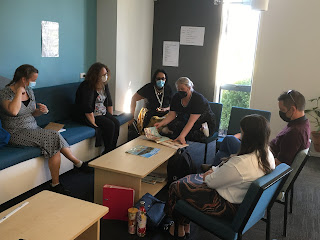
Last week I took this photo in our staffroom. It was one small part of a session in which our 'hurumanu' leaders were working with small groups of staff supporting their mahi with our learners. This is one such photo, and it has quite a number of layers of meaning and activity. As is so often the case when looking at photos, the layers are not obvious at first glance. 


The Hurumanu leader (Sarah) is leading the team through the use of a picture book. The book ('The house that Jack built', by Gavin Bishop) told a traditional story, but with a Māori lens, with Māori characters. Sarah's professional lens was one of critical literacy, of digging down into the story: who was present in the story and who was not? Whose voices are we hearing, and whose were missing? What was the obvious message? What was the less obvious message?

The re-telling of the story with a Māori lens also captured the work that we have accessed with the support of Dr Aaron Wilson of the University of Auckland, that of the need for text to be both a window and a mirror for the reader. Windows allow readers to see into the lives of others. Mirrors allow the reader to see themselves in the story, something so important for learners from diverse ethnic backgrounds. Readers need to be able to 'see themselves' in the texts if the texts are to retain relevance, and to impact most powerfully on the learner.

Both of these issues are brought to the forefront for us because of our engagement with The Manaiakalani Programme. This mahi shares what our collective research and data has revealed as 'High Leverage Practices', things we can do in our kura that make the greatest difference. We most probably wouldn't have been doing these things had we not been part of this transformational mahi.

The photo captures what I have said for a long time. Often we don't need external people to tell us how to do things (sometimes we do, of course), we have the expertise within our kura, we know how to solve many of the challenges that exist within our education system. We just have to have a body politic that trusts us to do that, and school leadership that keeps its eye on the ball, focussing on those challenges and, more importantly, the solutions.

Two of the people in the picture are interns/trainees from the Graduate School of Education. It says everything about the quality of the interns, and the values that they gather from NZGSE, that they remain with us well after 3pm, engaging alongside us in our own learning journeys, adding our knowledge and expertise to their own kete. That is not often the case with teachers in training from elsewhere.

The text was chosen deliberately to offer something for everyone, from those with a reading age of seven, to Year 10 and 11 students looking for deeper meaning. The text is being used in our 'hurumanu', that's our compound word for our junior cross curriculum work, in this case English and social studies working together. And as if that weren't enough, it is a piece of work that sits inside the new New Zealand Histories curriculum. Tūmeke!!

So there are indeed many layers of content and meaning from this one photo. It is easy for staff, when they have their heads 'down below the parapet' (if you'll forgive the military metaphor) to lose sight of the skills that they have, and the amazing mahi that they are doing. We see this right across our Uru Mānuka kāhui ako, and across the Manaiakalani network of Aotearoa - amazing staff, always looking to increase their skill set, driven by their moral imperative to do the best by our learners.

Tino pai tō mahi, e hoa mā

Wednesday, 19 January 2022

Flirting with creativity

I've spent some time over the summer break thinking about creativity, and practising one manifestation of creativity that works for me. I have several reasons for thinking a lot about creativity in our educational mahi.

  1. Our manaiakalani pedagogy 'Learn Create Share' puts creativity at its centre. It reflects the re-imaging of knowledge that Jane Gilbert wrote of in the early 2000s in her book 'Catching the Knowledge wave' in which she theorised that in the 21st century we need to redefine knowledge as not only knowing stuff, but being able to 'do something with that stuff', that is, to create. In our Manaiakalani kaupapa the act of creation doesn't;'t mean creating something new to humanity, but rather something new to the learner, creating a new understanding, a new product that uses the 'stuff' that the learner now knows.
  2. As technology, and artificial intelligence, increasingly replace people in mundane tasks, I find us left with the basic question: what then is the purpose of education? What matters, if AI can replace much that was a mainstay of the 19th and 20th century workforce? To which my answer is empathy and relationships, and creativity (although eve this latter is being challenged by AI!!)
  3. There is some fantastic research coming our of University of Auckland, via Professor Peter O'Connor and his team, on the impact of creativity on wellbeing.
Some of this this thinking lead me to lead the re-imagine our Hornby High School vision as 'a centre of creative excellence". A vision isn't a statement of what we are, nor is it (probably) a statement of what we will ever become. However it is a statement of aspiration, and as such it helps to guide us in what we choose to deliberately and intentionally do to support the growth of our rangatahi to be functioning and contributing members of a caring and empathetic society.

An aspirational vision also gives staff and students some sense of what we, of what they, could be. There is nothing more powerful than an idea whose time has come, and when one of our head students in 2021 made direct reference to how this vision has impacted his educational journey at HHS and inspired him I felt vindicated that we had chosen a powerful idea on which to focus. A vision is there to inspire people, to motivate them, and we ignore such forces at our peril.

None of this of course detracts from the need for quality teaching, for powerful and focussed direct instruction, for engaging cross curriculum work and activity that engage the learner. ALL of that goes without saying.. although I fear we need to say it loud and often because for some it is not as obvious as it ought to be.

For each of us creativity will look very different. It may mean creating a painting or a poem, but equally it may mean restoring an old car (or something else), it may mean solving an IT problem, building a bookcase, creating or cooking a new recipe, or finding a new way to defeat an opponent in an on-line game, or... you see what I mean.

At the moment one of my creative outlets (amongst several) is writing 'free verse' poetry. I've done quite a bit of writing in my time, including four successful text and work books which were published in the early 2000s. I also like to do some creative writing. This free verse poetry is a relatively recent thing. 

Now what fascinates me about ALL of this is the creative process.. what is it that drives the human brain in its creative work, where do ideas come from etc.  I have no doubt that neuroscientists will be able to explain much of that to me. I am mostly interested in my own experiences of it, and while trying to crystallise a fleeting idea for a poem yesterday, something. totally different just dropped into my head, on this very subject of creativity.


I still haven't 'captured' that other idea, by the way. It is still lurking like that dark dark shadow.

Thursday, 23 December 2021

The education 'lineout'

A headline last week left this mental image in my head: a rugby player, on the sideline, throwing the ball in to a line out. The player on the sideline was John Luxton, and the players in the line out were all politicians, mostly from the right. The 'ball' being thrown had the word 'education' written on it in childish crayon handwriting.

Source: https://www.shutterstock.com/editorial/image-editorial/jamie-george-saracens-throws-ball-into-lineout-10010888o


The words 'here we go again' have kept going round and round in my head. Of course our politicians know exactly what is wrong with our education system, and of course they know exactly how to fix it, in the same way that our local plumber knows how to do the heart valve bypass that a whānau member of mine will need in the next year or two.

Am I sceptical? Yes. Am I more than a little concerned? Damned right, I am. I suspect that a part of the answer will include .. yes, you guessed it.. 'more testing'. What annoys me is that no-one thinks to ask teachers how to improve education once it gets thrown into the political scrum. No-one thinks to look at the weight of evidence that is the 'teachers' 'front row' before suggesting improvements, once education gets thrown into the political scrum.

Yet as a profession we can tell you pretty much all of what is required, and perhaps unsurprisingly there are dissimilarities between what we would say. and what policy makers might suggest. Similarly there will likely be significant differences between what we would say and what the right wing neo liberals would suggest. Their solutions often involve greater choice for whānau. Sadly this in itself is based on.a flawed market model, flawed because it is based on a series of totally unrealistic assumptions like perfect knowledge, and consumer sovereignty.

You see, few educators would try to tell you that we have it right. However lots of educators can point you in the direction of the right answers. Take for example the current poor reading and numeracy outcomes for our learners. Solving this problem is not rocket science. Professor Stuart McNaughton (the PM;s education advisor), in his recent paper on reading, clearly points out that one of the biggest issues on reading in Aotearoa is that there is no systematic and universal approach to teaching reading. The conclusion must be that a good solution would be to adopt a universal approach to teaching reading. Even in this there is no one solution. There seem to be two sides to that argument, both flawed because they assume that the solution is a binary one. The answer isn't EITHER A and B. The loud voices seem incapable fo believing that the answer might actually be a little of A AND a little of B. Similarly with mathematics. Reflection on my own past is depressing when I think that I cam to teaching out of Initial teacher Education with NO (yes that's right ZERO) preparation for h[w to support literacy for learners!!!

The right wing desire to go back to what we have done in the past is another way of condemning the most vulnerable in our society to continuing failure. Our tail of underachievement is largely those of Pasifika and Māori origin, and those on low incomes. This is the result of what we have done over the past, whether it be silo'd subject teaching in secondary schools, or high stakes testing, or the belief that whānau choice will support successful schools and eliminate ineffective ones (educational Darwinism). Those schools that many think are 'successful' are those higher decile schools in which children start life with so many advantages. The success of those children has less to do with the school than with that comparative wealth of households. In this regard, the impact of the Manaiakalani pedagogy in those lower decile schools shows that we CAN make a difference, a big difference, for those children from poorer homes. 

Perhaps the biggest problem is that as a profession we allow ourselves to be taken in by the 'latest shiny thing', without stopping to think about the usefulness, the efficacy, of what we already do.

So .. what would my 'reckons' be (based on the weight of evidence, which is too vast to try to summarise in a simple pre-Christmas post like this) on what we need? Try these:

  1. Develop and adopt universal approaches to teaching reading and mathematics. Resource roll out, and insist that these approaches are used. Too many teachers think they know better, with views that are nothing more than 'myth'.
  2. Support the roll out of the Manaiakalani pedagogy across all lower decile schools (for those that wish)
  3. Deliberately and intentionally support and embed creative and critical thinking (and creativity more generakly.. go back to those wonderful programme Beeby programmes of the 60s) across schools, especially in initial teacher education
  4. Reform initial teacher education so that it supports strong behaviour management skills, and the entree into those universal approaches to teaching literacy and numeracy for ALL teachers (not just primary trained teachers). We already know how to do this, just take a look at the NZ Graduate School of Education model.. it WORKS!!!
  5. Reform the funding and staffing models for all schools so that they support the demands of 21st century schooling, nit 19th century schooling.
  6. STOP politicising education.. we are NOT your political football with which to capture the votes of the right wing, we are our children's futures, our nation';s future.


Well, that's all I want for Christmas.. is it too much to ask? Sadly, yes..